New Medical Breakthroughs: What You Need
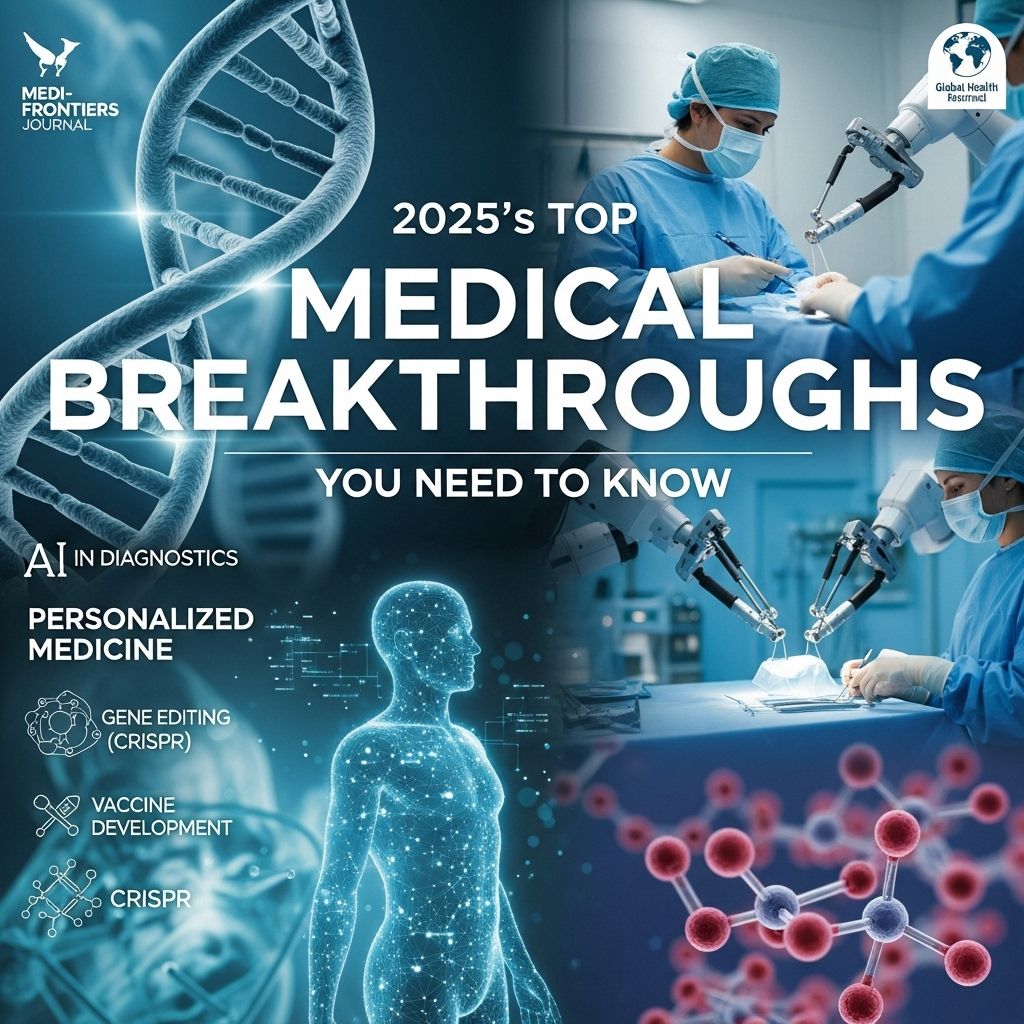
Hey there, friends! Have you ever paused for a moment, looked around at our rapidly changing world, and wondered what the future of our health really looks like? We live in an era where technology is moving at a breakneck pace, but nowhere is this transformation more exciting, or more deeply personal, than in the field of medicine. We aren't just talking about minor upgrades here, like a slightly better cough syrup or a faster way to book an appointment. We are talking about mind-blowing, sci-fi-level breakthroughs that are fundamentally rewriting what it means to heal, to age, and to live healthy lives.
It can be overwhelming to keep up with all these changes. Every week, there is a new headline about a miracle drug, a revolutionary genetic tool, or an artificial intelligence system that can spot diseases before they even manifest. But what do these breakthroughs actually mean for you and your loved ones? How close are we to seeing these innovations in our local clinics? Today, we are going to strip away the dense medical jargon and take a deep, conversational dive into the most significant medical breakthroughs of our time. Grab a warm cup of tea, get comfortable, and let’s explore the incredible future of medicine together.
The Genetic Revolution: CRISPR Moves from Lab to Life
For decades, scientists have known that many of our most stubborn diseases are hardcoded into our DNA. Conditions like sickle cell anemia, cystic fibrosis, and Huntington’s disease have caused immeasurable suffering because, historically, we could only treat the symptoms, never the root cause. But friends, that narrative is changing rapidly thanks to a revolutionary gene-editing technology called CRISPR-Cas9.
To understand CRISPR, imagine your DNA as a massive, multi-volume recipe book that tells your body how to build and maintain every single cell. Sometimes, there is a typo in one of those recipes—a single misplaced letter that causes a serious illness. In the past, we had no way to fix that typo without throwing out the whole book. CRISPR acts like a highly precise, molecular "find-and-replace" tool. It allows scientists to locate the exact typo in the DNA sequence, snip it out, and replace it with the correct sequence. It is simple, elegant, and incredibly powerful.
What makes this a current breakthrough rather than a future promise is that we are now seeing these therapies get official regulatory approval. Recently, health agencies approved the very first CRISPR-based treatment for sickle cell disease. For patients who have spent their entire lives dealing with excruciating pain crises and frequent hospitalizations, this is not just a treatment—it is a functional cure. They undergo a procedure where their stem cells are harvested, edited in a lab using CRISPR to correct the genetic mutation, and then infused back into their bodies. The results have been nothing short of miraculous.
But the story doesn't end there. Researchers are currently working on using CRISPR to treat genetic forms of blindness, heart disease, and even certain types of cancer. We are standing on the threshold of a world where genetic diseases, once considered lifelong sentences, might be cured with a single, highly targeted intervention. Of course, this raises important ethical questions about how far we should go with genetic modification, but the therapeutic potential to relieve human suffering is absolutely staggering.
Artificial Intelligence: The New Superpower in Diagnostics and Drug Discovery
We hear a lot about artificial intelligence (AI) in the news these days, from chatbots that write essays to algorithms that recommend our next favorite TV show. But behind the scenes, AI is quietly orchestrating a massive revolution in healthcare. If we look at how medicine has traditionally operated, it has always been a game of pattern recognition. Doctors look at symptoms, compare them to their training and experience, and make a diagnosis. Scientists test thousands of chemical compounds hoping to find one that fights a disease.
AI is taking this process and supercharging it. Let’s start with diagnostics. Imagine an AI system trained on millions of medical images—mammograms, X-rays, MRI scans, and skin biopsies. Because the AI can analyze these images at a level of detail invisible to the human eye, it can spot the earliest, microscopic signs of diseases like lung cancer or breast cancer years before a human doctor could. In medicine, early detection is often the difference between life and death. By partnering with AI, doctors can intervene when a disease is at its most treatable stage.
Then there is the monumental challenge of drug discovery. Historically, bringing a new drug to market has been a slow, painful, and incredibly expensive process. It typically takes over a decade and billions of dollars, with the vast majority of experimental drugs failing during clinical trials. Why? Because finding the right molecular structure to target a specific disease is like trying to find a needle in a haystack the size of the solar system.
Enter AI. Using advanced machine learning models, researchers can now simulate how different molecules will interact with human proteins in a digital environment. An AI can analyze billions of chemical combinations in a matter of days, predicting which ones are most likely to be effective and safe. This has compressed the initial drug discovery phase from years to just a few weeks. We are already seeing AI-designed drugs enter clinical trials for conditions like pulmonary fibrosis and various cancers. For those of us waiting for treatments for rare or complex diseases, this speed is a beacon of hope.
Immunotherapy and the Rise of Personalized Cancer Vaccines
Cancer has long been one of humanity’s greatest foes. For generations, our primary weapons against it have been chemotherapy and radiation. While these treatments have saved countless lives, they are notoriously harsh. They act like a sledgehammer, attacking rapidly dividing cancer cells but also destroying healthy cells in the process, leading to severe side effects.
But what if we could train our own bodies to fight cancer from the inside out? That is the core philosophy behind immunotherapy, one of the most exciting frontiers in modern oncology. Our immune systems are incredibly powerful, designed to seek out and destroy foreign invaders like viruses and bacteria. However, cancer cells are notoriously sneaky. They often wear a sort of molecular disguise that allows them to hide from our immune cells, growing unchecked.
Immunotherapy drugs, specifically checkpoint inhibitors, strip away this disguise, essentially pointing at the cancer cells and telling the immune system, "Hey, look over here! This doesn't belong." Once the immune system recognizes the threat, it unleashes its full force to destroy the tumor naturally. The results for patients with advanced melanoma, lung cancer, and leukemia have been revolutionary, leading to long-term remission in cases that were previously considered untreatable.
Taking this a step further, we are now witnessing the birth of personalized cancer vaccines. You might remember how m RNA technology was used to create vaccines during the pandemic. Now, scientists are using that same m RNA platform to create custom-tailored vaccines for cancer patients. Doctors take a biopsy of a patient’s tumor, sequence its DNA to identify the unique mutations present in that specific cancer, and then manufacture an m RNA vaccine tailored specifically to those mutations. When injected, the vaccine teaches the patient's immune system to hunt down and destroy any cell displaying those exact genetic markers. It is highly personalized, highly targeted, and represents a massive leap forward in our fight against cancer.
Cellular Reprogramming and the Quest for Longevity
Let's talk about something we all think about: aging. For a long time, we viewed aging as an inevitable, slow decline of our physical and mental faculties. We accepted that as the years roll by, our joints stiffen, our memory fades, and our risk for chronic diseases skyrockets. But what if aging isn't just a natural passage of time, but rather a biological process that can be slowed down, paused, or even reversed?
This is the premise of cellular reprogramming and senolytic therapy. As we age, some of our cells become damaged or worn out. Instead of dying off naturally, they enter a state of permanent arrest. Scientists call these "senescent cells," but they are more commonly known as "zombie cells." These zombie cells linger in our tissues, secreting harmful chemicals that cause inflammation and damage the surrounding healthy cells, contributing to many age-related diseases.
Researchers have developed drugs called senolytics, which are designed to target and selectively eliminate these zombie cells. In animal studies, removing senescent cells has led to remarkable rejuvenative effects: stronger bones, healthier cardiovascular systems, improved cognitive function, and longer lifespans. Clinical trials are now underway to see if these same benefits can be safely replicated in humans.
Alongside this, scientists are exploring cellular reprogramming—essentially resetting the biological clock of our cells. By introducing specific proteins (known as Yamanaka factors) into old cells, researchers have successfully reverted them back to a youthful state. While we are still a way off from a true "fountain of youth" pill, this research is shifting our focus from simply extending lifespan (how long we live) to extending healthspan (how long we live free from chronic disease and disability). We want to ensure that our golden years are vibrant, active, and full of life.
Key Takeaways: What You Need to Remember
- CRISPR is curing the incurable: Gene-editing technology has transitioned from laboratory experiments to real-world, approved treatments, offering functional cures for genetic disorders like sickle cell disease.
- AI is our new diagnostic ally: Artificial intelligence is dramatically accelerating drug discovery times and helping doctors detect life-threatening conditions much earlier than previously possible.
- The immune system is our best weapon: Immunotherapies and personalized m RNA cancer vaccines are teaching our own bodies to identify, target, and destroy cancer cells with minimal damage to healthy tissues.
- Aging is being redefined: Emerging research into senescent "zombie" cells and cellular reprogramming is shifting the medical paradigm toward extending our healthspan, keeping us healthier for longer.
- Personalized medicine is the future: We are moving away from a "one-size-fits-all" approach to healthcare. Future treatments will be custom-tailored to your unique genetic makeup and biological profile.
Frequently Asked Questions
Are these new medical breakthroughs safe, and how long does it take for them to reach the average patient?
This is a question we all ask, and it is incredibly important. Safety is the absolute top priority in medicine. Before any new treatment, drug, or genetic therapy can be administered to the public, it must undergo a rigorous, multi-phase clinical trial process. This process involves testing the treatment on small groups of volunteers to check for safety, then larger groups to measure effectiveness, and finally massive groups to identify any rare side effects. This entire journey can take anywhere from five to ten years. However, because of technologies like AI and accelerated regulatory pathways for life-saving drugs, this timeline is beginning to shrink. While these breakthroughs are incredibly promising, they are thoroughly vetted by scientists and regulatory bodies like the FDA before they ever reach your local clinic.
Will these advanced treatments be affordable, or are they only for the wealthy?
This is one of the most critical challenges of modern medicine. When a groundbreaking therapy like a CRISPR gene edit first comes to market, the price tag can be astronomical—sometimes reaching millions of dollars per patient. This is due to the high cost of research, development, and the highly personalized nature of the treatment. However, history shows us that as technology matures, manufacturing scales up, and competition enters the market, prices tend to fall. Additionally, healthcare advocates, governments, and insurance companies are actively working on new payment models to make these cures accessible. The goal is to ensure that these life-saving innovations do not become exclusive luxuries, but rather standard care

Post a Comment for "New Medical Breakthroughs: What You Need"
Post a Comment