Top 3 AI Stocks to Own for the Next Decade
Key Players in the AI Ecosystem
Artificial intelligence (AI) is rapidly transforming industries and reshaping the global economy. While many companies are positioning themselves as leaders in this space, not all will survive or thrive in the long term. Some may become acquisition targets, while others may struggle to keep up with the pace of innovation. When considering AI stocks for a long-term investment strategy, it's essential to focus on companies that play critical roles across different stages of the AI pipeline.
1. Taiwan Semiconductor Manufacturing Company
Taiwan Semiconductor Manufacturing Company (TSMC), listed on the NYSE under the ticker symbol TSM, may not be an AI stock in the traditional sense, but it plays a pivotal role in the AI industry. As the world's leading third-party semiconductor foundry, TSMC specializes in manufacturing chips designed by "fabless" companies that do not have their own fabrication facilities.
In the realm of advanced AI chip manufacturing, TSMC holds a near-monopoly. Its cutting-edge technology and high efficiency make it the go-to choice for companies requiring state-of-the-art chips for data centers. While competitors like Intel and Samsung also operate foundries, they face challenges such as production delays and low yields, which make them less reliable compared to TSMC.
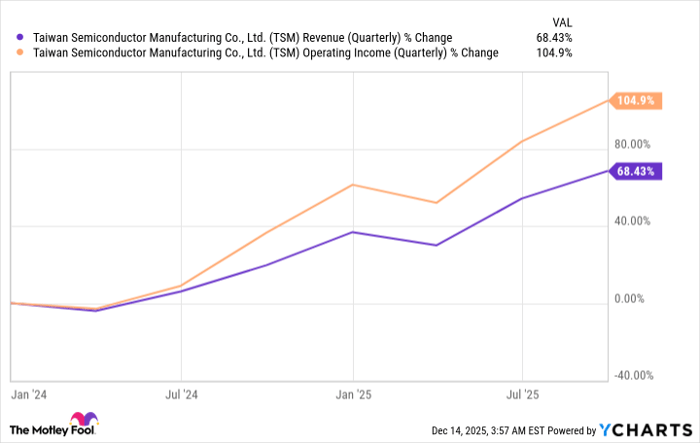
This dominance has allowed TSMC to gain significant pricing power. Over the past few years, both its revenue and operating income have grown substantially, but its profits have increased at an even faster rate due to its position in the AI chip market.

2. Nvidia
Nvidia, listed on the NASDAQ under the ticker symbol NVDA, is a key player in the AI ecosystem as a designer of critical components. Its leadership in the parallel processor market has driven its stock to unprecedented heights, making it one of the most valuable public companies globally, with a market cap nearing $4.2 trillion.
Initially known for producing graphics processing units (GPUs) used in video games, Nvidia has since expanded into other computing workloads. The rise of AI has further solidified its position, as its hardware is now widely used in data centers for training and operating AI systems.
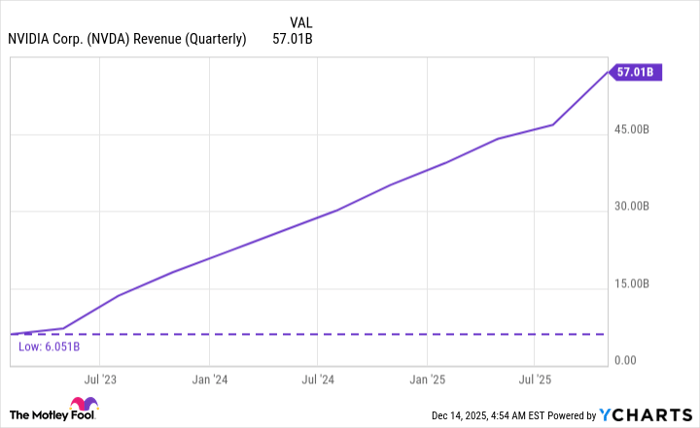
In the third quarter, Nvidia reported $57 billion in revenue, with $51.2 billion coming from its data center segment. This growth underscores the increasing demand for hardware capable of handling large-scale AI workloads.
While its GPUs have received much attention, another key component of Nvidia's success is CUDA, its parallel computing platform and application programming interface. CUDA allows developers to program Nvidia's chips for specific tasks, and its widespread use in AI development adds to the company's competitive advantage. Since CUDA programs only run on Nvidia chips, switching costs for users are high, further strengthening the company's position.
Despite competition from tech giants like Alphabet and Amazon, who are developing their own AI chips, Nvidia has a significant head start. While it may lose some market share over time, its strong foundation and the growing AI market should help maintain its stability.
3. Microsoft
Microsoft, listed on the NASDAQ under the ticker symbol MSFT, has two major advantages when it comes to AI. First, its Azure cloud infrastructure is the second-largest in the world and is a preferred choice for companies building and hosting AI applications. Azure's AI capabilities have helped it close the gap with Amazon Web Services, the market leader.
Second, Microsoft's software portfolio includes widely used products such as Microsoft 365, LinkedIn, GitHub, and Windows. This extensive user base allows Microsoft to seamlessly integrate AI into existing tools, making it easier to monetize the technology. For example, Microsoft 365 Copilot offers an additional revenue stream for the company.
Unlike pure-play AI companies that rely solely on AI for revenue, Microsoft's business is well-diversified across software, hardware, gaming, cloud computing, and professional networking. Even if the AI hype fades, Microsoft's core business will remain strong and profitable.
Final Thoughts
While TSMC, Nvidia, and Microsoft are all key players in the AI ecosystem, each brings a unique value proposition. TSMC's manufacturing expertise, Nvidia's design innovation, and Microsoft's software integration make them strong long-term investments. However, it's important to consider individual financial goals and risk tolerance before making any investment decisions.

Post a Comment for "Top 3 AI Stocks to Own for the Next Decade"
Post a Comment