Quantum Leap in 2026: IONQ and RGTI Lead, QUBT Falls Behind
Quantum Computing Market Gains Momentum in 2025
Quantum computing has transitioned from theoretical research to commercial viability, with industry forecasts suggesting significant growth over the next decade. In 2025, the quantum computing market is projected to be worth billions of dollars, with different firms offering varying estimates. For instance, Markets and Markets anticipates a rise from approximately $3.52 billion in 2025 to $20.2 billion by 2030, representing a compound annual growth rate (CAGR) of 41.8%. Meanwhile, McKinsey’s 2025 Quantum Technology Monitor suggests that the combined market for quantum computing, quantum communication, and quantum sensing could reach up to $97 billion globally by 2035 under current conditions.
McKinsey also highlights that the quantum technology market is poised for continued expansion, with potential growth reaching $198 billion by 2040, depending on adoption rates, investment levels, and technological progress.
Federal Investment Fuels Quantum Innovation
A key driver behind the advancement of quantum computing in the United States is federal investment in research and development. On November 4, 2025, the U.S. Department of Energy (DOE) announced $625 million in funding to renew its five National Quantum Information Science (QIS) Research Centers. This initiative, part of the National Quantum Initiative framework, supports fundamental science and technology development across various aspects of quantum computing, networking, and sensing.
These centers bring together national laboratories, universities, and industry partners to accelerate innovation. The renewed funding is expected to facilitate the transition of key hardware, materials, and systems-engineering breakthroughs from national labs and academic-industry collaborations into early commercial deployments. This development aligns with the industry's anticipation of a more visible quantum leap in applied capabilities around 2026.
Monetary Policy Supports Deep-Tech Development
In December 2025, the U.S. Federal Reserve reduced the target federal funds rate by 25 basis points to 3.50%–3.75%, marking the third consecutive rate cut in 2025. This move reflects a shift away from a restrictive monetary stance toward a more neutral posture, amid cooling inflation and signs of labor-market softening. Equity markets responded positively, while bond yields declined.
The Fed’s decision to ease financial conditions heading into 2026 is expected to support longer investment horizons and improved capital availability for deep-tech development. This environment is crucial as quantum hardware programs move beyond extended R&D cycles toward more visible performance benchmarks and early commercialization milestones.
Key Quantum Computing Stocks to Watch in 2026
IonQ (IONQ)
IonQ made a significant breakthrough in October 2025 by achieving two-qubit gate fidelities above 99.99% using its trapped-ion control stack. This achievement reduces error-correction overhead and strengthens IonQ’s position for early commercial advantage. For 2026, IonQ has outlined a roadmap focused on scaling system performance, expanding cloud and enterprise partnerships, and converting growing bookings into recurring revenues.
The company emphasizes continued improvements in fidelity, algorithmic performance, and customer access through major cloud platforms as central to its strategy. This positioning could allow IonQ to capitalize on the anticipated quantum leap of 2026 as early commercial use cases begin to broaden.
Currently, IONQ carries a Zacks Rank #3 (Hold). It is expected to record earnings growth of 66.2% in 2026 on revenue growth of 68.9%. Based on short-term price targets offered by 10 analysts, IONQ’s average price target represents an increase of 61.9% from the last closing price of $46.07.
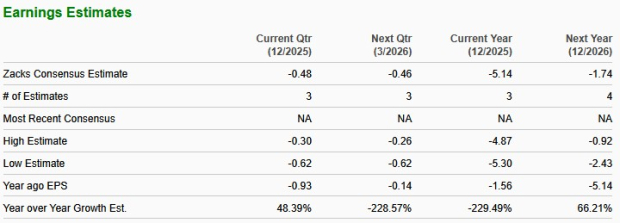
Image Source: Zacks Investment Research
Rigetti (RGTI)
Rigetti is focusing on a clear technology roadmap and continued investment in execution. During its third-quarter 2025 announcement, the company noted that it expects to deploy a 150-plus qubit system with improved median two-qubit gate fidelity (99.7%) by the end of 2026, following the delivery of its 100+ qubit system in 2025.
Rigetti maintains a strong cash position, with over $600 million in cash and investments, allowing it to fund R&D and roadmap execution without relying on dilutive financing. Strategic partnerships, government contracts, and hybrid quantum-classical integration efforts are expected to support scaling efforts through 2026 as the company works toward broader commercialization of its QCaaS offerings.
RGTI currently carries a Zacks Rank #3. It is expected to witness earnings growth of 75.9% in 2026 on revenue growth of 185.6%. Based on short-term price targets offered by seven analysts, Rigetti’s average price target represents an increase of 65.8% from the last closing price of $23.53.
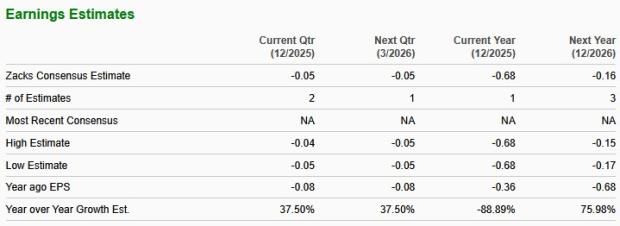
Image Source: Zacks Investment Research
A Stock With Higher Near-Term Risks
Quantum Computing Inc. (QUBT)
Quantum Computing Inc. presents higher near-term risks compared to its peers. Recent quarterly results highlighted widening losses, restructuring, and investor concerns about near-term revenue scale and margins. QUBT continues to generate minimal revenues relative to operating expenses, relies heavily on capital market activity to fund operations, and lacks clear visibility into scalable commercial adoption compared to better-capitalized peers.
QUBT is expected to report no earnings growth in 2026. The stock currently carries a Zacks Rank #3. Investors seeking exposure in 2026 may find QUBT’s risks too high given its current financial position.
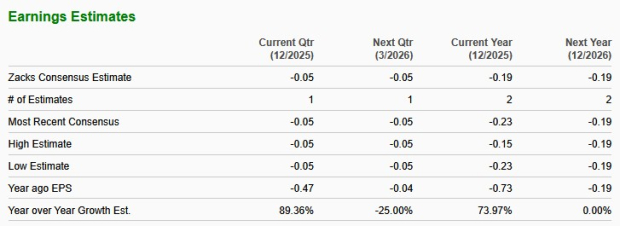
Image Source: Zacks Investment Research

Post a Comment for "Quantum Leap in 2026: IONQ and RGTI Lead, QUBT Falls Behind"
Post a Comment