Judges Question California and GOP Lawyers on Prop. 50 Redistricting Case
Overview of the Legal Case
A significant legal case is currently unfolding in the Central District of California, involving a trio of federal judges who are scrutinizing the state's new voter-approved congressional districts for the 2026 midterms. This case has the potential to determine the fate of these districts, which were approved by voters in November under Proposition 50.
The attorneys for the California Republican Party and the Trump administration's Department of Justice have argued that Democratic legislators and redistricting experts engaged in racial gerrymandering, favoring Latinos. On the other hand, the state's legal representatives have emphasized that their primary goal was political, aiming to weaken Republicans' voting power in California as a countermeasure to similar gerrymandering in Texas and other GOP-led states.
The Judges’ Perspective
During the hearing, the three federal judges from the Central District of California challenged the narratives presented by both sides. They are considering whether to grant the GOP’s request for a temporary injunction to block the reconfigured congressional districts. The GOP has focused on public comments made by Paul Mitchell, a redistricting expert for California's Democratic-led Legislature, who mentioned his intention to create a replacement Latino majority/minority district in Los Angeles.
District Court Judge Josephine Staton questioned the focus of the GOP attorneys on Mitchell's intent rather than the voters who approved Proposition 50. She pointed out that if the voters' intent is the key factor, then the GOP's argument lacks substance.
Voter Approval and Stakes
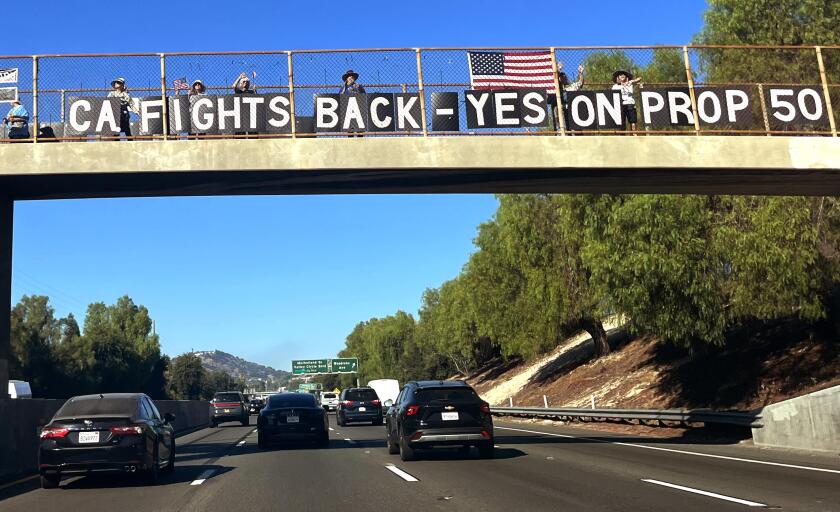
Nearly two-thirds of California voters approved the new Proposition 50 congressional district map in a Nov. 4 special election. Governor Gavin Newsom promoted the idea as a way to counter partisan gerrymandering after President Trump pressured Texas to redraw maps to support the GOP’s narrow House majority.
The stakes for California and the nation are high. If the new map is used for the 2026 midterms, it could give California Democrats up to five additional U.S. House seats. This could allow them to push back against the gains Republicans make due to redistricting in staunchly GOP states and increase Democrats' chance of seizing the House and shifting the balance of power in Congress.
A win for Democrats could also boost Newsom’s national clout and help him position himself as the nation's strongest and most effective Trump critic as he enters his final year as California governor and considers a White House bid.
Legal Arguments and Evidence
During closing arguments, an attorney for the U.S. Department of Justice argued that the race-based aspect of the redrawn districts started with the drafting of the Assembly bill that led to Proposition 50 being placed on the ballot. However, Judge Staton seemed unconvinced, stating, “These maps have no effect until the voters give them effect.”
The GOP cannot challenge the map on grounds of political gerrymandering because the Supreme Court decided in 2019 that such complaints have no path in federal court. This leaves the GOP focusing on race, but proving that race predominated over partisanship is a challenge, according to legal scholars.
Expert Testimonies and Analysis
The GOP brought RealClearPolitics elections analyst Sean Trende to the stand, who claimed that the new 13th Congressional District in the San Joaquin Valley had an "appendage" that snaked northward into Stockton, indicating racial gerrymandering. Trende presented an alternative map that he said retained Democratic representation without being driven by race.
However, Judge Staton questioned whether Trende's map was substantially different from Mitchell's, noting they both seemed to fall within a similar range of Latino representation. Judge Wesley Hsu criticized the GOP's attempt to focus on one district, the 13th Congressional District, to make the case that there was a race-conscious effort in the attempt to flip five seats in the Democrats' favor.
Jennifer Rosenberg, an attorney for the state, argued that Trende's analysis was too narrow, pointing out that he only addressed two tiny portions of District 13 and focused on one subpart. Judge Kenneth Lee questioned Rosenberg on how much she believed Mitchell’s public statements about wanting to create a Latino district in Los Angeles influenced his redrawing.
Conclusion and Implications
If the federal judges grant a preliminary injunction, California would be temporarily blocked from using the newly drawn map in the 2026 election. Attorneys for the state would likely appeal to the U.S. Supreme Court. Just two weeks ago, the nation's highest court allowed Texas to temporarily keep its newly drawn congressional districts, which faced similar complaints of racial gerrymandering.
The U.S. Supreme Court indicated it viewed the Texas redistricting as motivated primarily by partisan politics. In its ruling, it explicitly drew a connection between Texas and California, noting that several states, including California, have redrawn their congressional map "in ways that are predicted to favor the State’s dominant political party."

Post a Comment for "Judges Question California and GOP Lawyers on Prop. 50 Redistricting Case"
Post a Comment