Breakthrough in Thin-Film Solar Cells Achieved with Nanometric Germanium Oxide Layer
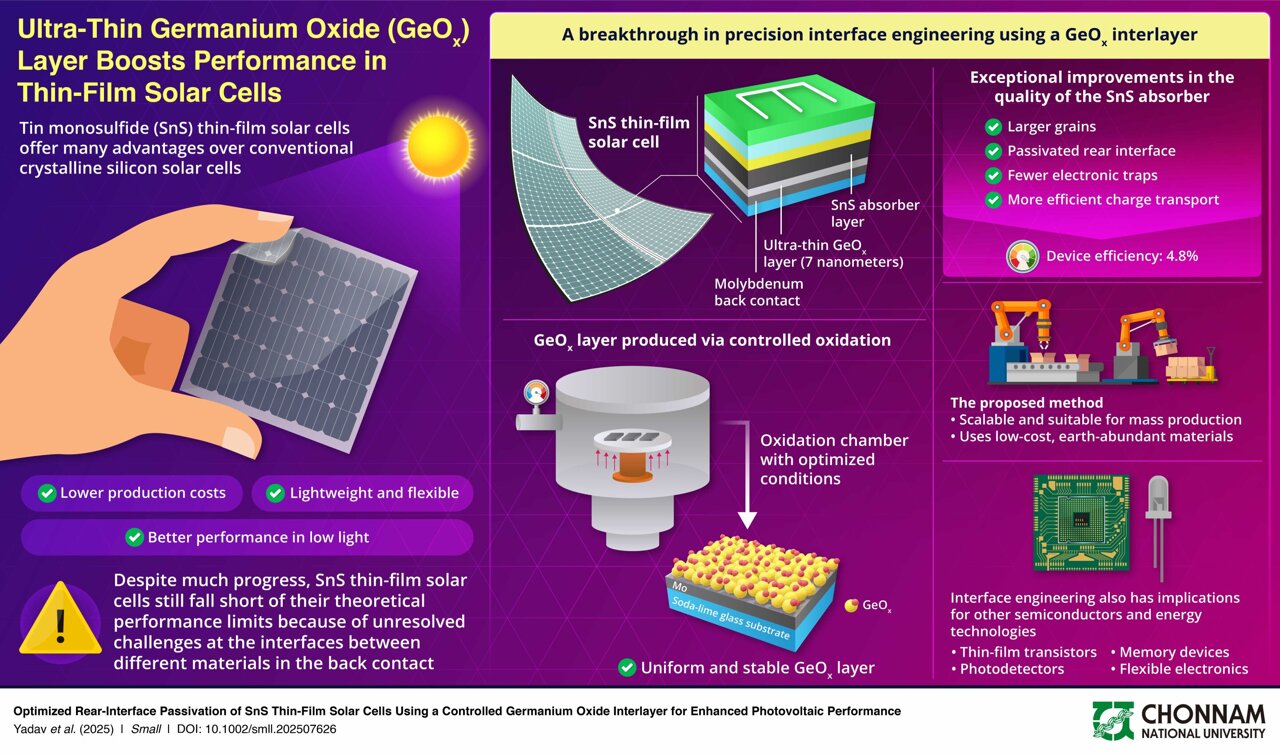
The Rise of Thin-Film Solar Cells
As the global demand for clean and sustainable energy grows, solar power has emerged as a leading solution. Among various renewable energy sources, solar power stands out due to its abundance and scalability. In recent years, thin-film solar cell technologies have gained attention as an alternative to traditional crystalline silicon solar cells. These thin-film designs offer lower manufacturing costs, better reproducibility, and the potential for use in flexible electronics.
One of the most promising materials for thin-film solar cells is tin monosulfide (SnS). Unlike other materials that rely on scarce elements like indium, gallium, and tellurium, SnS is non-toxic and cost-effective. It aligns with the United Nations' Sustainable Development Goals and has ideal optical and electronic properties for capturing sunlight—though this potential has yet to be fully realized.
Challenges in Thin-Film SnS Solar Cells
Despite numerous studies, scientists have faced significant challenges in achieving the theoretical performance limits of thin-film SnS solar cells. A major issue lies at the rear-contact interface, where SnS connects to the metal electrode. Here, structural defects, unwanted chemical reactions, and atomic movement hinder the device's ability to collect charges efficiently.
This problem has limited the efficiency and practical application of SnS-based solar cells. However, recent breakthroughs are beginning to change this narrative.
Germanium Oxide Interlayer: A Game-Changer
A research team led by Professor Jaeyeong Heo and Dr. Rahul Kumar Yadav from Chonnam National University in the Republic of Korea has made a significant advancement in thin-film solar cell design. Their study, published in Small on September 19, 2025, introduces an innovative approach involving the insertion of an ultra-thin layer of germanium oxide (GeOx) between the molybdenum back contact and the SnS absorber layer.
The researchers used a precise and scalable method to create a 7-nanometer thick GeOx interlayer. They utilized the natural oxidation behavior of a thin germanium film during a vapor transport deposition process, making it suitable for industrial applications.
"Despite its nanoscale thickness, this interlayer addresses several long-standing challenges at once," explains Prof. Heo. "It suppresses harmful deep-level defects, blocks unwanted sodium diffusion, and prevents the formation of resistive molybdenum disulfide phases during high-temperature fabrication."
Improvements in Device Performance
These combined effects significantly enhance the quality of the SnS absorber layer. This leads to larger, more uniform grains, improved charge transport and collection, and a reduction in electrical losses.
The implementation of the controlled GeOx interlayer resulted in a notable increase in power conversion efficiency. Standard devices saw an improvement from 3.71% to an impressive 4.81%, marking one of the highest efficiencies reported for SnS-based solar cells using vapor deposition methods.
Broader Implications for Technology
The ability to engineer precise material interfaces has implications beyond solar cells. For instance, metal/semiconductor interfaces in thin-film transistors determine contact resistance and switching performance. Favorable interfacial properties are also crucial for high energy conversion efficiency in thermoelectric devices, sensitivity and charge transfer in sensors, mechanical stability in flexible electronics, and performance in photodetectors and memory devices.
"Across all these applications, mastering the metal/semiconductor interface remains central to advancing next-generation devices," says Prof. Heo. "We believe that this work will open new avenues for research, contributing to the development of advanced solar cells and other key technologies."
Future Prospects
This breakthrough represents a significant step forward in the development of efficient and sustainable solar technologies. As research continues, the insights gained from this study could lead to broader applications in various fields of electronics and energy systems.
The findings highlight the importance of material interface engineering in improving device performance and paving the way for future innovations. With continued exploration and refinement, the potential of SnS-based solar cells and related technologies may soon reach their full capacity.

Post a Comment for "Breakthrough in Thin-Film Solar Cells Achieved with Nanometric Germanium Oxide Layer"
Post a Comment