Tunnel Boring Machine Parts for NJ Gateway Rail Tunnel
Gateway Rail Tunnel Project: A Major Infrastructure Initiative
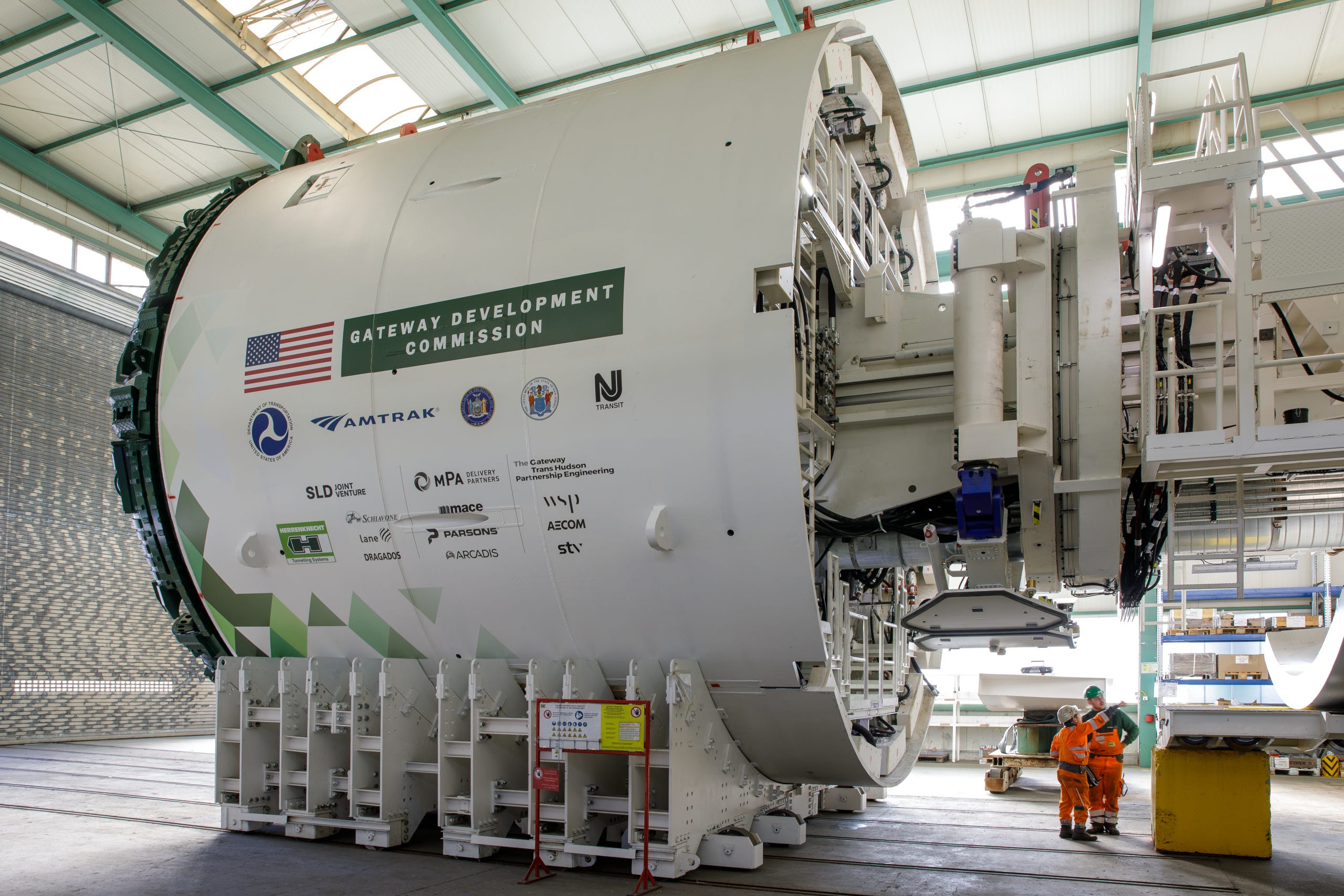
Disassembled sections of two tunnel boring machines, essential for constructing a $16 billion rail tunnel between North Jersey and Manhattan, are on their way to the Garden State. These German-made machines were assembled, tested, and disassembled before being shipped to ports in Elizabeth and Baltimore. Tom Prendergast, CEO and president of the Gateway Development Commission, shared this information with the board on December 15.
The first sections of the machines are expected to arrive in North Bergen later this month, where they will be reassembled. This project is the largest federally funded infrastructure program in the country, involving the construction of a two-track tunnel for NJ Transit and Amtrak between Secaucus and Penn Station in New York. The new tunnel is expected to be completed by 2035.
Once the new tunnel is completed, the century-old two-track tunnel currently used by the railroads will undergo long-overdue repairs to address aging and damage. All four tracks are expected to be operational by 2038.
Tunneling will begin in the spring after approximately three months of testing the boring machines on-site. Two machines will drill two tubes and construct the concrete liner through the Palisades rock under North Bergen, Union City, Hoboken, and Weehawken. At that point, these machines will be swapped out for ones more suited to collect and discard muck from the Hudson River.
When the tunnel reaches Manhattan, the machines will slice through the historic bulkhead supporting 12th and 11th avenues, ending at the underground entrance of New York Penn Station. The machines will dig about a mile in total, at a rate of about 30 feet per day.
Overcoming Challenges
The Dec. 15 board meeting was the first the Gateway Development Commission has held since September 30. During this time, the federal government shut down, and the Trump administration halted reimbursement payments to the commission amid a controversial review of its procurement practices. Additionally, President Donald Trump vaguely threatened to terminate the project, the commission’s president and CEO was hospitalized for a cardiac event, and a worker died at the concrete casing project site in Manhattan.
Prendergast stated that investigations into the worker's death are ongoing, but the agency conducted “safety stand-downs” immediately after the incident. He emphasized the importance of proactive safety measures to ensure awareness of hazards associated with work on the site.
Amtrak is the lead agency for the project site, and the worker was employed by New York Concrete Corp. Prendergast mentioned that the agency performed safety stand-downs across the entire project to address potential risks.
Federal Funding and Procurement Issues
Regarding funding issues, Prendergast noted that the Gateway Development Commission responded to a letter it received earlier this month from the U.S. Department of Transportation. The DOT updated the commission on its review of procurement and steps the commission should take to resume federal funding.
The central focus of the review is the agency’s disadvantaged business enterprise (DBE) program, which involves small, women, and minority-owned businesses in contracts using federal dollars. Prendergast stated that the commission is fully compliant with the requirements and is engaged in ongoing discussions with the DOT to get the funds flowing again.
Work on the five active construction sites has continued during the funding pause, with the Gateway commission relying on cash-on-hand and a line of credit to pay contractors. At the Dec. 15 meeting, the board approved the agency’s $77 million 2026 budget, including $30 million for interest on a short-term facility.
Legal Disputes and Labor Agreements
A judge ruled in favor of the Gateway Development Commission after George Harms Construction Inc., a Farmingdale-based contractor interested in bidding on one of the agency’s upcoming projects, asked the court to pause bidding on the project. Susan D. Wigenton, a judge in the U.S. District Court in New Jersey, denied the request, stating that Harms did not meet the burden of demonstrating a likelihood of success on the merits or irreparable harm.
The dispute between Harms and the Gateway commission has been ongoing for months. Harms, which has a labor agreement with the steelworkers union, argued that it could not bid on the surface alignment project because the Gateway commission struck a project labor agreement with the Hudson County Building and Construction Trades Council, which includes 21 labor unions but not the steelworkers.
Wigenton wrote that the Gateway Development Commission has the power to sue and be sued, acquire property, and enter into and execute contracts. She also noted that Harms could potentially succeed in court on arguments regarding First Amendment rights and whether the Gateway commission’s project labor agreement would "unlawfully compel speech in the form of fringe benefits payments."
Stephen Sigmund, a Gateway commission spokesman, expressed satisfaction with the court's decision. Kevin J. Coakley, counsel for Harms, said the company is considering its next steps, including an appeal to the U.S. Court of Appeals for the Third Circuit.

Post a Comment for "Tunnel Boring Machine Parts for NJ Gateway Rail Tunnel"
Post a Comment