2025 Audi RS 3: Exceptional Excitement
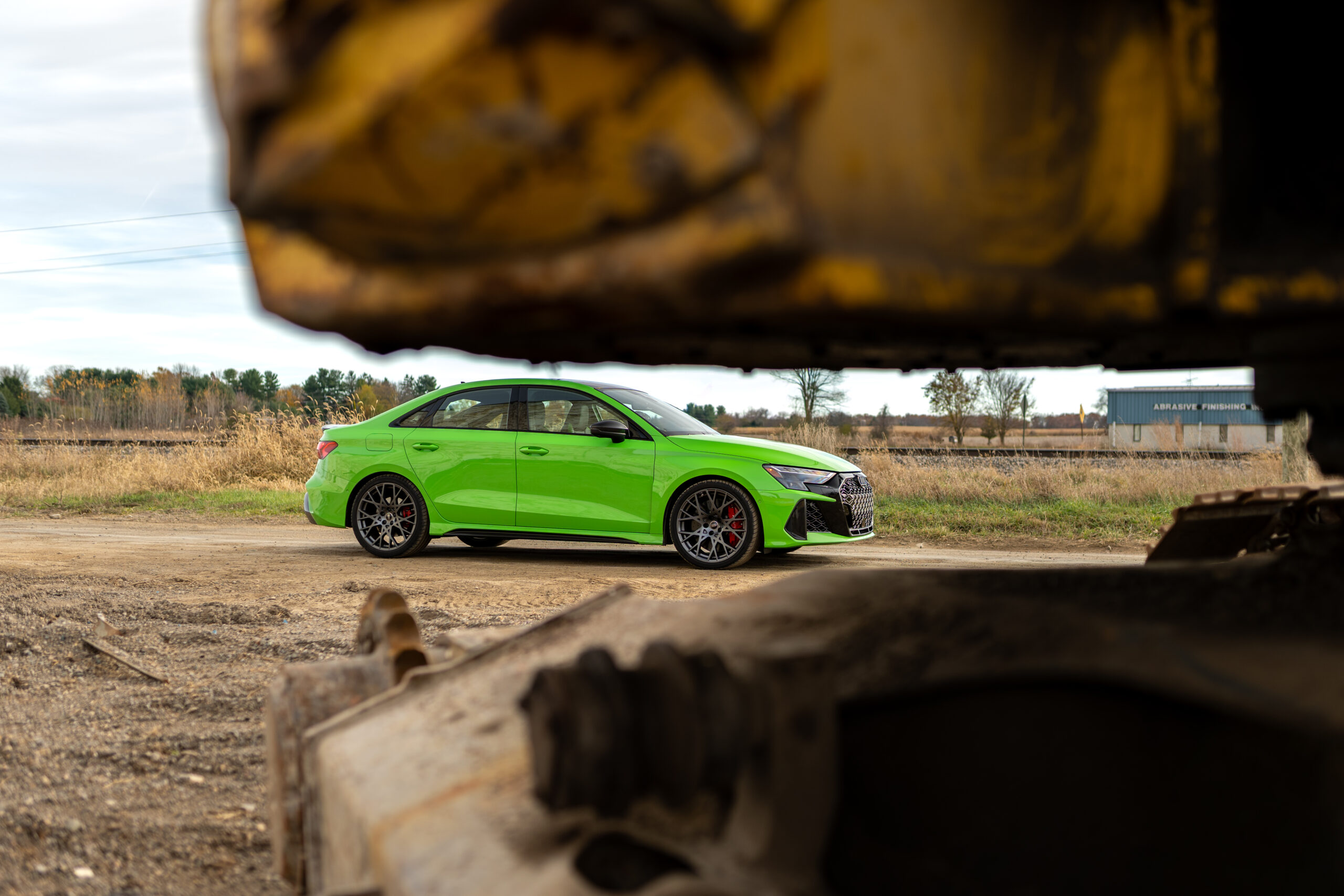
Audi RS 3: A Unique Driving Experience
You probably know the joke that Detroit cars aren’t built to turn corners. That’s because the nearest bendy bits are an hour’s drive from the city. Even then, the roads southeast of Pinckney, Michigan, are not on par with the hills of southeast Ohio or the canyons of California or the Smoky Mountains. But you don’t need spectacular roads to realize that the Audi RS 3 is uncommonly fun.
Fans of German performance will be quick to note that the RS 3, with its turbocharged inline-five engine, is the last of an exclusive family. Audi may not have made the first five-cylinder engine (Mercedes got there three years before, with a diesel, in ‘74), but it certainly made the most ferocious. Paired with the company’s groundbreaking all-wheel drive system, the two-liter, turbocharged five-cylinder was a winner. It earned Audi two manufacturers’ titles in the World Rally Championship, one in ‘82 and another in ‘84. First built as a lighter alternative to the inline-six, the five-cylinder was phased out in the mid-’90s, when it was replaced by the V-6. The five-cylinder in the all-wheel-drive RS 3 is a larger-displacement, 2.5-liter originally built for the 2009 TT RS, a nod to the glory days of the ‘80s. Audi axed the TT RS for 2023, leaving the second-generation RS 3, fresh off a 2025 facelift, as the last new car with an inline-five sold in the United States.
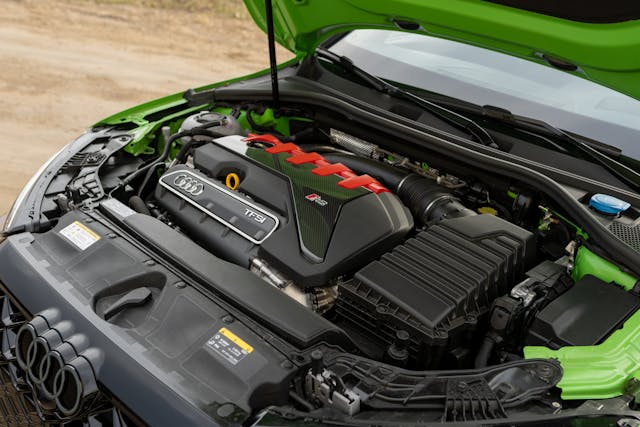
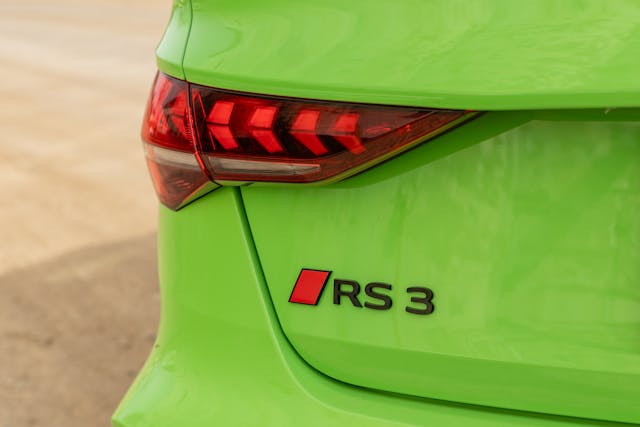
Last year’s facelift brought some aesthetic tweaks inside and out, including new front and rear splitters and a new steering wheel. For 2026, Audi has made the $700 tech package standard and hiked the price by $1405. The increase is unsurprising, given the impact of U.S. tariffs on German cars. Perhaps the hike shouldn’t be upsetting. Audi wouldn’t give us official numbers, but based on inquiries made by forum members to Audi (here and here), RS 3 sales in the U.S. started with a trickle at 245 units in 2017 and did not break 1900 units a year through 2024. Buyers know that getting into an RS 3 comes with a level of exclusivity, and that’s likely part of the appeal.
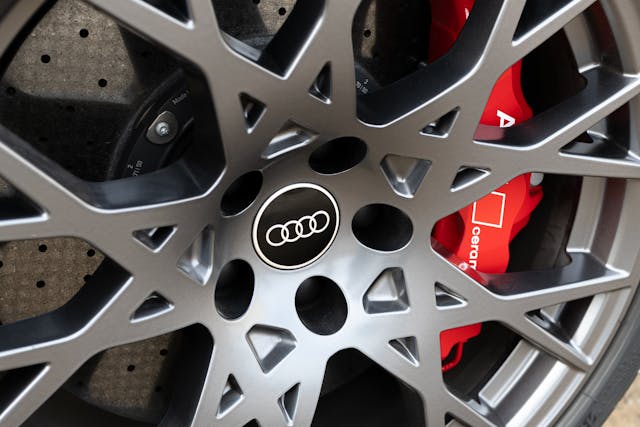
The 2025 RS 3 starts just under $65K. (The 2026 car starts at $67,395.) Our tester cost over $77,000, largely because of the $5600 Dynamic Plus package (carbon-ceramic brakes, a 180-mph top track speed, ultra high-performance summer tires) and the $2750 Carbon package (dark gray matte wheels and carbon-fiber trim). Strangely enough, the eye-searingly green paint was a no-cost option. The 2026 version of our tester would cost $77,845.
The RS 3 belongs to the VW Group’s ubiquitous MQB family. That acronym stands for a German phrase, Modularer Querbaukasten, which translates to “modular transversal toolkit.”
Top Gear wrote in 2014 that VW Group engineers “get shirty when you use the word ‘platform,’” and that MQB is best understood as “a series of hard points for a huge range of cars and powertrains.” Yes, MQB came out in 2012. Enthusiasts are the winners here, though: The MQB approach lowers production costs by allowing the same lines to build a huge range of vehicles, which allows Audi to install a very special engine in a $40K mass-produced compact car, rather than delegate the project to some coachbuilder. Imagine how expensive the RS 3 would have been if Audi had!
Specs: 2025 Audi RS 3
Price, base / as-tested: $64,695 / $77,045
Powertrain: 2.5-liter turbocharged inline-five, seven-speed dual-clutch automatic transmission
Output: 394 hp @ 5600–7000 rpm , 369 lb-ft of torque @ 2250–5600 rpm
Layout: Four-door, five-passenger, all-wheel-drive sedan
Weight: 3627 pounds
0–60 mph: 3.6 seconds (manufacturer est.)
Top speed: 155 mph, or 180 with Dynamic Plus package
EPA-rated fuel economy: 20/29/23 (city/highway/combined)
Competitors: BMW M2, Mercedes-AMG CLA 45 S, Cadillac CT4-V Blackwing
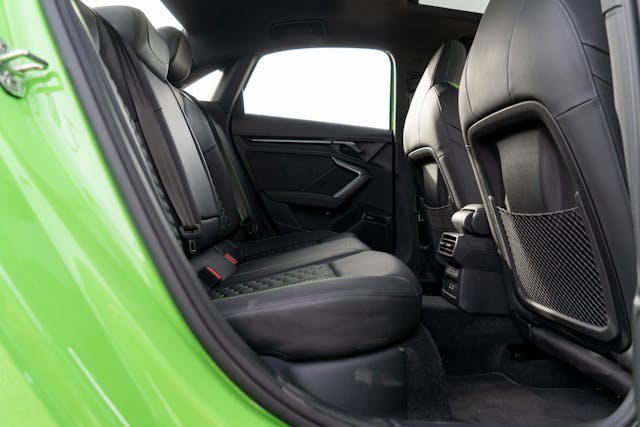
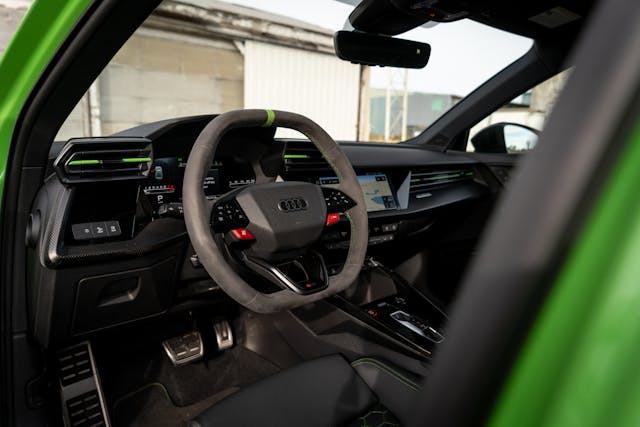
That entry-level foundation does peek through in the interior. Beyond Nappa-leather sport seats and an RS-specific steering wheel, the cabin of the RS 3 is essentially the same as what you’d get in the $40,000 A3. This wouldn’t be so bad if Audi’s interiors were class-leading. Unfortunately, Audi has stalled in this regard, and aspirational manufacturers like Mazda have closed the gap. The satin-finish carbon-fiber trim and perforated, back-lit microfiber door panels aren’t awful, but they are out of place, especially in a full-bore RS Audi, when $36K Hyundais are running around with more tasteful accoutrements (and real Alcantara!). Even so, we forgive the RS 3 all the disappointments of its interior, because Audi spent the money where it mattered.
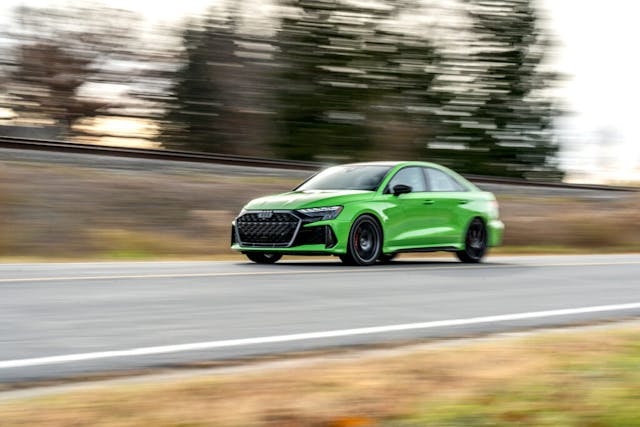
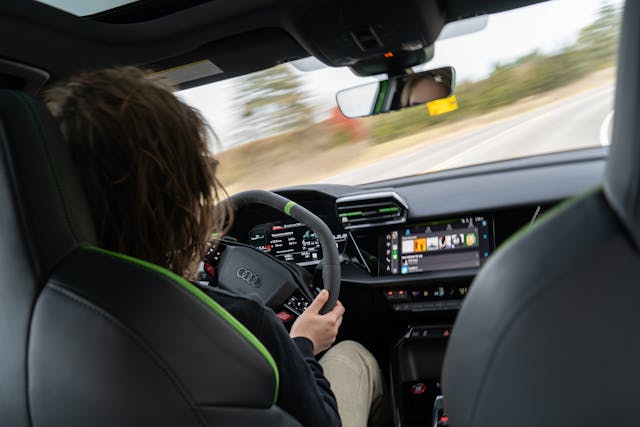
Contrary to what the eye-searing paint suggests, the RS 3 is quite docile by default. I drove it on my regular highway commute between Detroit and Ann Arbor, about a 1.5-hour round trip, and it was a perfectly pleasant, if stiffly sprung, commuter. The high-performance tires whined, and bumped and thumped over flaws in the pavement, but the inline-five and dual-clutch transmission delivered smooth, timely downshifts and appropriate surges of torque whenever I needed them. The seats were comfortable, and the exhaust was barely audible at highway speeds. Even the carbon-ceramic brakes, famous for biting at the top of pedal application when cold, were easily modulated.
As good sports cars do, the RS 3 car encourages you to immerse yourself in the act of driving and rewards you for doing so. You sit forward, over the short, raked nose, and feel very close to the front axle. The tires are pushed out to the corners, and all the overhangs are short. When you’re driving with a measure of spirit, the short sidewall becomes a blessing, sharpening turn-in and transmitting more information about the road surface through the steering rack and into your hands. The steering feel may not be as transparent as that of a Miata, but it’s pretty good, and warns you by tensing up when the car’s starting to get a little stressed. The dual-clutch transmission is delightfully bimodal: A gentle tug triggers a gentle downshift, and a snatch of the paddle prompts an equally quick shift, with that characteristic DCT bang! Even if you only wanted one downshift for a 60-80 mph pull on the highway, the gearbox keeps revs high, as if eyeing you and asking, “We gonna do this or not?”
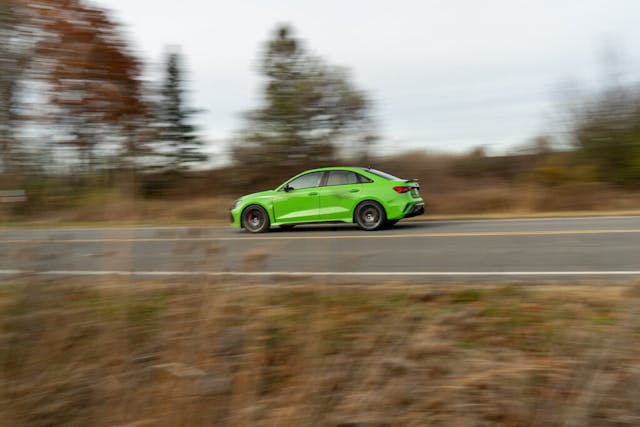
The RS 3 uses the third generation of Audi’s Modular Infotainment Toolkit (MIB 3). Unlike many new cars, the central touch screen is tucked into the dash rather than perched atop it or extending from the digital instrument cluster. Beneath the touchscreen are buttons for HVAC. Unfortunately, the UI is dated, and it isn’t immediately obvious how to connect a smartphone. Once we finally figured it out, we didn’t look back—and neither will many owners. The stereo is built by Sonos, a new partner of Audi’s, best known for its Wi-Fi-connected home speaker systems and infuriating mobile app. The stereo in the RS 3 is adequate but not remarkable. As with the rest of the interior, we had too much fun driving the RS 3 to get really mad about any of this.
The Audi RS 3 has no direct rival, mostly because there isn’t another inline-five-powered, all-wheel drive compact car on sale in the United States. (In Europe, you can still buy its crossover equivalent, the Q3 RS.) A budget of $70,000 opens the door to some very different flavors of performance. The BMW M2 is available only as a rear-drive coupe and boasts cutting-edge infotainment, an available manual transmission, and more power, thanks to another authentically German powerplant, a twin-turbo inline-six. The other German to consider is the AWD Mercedes CLA 45 S, with its 415-hp turbocharged four-cylinder. GM offers the RWD-only CT4-V Blackwing performance sedan, with its wonderfully precise chassis and 472-hp, twin-turbo six. The Audi will appeal most to the minimalists, who aren’t bothered by the interior or infotainment and crave a unique driving experience, and to the purists, who want a truly Audi Audi.
The RS 3 is a “you know if you know” car. However, you don’t have to be an Audi aficionado to appreciate the RS 3 (though it’s worth the respect). It’s a genuinely engaging car that’s fun to fling around and content to cruise. It’s compact, powerful, and unique. It is also the last of a breed that may not return a second time. If you like it, get one while you can.
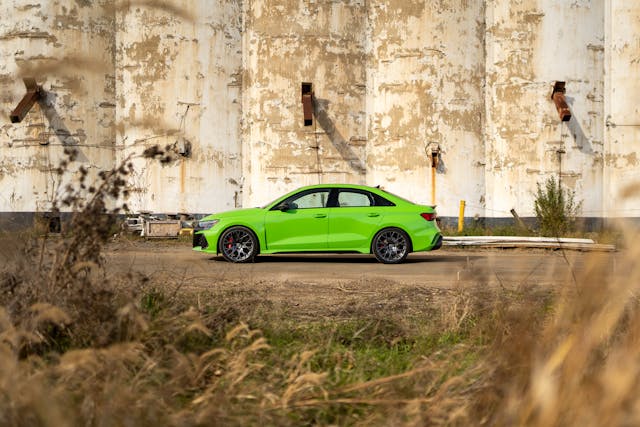
2025 Audi RS 3
Highs: Last example of a unique engine, a truly compact sport sedan.
Lows: interior got the short end of the stick / sporty upgrades to interior don’t hide the $40K roots, high NVH from high-performance summer tires
Summary: A dying breed, and an uncommon pleasure.

Post a Comment for "2025 Audi RS 3: Exceptional Excitement"
Post a Comment