VAW-117 E-2D Hawkeye Bears Marks of Last Year's Middle East Mission
The E-2D Hawkeye: A Vital Asset in Modern Air Defense
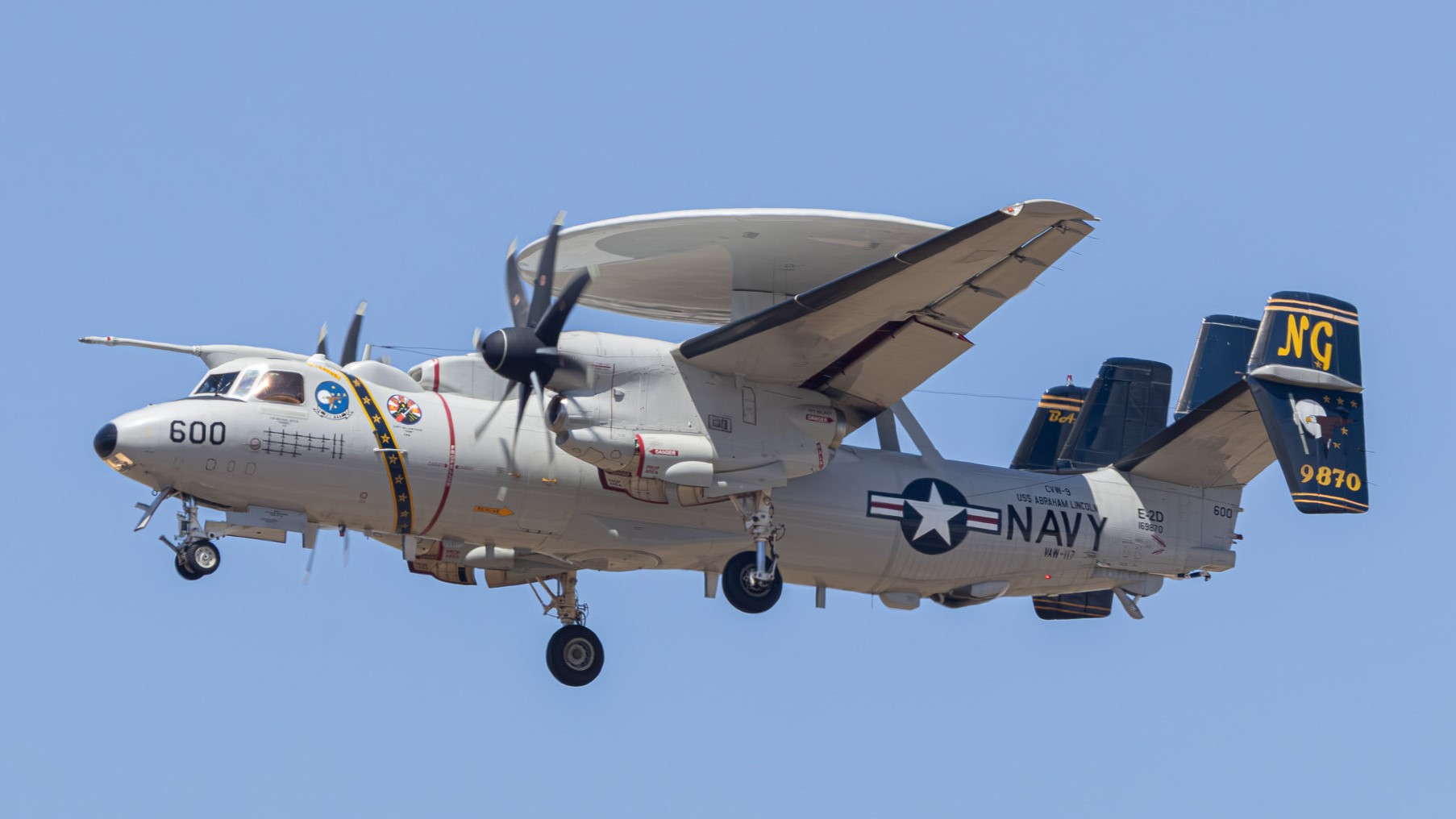
The U.S. Navy's E-2D Hawkeye has become a symbol of advanced air and missile defense capabilities, particularly during recent operations in the Middle East. Recently, freelance news photojournalist Matt Hartman captured images of an E-2D Hawkeye from Airborne Command and Control Squadron (VAW) 117, known as the "Wallbangers," while it was landing at Naval Air Station Point Mugu during the Gray Flag large force test event on Sept. 17, 2025. These photos reveal something unusual: kill markings on the aircraft’s fuselage.
The markings include the shapes of 13 drones, identified as Iranian-made Shahed-129, and four cruise missiles. While these symbols are not new—having appeared since early 2025—they serve as a reminder of the critical but often underappreciated role that support aircraft play in modern warfare.
Why Does the E-2D Have Kill Markings?
At first glance, it may seem odd for the E-2D Hawkeye, an airborne early warning and control (AEW&C) platform, to have kill markings. After all, the E-2D does not carry weapons. However, its role is far more strategic than simply detecting threats. As an AEW&C asset, the E-2D is responsible for detecting and tracking aircraft, ships, ground vehicles, and missiles over long distances. It then relays this vital information to other allied assets, enabling them to engage targets effectively.
During the late 2024 deployment of VAW-117 in the Middle East, the E-2D played a crucial role in defending against multiple attacks by Iranian and Houthi militias. The U.S. Navy acknowledged this when VAW-117 returned home on Dec. 14, 2024, stating that the Wallbangers contributed to the successful defeat of eight one-way attack unmanned aerial systems, five anti-ship ballistic missiles, and four anti-ship cruise missiles. Despite discrepancies between the number of kill markings and the Navy’s reported figures, these symbols indicate that the E-2D’s role extends beyond mere surveillance.
Another E-2D from VAW-117 was also photographed with a drone kill marking during the Northern Edge 2025 exercise in August, reinforcing the significance of these symbols.
The Evolution of the E-2D Hawkeye
The E-2D Advanced Hawkeye (AHE) represents a major advancement in the E-2 series, which has been the backbone of the U.S. Navy's airborne early warning and battle management capabilities for decades. This next-generation model introduces a suite of upgrades that significantly enhance its capabilities compared to earlier versions.
At the heart of the E-2D is a state-of-the-art radar system, described by the Navy as a “two-generation leap” in capability. This advanced radar improves detection range, target resolution, and tracking accuracy. Combined with other system upgrades, the E-2D can cover vast areas both at sea and over land, providing critical situational awareness for the fleet.
Unlike previous models, the E-2D functions as a highly integrated command and control node, acting as a “digital quarterback” in managing diverse, concurrent missions. It directs airborne strike operations, coordinates with ground forces, supports search and rescue efforts, and serves as a communications hub across a dispersed fleet.
VAW-117’s Deployment on USS Abraham Lincoln
In 2024, the USS Abraham Lincoln (CVN-72), flagship of Carrier Strike Group 3, embarked on a high-visibility deployment that spanned the Indo-Pacific and U.S. Central Command (CENTCOM) regions. Initially focused on routine operations and partnership-building, the mission included a Multi-Large Deck Event (MLDE) with the Italian Navy’s Cavour Carrier Strike Group and port calls such as Malaysia.
However, in August, the strike group was redirected to the Middle East to relieve the USS Theodore Roosevelt in response to escalating tensions. During its time in the CENTCOM and 5th Fleet Area of Responsibilities (AORs), the strike group conducted combat strikes against Houthi targets in Yemen, defended sea lanes through Bab el-Mandeb, and supported Operation Prosperity Guardian, which protects maritime commerce from attacks.
This deployment marked several “firsts,” including the combat employment of the F-35C Lightning II from the USS Lincoln, the use of the ALQ-249 Next Generation Jammer, and a Nimitz-class carrier refueling at sea via a commercial oiler.
The Composition of the Abraham Lincoln Carrier Strike Group
The Abraham Lincoln Carrier Strike Group consists of the flagship USS Abraham Lincoln (CVN-72), along with embarked staffs of CSG-3 and Destroyer Squadron (DESRON) 21, Carrier Air Wing (CVW) 9, Arleigh Burke-class guided missile destroyer USS Frank E. Petersen Jr. (DDG 121), and DESRON 21's USS Spruance (DDG 111) & USS Michael Murphy (DDG 112).
CVW-9 includes nine squadrons operating the F-35C Lightning II, F/A-18E/F Super Hornet, E-2D Hawkeye, C-2 Greyhound, and MH-60R/S Sea Hawk. These squadrons include the "Black Knights" of Marine Fighter Attack Squadron (VMFA) 314, the "Tophatters" of Strike Fighter Squadron (VFA) 14, the "Black Aces" of VFA-41, the "Vigilantes" of VFA-151, the "Wallbangers" of Airborne Command and Control Squadron (VAW) 117, the "Wizards" of Electronic Attack Squadron (VAQ) 133, the "Raptors" of Helicopter Maritime Strike Squadron (HSM) 71, the "Chargers" of Helicopter Sea Combat Squadron (HSC) 14, and the "Rawhides" of Fleet Logistics Support Squadron (VRC) 40.

Post a Comment for "VAW-117 E-2D Hawkeye Bears Marks of Last Year's Middle East Mission"
Post a Comment