Secrets of bridge resilience revealed in extreme disasters
Understanding the Resilience of Steel Truss Bridges
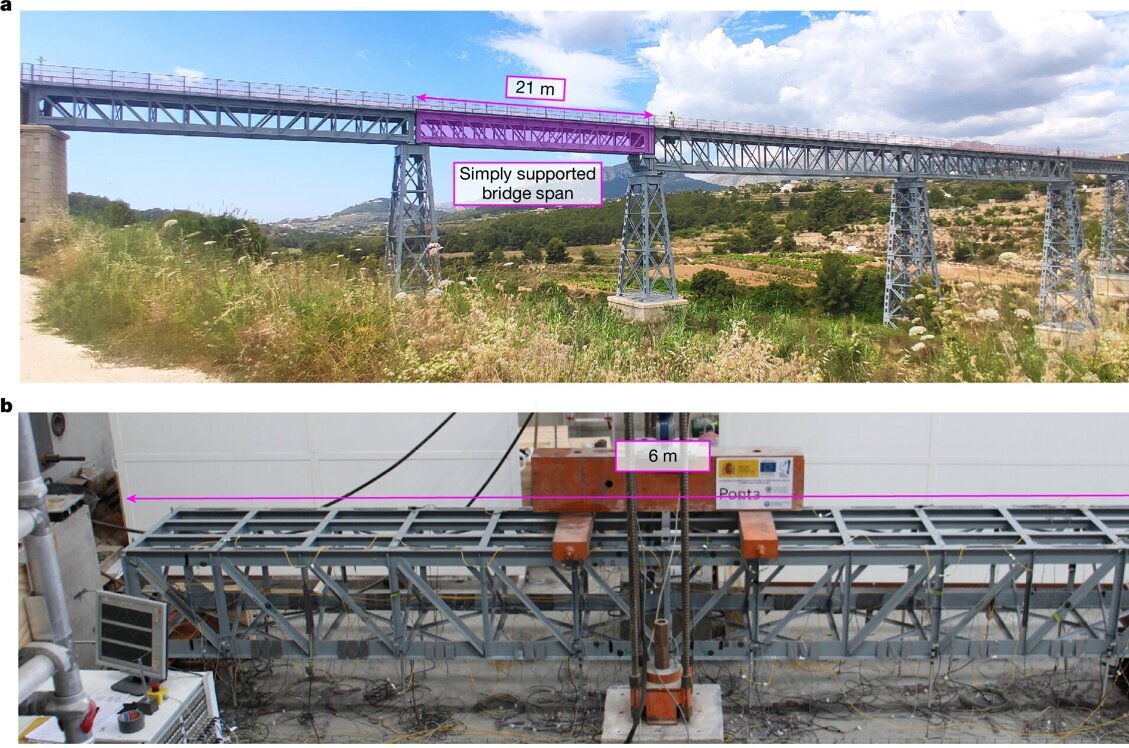
A groundbreaking study conducted by a team from the Universitat Politècnica de València (UPV) and the University of Vigo (UVigo) has revealed fascinating insights into why steel truss bridges do not collapse when subjected to catastrophic events such as impacts or earthquakes. The research, published in Nature, highlights that these structures exhibit resilience similar to that of spider webs, adapting and maintaining functionality even after significant damage.
The findings are particularly important given the critical role that bridges play in transportation networks. Their failure can lead to severe consequences, including loss of life and substantial economic losses, with each day of closure potentially costing millions of euros. As natural events become more intense and unpredictable, ensuring the stability of bridges following local failures is increasingly vital.
Key Insights from the Study
Researchers have identified secondary mechanisms that allow steel truss bridges to resist further damage and continue bearing loads even after an initial failure. These mechanisms create what is known as "latent resistance," enabling the structure to remain intact rather than collapsing entirely.
José M. Adam, a researcher at the ICITECH Institute of the Universitat Politècnica de València and coordinator of the Pont3 project, explains that just as spider webs can adapt and continue to trap prey after suffering damage, damaged steel truss bridges may still be able to withstand greater loads than they typically bear under normal conditions.
Belén Riveiro, a researcher at the Center for Research in Technology, Energy and Industrial Processes at the University of Vigo, emphasizes the importance of understanding how initial failures can spread disproportionately in some cases while having minimal impact in others. This knowledge helps in developing better strategies for monitoring, evaluating, and repairing existing bridges.
Learning from Nature: From Lizards to Spider Webs
The research team's work draws inspiration from nature, highlighting how natural systems can inform engineering solutions. In previous studies, the team discovered ways to prevent buildings from collapsing during extreme events by imitating lizards. This time, they turned their attention to spider webs, which share behavioral similarities with steel truss bridges.
By comparing their findings with a 2012 study published in Nature that focused on spider webs, the researchers demonstrated that the principles governing the resilience of spider webs can also apply to bridge structures. This cross-disciplinary approach offers new possibilities for designing safer and more resilient infrastructure.
Implications for Future Bridge Design
The study contributes significantly to improving the design and maintenance of bridges, especially in the face of extreme events. By understanding the latent resistance mechanisms in steel truss bridges, engineers can develop better strategies for ensuring their safety and longevity.
Carlos Lázaro, principal investigator of the Pont3 sub-project at UPV, notes that this research provides a foundation for defining new robustness requirements for steel truss bridges. The ultimate goal is to enhance the safety of these critical infrastructures, which are widely used in transportation networks around the world.
Conclusion
The findings from this study underscore the importance of learning from nature to solve complex engineering challenges. By drawing parallels between the resilience of spider webs and the structural integrity of steel truss bridges, researchers are paving the way for safer, more durable infrastructure. As climate change and natural disasters continue to pose threats, such innovations will be essential in protecting lives and minimizing economic losses.

Post a Comment for "Secrets of bridge resilience revealed in extreme disasters"
Post a Comment