Forrestal-Class Carriers Send a Message to the U.S. Navy
The Birth of the Jet-Era Supercarriers
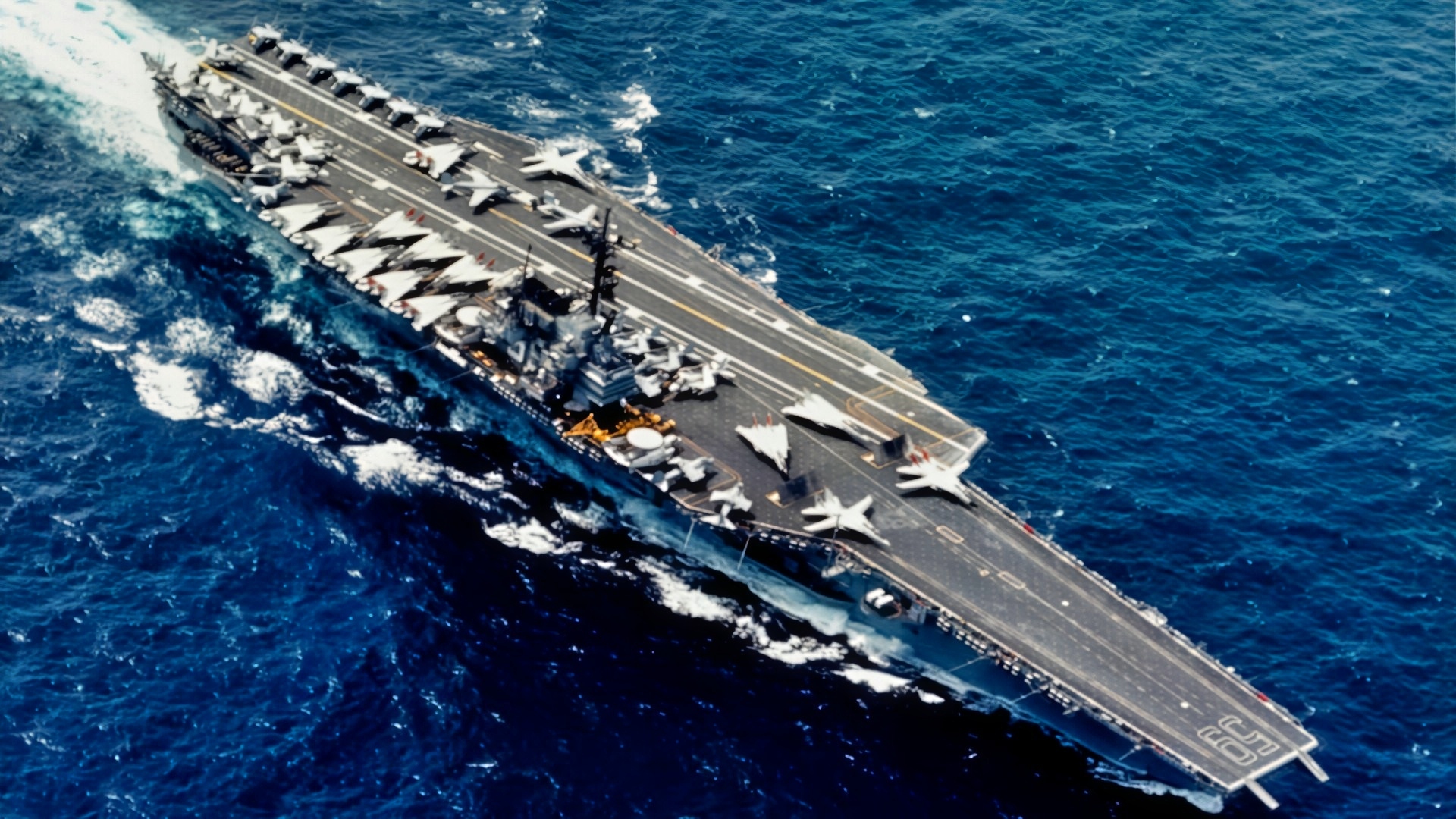
The Forrestal-class carriers—Forrestal, Saratoga, Ranger, and Independence—marked a pivotal shift in naval aviation. These were America’s first true jet-era supercarriers, designed to launch heavy strike aircraft and high-performance fighters at sustained tempo across global crises. Conceived during the early Cold War, they integrated advanced technologies like steam catapults, angled decks, deck-edge elevators, deep magazines, and generous fuel capacity into a cohesive flight-deck system. Though conventionally powered, they provided global reach through underway replenishment and decades of deployments, from the Mediterranean to Vietnam, the Gulf, and post-Cold War policing.
Despite facing serious mishaps, such as the 1967 Forrestal fire, which led to significant safety improvements across the fleet, these carriers left a lasting blueprint that every American supercarrier since has followed. Their design and operational capabilities redefined what a carrier could achieve, setting the stage for modern naval power projection.
The Strategic Necessity of the Forrestal-Class
Strategically, the need for these carriers was clear. Washington required sovereign airpower that didn’t depend on foreign bases. This was crucial for credible presence in the Mediterranean and Atlantic for NATO crises, and for Pacific reach in contingencies from Korea to the Taiwan Strait. The ability to arrive quickly, sustain sorties, and move without diplomatic constraints shaped deterrence and diplomacy alike. The Forrestal-class was the Navy’s answer: a purpose-built, jet-optimized supercarrier capable of projecting power daily rather than merely surviving a single set-piece battle.
During the Cold War, the geopolitical landscape was tense. Berlin flashpoints, a hot war in Korea, nuclear standoffs, and a submarine competition stretching from the Greenland-Iceland-UK gap to the western Pacific defined the era. The Soviet Union fielded long-range bombers, anti-ship munitions, and a growing submarine force. NATO’s flanks were pressure points where a carrier’s mere arrival could steady allies and complicate adversary plans. In this environment, the Forrestal-class promised mobile, resilient airfields that could steam to crisis zones, enforce no-fly demands, provide strike options, and leave without permission slips.
Design Innovations That Defined the Class
What made the Forrestal-class special was their integration of essential jet deck elements into a single, coherent operating system. Steam catapults and high-capacity arresting gear were designed from day one for heavy jets, using long steam cats to throw large aircraft off the bow and reinforced arresting gear to stop them safely—at night, in crosswinds, at the upper ranges of landing weight. The angled flight deck was more than a retrofit; it organized the entire deck plan, allowing Bolters to go around without plowing into parked aircraft and enabling overlapping cycles of launching and recovering, increasing tempo.
Deck-edge elevators moved major elevators to the deck edge, unclogging the center of the flight deck, smoothing taxi paths, and reducing the choreography risks that once snarled straight-deck operations. Deep stores and fueling architecture supported rapid re-arm and refuel cycles with safety margins learned in war. Command, control, and sensors built for traffic included improved air-traffic control, radar, and combat information functions needed to direct dozens of jets while managing air defense and strike sequencing.
Conventional Propulsion: A Pragmatic Choice
Viewed from today’s nuclear-powered fleet, conventional boilers can look like a limitation. But in the Forrestals’ prime decades, the answer is more nuanced. Operationally, the Navy had perfected underway replenishment, and oilers kept pace with carrier groups worldwide. The ships’ conventional plants did not prevent long deployments or high sortie rates. They showed up where they were needed—and stayed.
Nuclear power later proved decisive for endurance and logistics: longer periods between refueling, less oiler overhead, and margin for the unexpected. It also drove up initial cost and complexity. For the Forrestal era, conventional propulsion was a pragmatic trade that delivered four big decks faster and at acceptable cost. Their lack of reactors wasn’t a showstopper; it was a choice that fit the technology, budgets, and timelines of the 1950s—and it never kept these carriers from front-line relevance.
Building On Previous Classes
The Forrestals were a consolidation of hard lessons. From the Essex class, they retained the culture of damage control, ordnance discipline, and deck-handling rigor forged under fire. From Midway, they inherited the virtues—and limits—of a bigger hull and strengthened decks, while pushing beyond retrofit compromises. From 1950s trials and conversions, they made permanent the angled deck, optical landing systems, and steam cats, turning experiments into standard practice.
Crucially, the Forrestals were sized and laid out for the airplanes that were coming, not the ones that had just fought a war. Heavy bombers like the A-3 Skywarrior and A-5 Vigilante, all-weather strikers like the A-6 Intruder, fleet-defense fighters from F-4 Phantom to F-14 Tomcat—the class absorbed each generational change without losing the rhythm of the deck.
Operational History: From Crisis Response To Sustained Combat
Across four hulls, the Forrestal-class became the backbone of Cold War carrier presence and a familiar silhouette in more than one ocean. In the Mediterranean and Atlantic, Forrestal and Saratoga were almost permanent fixtures of the Sixth Fleet, cycling through deterrent patrols, NATO exercises, and real-world flare-ups around the Middle East and Balkans. Their air wings enforced stability by simply being close, aircraft spotted and ready while diplomats bargained.
In Vietnam and the Western Pacific, Ranger carried much of the class’s combat weight in Southeast Asia, deploying multiple times to the Gulf of Tonkin. Day after day she launched alpha strikes, armed reconnaissance, and barrier CAPs, absorbing the wear that long wars carve into deck plates. Forrestal also deployed to Vietnam before tragedy struck, and returned to service to continue Atlantic and Mediterranean work.
As the Cold War wound down, the class remained useful. Saratoga and Ranger supported Gulf operations; Independence—relieving an older forward-based carrier—took up permanent station in Japan in 1991, giving the U.S. a constant big deck at the edge of the Western Pacific. Flying combat air patrols, enforcing sanctions, and providing quick-reaction strike options became routine.
Accidents And The Changes They Forced
Carrier aviation is not forgiving, and the class endured mishaps that reshaped the fleet’s approach to safety. The 1967 Forrestal fire, preparing for strikes off Vietnam, ignited fuel and detonated ordnance among tightly parked aircraft. The chain reaction was devastating, with heavy loss of life and widespread damage. The Navy’s response was sweeping: revamped damage control training, improved firefighting gear, rethought ordnance handling, and revised deck layouts that prioritized separation and blast paths. Those changes have saved lives ever since.
In 1992, during a NATO exercise, Saratoga inadvertently launched Sea Sparrow missiles that struck the Turkish destroyer TCG Muavenet, killing and injuring sailors. Investigations drove reforms in weapons release procedures, training, and communications during complex, multinational drills where split-second decisions and mixed command relationships can collide.
Sustaining Effectiveness Across Decades
Three ingredients sustained the Forrestals across changing eras: built-in growth, a deck meant for tempo, and a maintenance and training ecosystem. The class carried the structural margin and electrical headroom to accept heavier arresting engines, stronger catapults, new radars, better electronic-warfare suites, and ever more power-hungry avionics. That margin delayed obsolescence and protected relevance.
With deck-edge elevators, a wide angled deck, and long steam cats, these ships were sortie machines. They could launch and recover persistently, day and night, in difficult seas—what combatant commanders value most. The Navy learned to sustain big decks as living systems: predictable yard periods, deep spares pipelines, standardized training, and qualification rhythms that kept air wings and deck crews sharp.
Why The Class Was Retired
By the 1990s, three forces converged: post-Cold War downsizing, air wing evolution, and aging and cost. With fewer carriers authorized, the Navy prioritized younger, larger, nuclear-powered decks that offered better endurance and lifetime economics. Aircraft gained weight and complexity, and even a well-designed conventional hull faced costly upgrades. Decades at sea accumulated fatigue and corrosion that were expensive to chase.
Extending Forrestal-class service for another generation would have required deep investment better directed to airframes with more remaining life and to nuclear-powered platforms that reduced logistics burdens at sea. One by one, the ships decommissioned in the 1990s. Proposals to preserve them as museums struggled against cost and feasibility. Their departure reflected arithmetic, not failure: the fleet pivoted to a nuclear baseline and fewer total decks.
Nuclear Or Conventional: A Practical Consideration
It’s worth separating theory from practice. In theory, nuclear carriers bring unmatched endurance and free up replenishment capacity for escorts and air wings. In practice, during the Forrestals’ active decades, conventional power did not prevent global reach or sustained operations. Oilers were part of the plan; the plan worked. The strategic value the class delivered—presence, deterrence, and combat power—was not contingent on reactors.
Over the very long term, nuclear’s advantages compound: fewer refueling interruptions, more margin for unplanned crises, and logistics simplification across a larger fleet. Those advantages explain procurement choices after the Forrestal era, but they do not retroactively diminish what these conventional ships achieved. They did the job—over and over—because the Navy built the operational architecture to make conventional power work.
Legacy: The First Truly Modern American Supercarriers
Strip away nostalgia and ask the hard question: did the Forrestal-class change what the Navy could do? The answer is yes, and in multiple dimensions. They set the architecture: deck-edge elevators, angled landing areas sized for real traffic lanes, steam catapults, deep aviation support spaces, and a flight-deck choreography tuned for jets—this is the design DNA carried by every American supercarrier since.
They professionalized the jet deck, maturing procedures for launch/recovery, fueling, arming, and aircraft movement under pressure. They also transformed damage control after 1967, forging a safety culture that moves from classroom to hangar deck to line shack. They delivered strategic flexibility, serving as policy by presence in the Mediterranean, sustained combat power at sea in Vietnam, and a steady hand on the throttle in the Gulf and post-Cold War enforcement.
Carriers are diplomacy with options; the Forrestals were that promise, fulfilled, for nearly four decades. They proved conventional could be “super.” Before nuclear propulsion became standard, these ships showed that conventional plants could underpin a global, jet-era carrier strategy. They bought time, space, and confidence for the fleet to transition, without leaving a capability gap.
That is why, when naval architects and aviators trace the lineage of the modern American supercarrier, they keep returning to these four hulls. The Forrestal-class didn’t just bridge eras—it created the era: big-deck, high-tempo, jet-centric sea power executed day after day, crisis after crisis.

Post a Comment for "Forrestal-Class Carriers Send a Message to the U.S. Navy"
Post a Comment