What Is the U.S. Equivalent of China's J-16 Fighter?
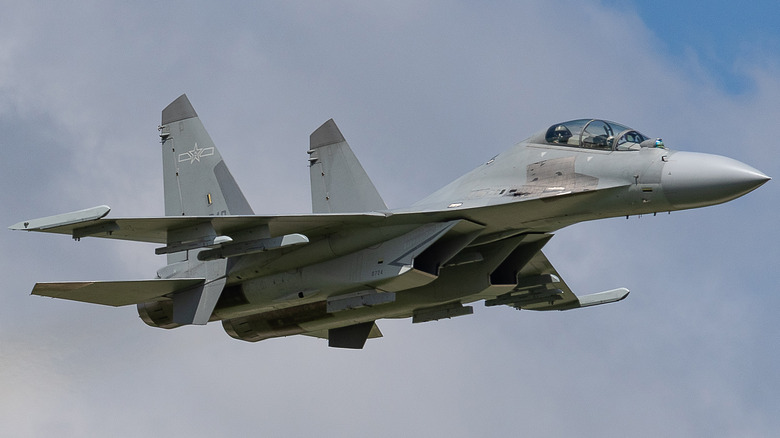
China's Air Force: A Growing Power in the Global Military Landscape
China has established itself as a major player in the global military arena, particularly in terms of its air force capabilities. The People's Liberation Army Air Force (PLAAF) and the People's Liberation Army Naval Air Force (PLANAF) have seen significant advancements over the past few decades. These developments have positioned China among the top three largest air forces in the world, with a growing number of aircraft and increasingly modern technology.
The sheer scale of China’s air force is impressive. While exact figures can vary depending on the source, it is clear that the number of fighter jets in China’s inventory is rapidly approaching that of the United States. This growth is not just about quantity but also about quality. Several new Chinese jet designs now match or even exceed the technological standards of Western counterparts.
One such example is the Shenyang J-16, often referred to as the Qianlong. Introduced in 2013, this multirole fighter jet is based on the Russian Sukhoi Su-30 design but has evolved into a highly capable aircraft. Unlike a simple imitation, the J-16 incorporates advanced systems and technologies that make it a formidable contender in modern aerial combat.
Comparing the J-16 to Western Fighters
When assessing the J-16, it is helpful to compare it to similar Western fighter jets. The most direct equivalent is the U.S. F-15E Strike Eagle. Both aircraft are designed for multirole operations, meaning they can engage in both air-to-air and air-to-ground combat. Their performance characteristics, including range, speed, and munitions compatibility, are remarkably similar.
In terms of armament, the J-16 is equipped with up to eight radar-guided missiles and four infrared-guided missiles. The F-15E typically carries a similar number of missiles, including the AIM-120 AMRAAM and AIM-9 Sidewinder. While the Sidewinders use older technology, they remain effective against modern targets. Both aircraft are also capable of carrying a wide range of bombs, including laser-guided and satellite-guided variants. The J-16, in particular, is linked to China’s BeiDou satellite system, enhancing its precision strike capabilities.
Interestingly, the J-16 was introduced nearly 25 years after the F-15E, yet their similarities suggest a shared developmental lineage. The F-15E was introduced in 1989, followed by the Russian Su-30 in 1996, and finally the J-16 in 2013. This timeline highlights how China built upon existing designs to create a competitive fighter jet.
Other Modern Equivalents
While the F-15E is the closest Western counterpart to the J-16, there are other fighter jets with comparable specifications. One such example is the French Dassault Rafale. Designed for multirole operations, the Rafale is known for its versatility and advanced avionics. Although slightly slower than the J-16, the Rafale received significant upgrades in 2018, making it a strong competitor. In fact, Chinese military analysts have described the J-16 as the Rafale’s "peer" in certain aspects.
Another notable variant is the J-16D, an electronic warfare version of the J-16. Instead of traditional weapons, the J-16D is equipped with electronic warfare pods that serve as radar jammers. The closest Western equivalent to this capability is the EA-18G Growler, a specialized electronic warfare aircraft developed from the F/A-18F Super Hornet. Both aircraft fulfill similar roles in disrupting enemy radar and communication systems.
The F/A-18F Super Hornet is another close match to the J-16. Originally designed as a multirole fighter, the F/A-18F was upgraded with more powerful engines and advanced technology. Despite being over 35 years old, the F-15E remains a relevant comparison due to its continued relevance and adaptability.
Conclusion
China’s air force continues to grow in both size and sophistication, with the J-16 serving as a prime example of its technological advancements. By drawing on international designs and incorporating cutting-edge systems, China has created a formidable air force that rivals many Western counterparts. As the global military landscape evolves, China’s role as a key player is only expected to grow.

Post a Comment for "What Is the U.S. Equivalent of China's J-16 Fighter?"
Post a Comment