The Secret Defense of the Jacobin Hummingbird
A New Discovery in the Rainforest
In March 2024, a chance encounter in the rainforests of Panama led to an exciting discovery about the defensive behaviors of white-necked Jacobin hummingbird chicks. Michael Castaño from the Smithsonian Tropical Research Institute and Sebastian Gallan-Giraldo from the University of Antioquia in Colombia were monitoring a hummingbird nest in Soberanía National Park with the help of researchers Jay Falk and Scott Taylor. After observing the nest for a month, they witnessed a chick hatch. What they saw was unusual—this chick was covered in long, fluffy natal down feathers, giving it a fuzzy, brownish appearance. Additionally, the chick jerked its head back, resembling the movements of a caterpillar. The researchers later published their findings in March 2025.
Understanding the White-Necked Jacobin Hummingbird
Hummingbirds are small birds native to the Americas and belong to the Trochilidae family. There are hundreds of known species, and new ones are occasionally discovered. One of the most remarkable traits of hummingbirds is their ability to fly backward. However, there is still much to learn about them, especially those that live in remote areas.
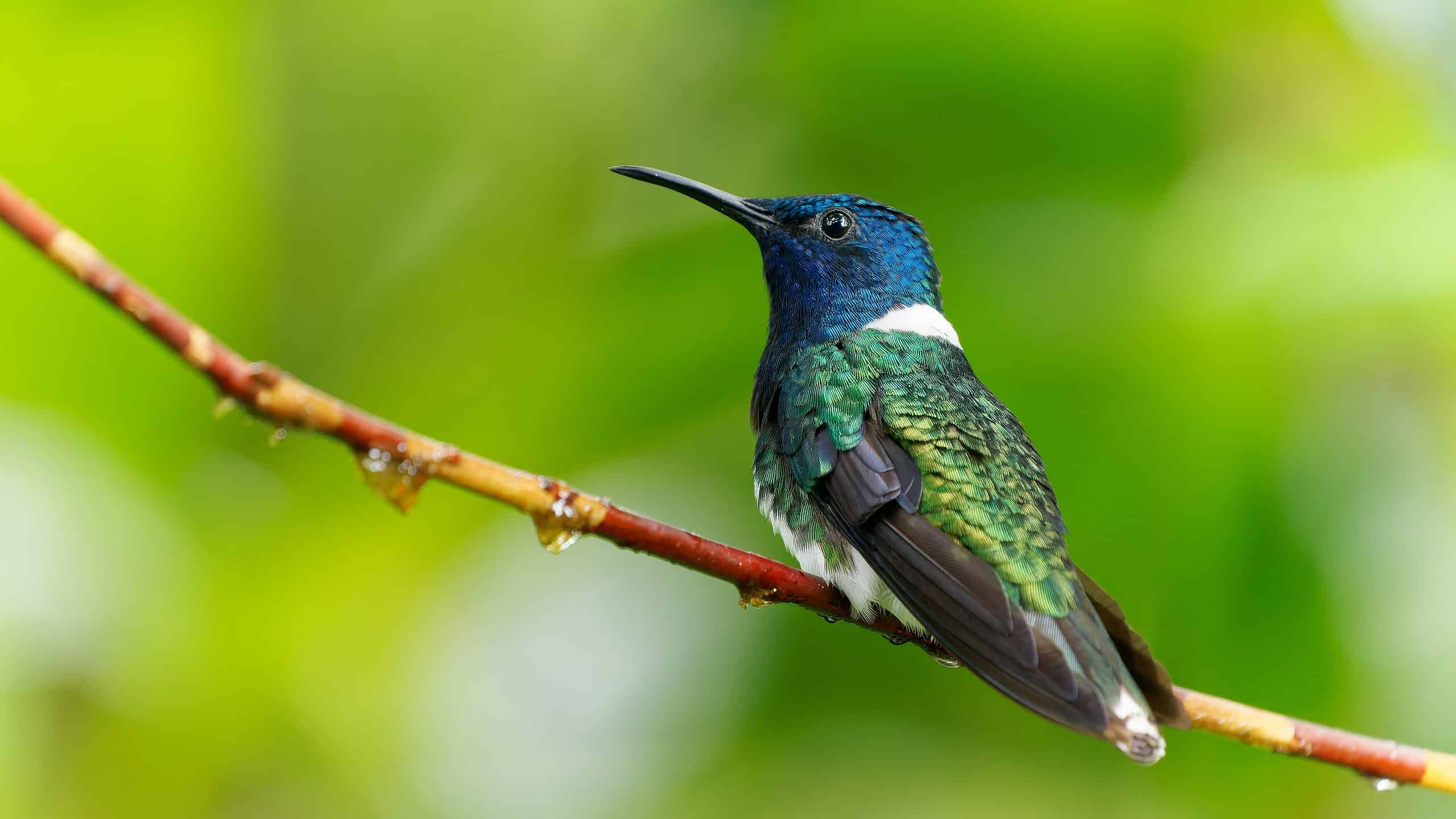
The white-necked Jacobin hummingbird (Florisuga mellivora) is a medium-sized bird measuring between 4.3 and 4.7 inches. Its range includes parts of Mexico, Central America, and northern South America, including Brazil, Bolivia, and Peru. These birds are typically found in humid forest canopies and edges, often high in trees. They also appear near clearings and on coffee and cacao plantations. Their diet consists mainly of tree flower nectar.
Male white-necked Jacobin hummingbirds have a dark blue head and chest, with a white belly and tail. They also have a white band on the nape of their neck. Female birds have variable plumage, but most have green upperparts and a blue-green throat.
Breeding and Nest Protection
White-necked Jacobin hummingbirds are skilled at building nests to protect their eggs and chicks. Nests are small and located high up, sometimes as high as 10 feet off the ground. They are constructed in a shallow cup shape using plants and cobweb materials that blend in with their surroundings. To further protect the nest, it is often positioned under a leaf that acts as a roof.
Female hummingbirds have also been observed using a special fluttering flight to distract predators.
Hatchling Defense Mechanisms
Despite these precautions, some predators still manage to reach the nest. Therefore, the chicks themselves have evolved impressive techniques to defend against threats. Their long brow feathers and twitching movements make them resemble toxic brown, urticating caterpillars found in the region. Researchers even observed a hatchling using this technique to deter a predatory wasp.
Mimicry as a Defense Strategy
Mimicry is a fascinating defense mechanism used by many creatures around the world. It involves imitating another species to avoid predation. One form of mimicry, called Batesian mimicry, occurs when a non-toxic species mimics a dangerous or unpleasant one to fool predators.
Batesian mimicry requires three elements: a model, a mimic, and a predator. In this case, the model is a toxic orange/brown caterpillar, the mimic is the newly hatched chick of the white-necked Jacobin hummingbird, and the predator is any animal that attacks hummingbird chicks, such as predatory wasps.
Aposematic Signaling and Success Factors
Aposematic signaling is a warning signal that uses color and behavior to indicate danger. The caterpillar’s appearance and jerky movements serve as a warning to predators. For Batesian mimicry to be effective, the model must be more common than the mimic. This ensures that predators associate the warning signals with an unpleasant experience.
Research suggests that if there are more models than mimics, the mimicry is more successful. However, other studies propose that this dynamic can lead to an evolutionary feedback loop, where the model becomes more toxic, and the mimic evolves to better resemble the model.
Other Examples of Batesian Mimicry
This type of mimicry is common in frogs, snakes, and butterflies. For instance, the sanguine poison frog mimics the Ecuador poison frog to avoid predation. Butterflies like Papilio Memnon copy several other butterfly species, while coral snakes are mimicked by scarlet kingsnakes.
A Unique Case of Mimicry
What makes the white-necked Jacobin hummingbird chicks unique is that they mimic the larval stage of an insect, not just its appearance but also its movements. This represents a significant advancement in Batesian mimicry, showing how nature continues to evolve and adapt.

Post a Comment for "The Secret Defense of the Jacobin Hummingbird"
Post a Comment