Tens of Thousands March for Gaza in Brussels
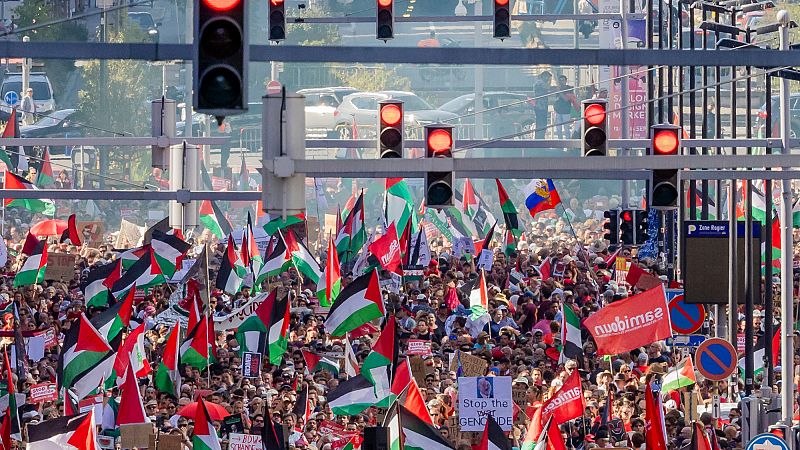
Protests in Brussels Highlight Growing European Solidarity with Gaza
Tens of thousands of demonstrators wearing red gathered in Brussels on Sunday to express their opposition to the Israeli government and to symbolically draw a red line against its ongoing military actions in Gaza. The protest aimed to urge EU member states to adopt stronger measures and implement firm sanctions against Israel. This event marked the second edition of the "Red Line for Gaza" march, which has become a powerful platform for public dissent and advocacy.
Local authorities estimated that approximately 70,000 people participated in the march, while organizers claimed the turnout was around 110,000. The procession stretched over 3.5 kilometers across the Belgian capital, drawing attention from both locals and international observers. The demonstration was supported by more than 200 human rights organizations and aid agencies, including Oxfam, Doctors without Borders, Amnesty International, Greenpeace, and Save the Children, all of whom are advocating for an end to the conflict and increased humanitarian support for Palestinians.
The protest comes at a time when Belgium is considering recognizing a Palestinian state at the United Nations General Assembly later this month. This move would be accompanied by potential sanctions against Israel under specific conditions. Katrien Van der Heyden, Teamleader Education at Oxfam Belgium, highlighted the role of previous demonstrations and campaigns in influencing the government’s stance. She emphasized that sustained public pressure has been crucial in pushing for action, citing the success of Oxfam’s "Speak up for Palestine" campaign, which has collected over 100,000 signatures demanding a permanent ceasefire and an end to the violence.
Oxfam Belgium collaborated with hundreds of Flemish actors, artists, and influencers to launch the campaign. The initiative calls for safe and unrestricted access to humanitarian aid for Palestinian civilians, economic sanctions on Israel, and an immediate halt to the conflict. While many demonstrators acknowledged the government's recent steps as progress, they remain unsatisfied with the compromise reached and demand stronger measures from Belgium and other EU nations.
"You don't compromise about children's lives, people's lives," Van der Heyden said. "You don't compromise as a government. You have to draw a red line, which is non-negotiable." She pointed out a growing divide between public sentiment and political action, noting the stark contrast between the anger felt by citizens and the perceived inaction of EU leaders.
Isja Puissant, spokesperson for the Global Movement to Gaza in Belgium, echoed these sentiments, stating that politicians have been slow to act despite the urgent need for intervention. "We have been asking our politicians for two years to intervene in Palestine," she said. "They are still just discussing the recognition of a Palestinian state by the end of September, when in reality, there might not be any Palestinians left by that time."
The Global Movement to Gaza is a grassroots coalition consisting of 44 countries committed to ending the blockade of Gaza. Recently, twenty ships with over 300 crew members set sail from Barcelona as part of the Global Sumud Flotilla, aiming to establish a humanitarian corridor. Ships from Tunisia and Italy are expected to join the effort, with the flotilla set to depart from Tunisia on Wednesday after several delays.
Rising European Solidarity
In recent weeks, numerous pro-Palestine demonstrations have taken place across Europe, including in Ireland, Italy, Germany, the United Kingdom, and Spain. These events reflect a growing wave of solidarity in response to Israel's expanded offensive in Gaza, which has drawn widespread international condemnation. The humanitarian crisis in the region has worsened, with the UN declaring famine now occurring in the Gaza governorate and predicting it will spread to Deir al Balah and Khan Younis by the end of the month.
The "Red Line for Gaza" march in Brussels first took place in June, with at least 75,000 participants. Similar events have also been held in the Netherlands, where large crowds turned out for each edition. In addition to the marches, red lines have appeared in shop windows across major Belgian cities, serving as a visible sign of support for the movement.
The conflict in Gaza began after Hamas-led militants attacked southern Israel on 7 October 2023, killing around 1,200 people, many of them civilians. Hamas took 251 hostages, and is currently holding 50 of them, 20 of whom are believed to be alive. In response, Israel launched a military operation that has resulted in the deaths of over 64,000 Palestinians, according to the Hamas-run Gaza Health Ministry. Most of the victims are women and children, and large areas of Gaza have been destroyed. Over 2 million people have been displaced, and the situation continues to deteriorate.

Post a Comment for "Tens of Thousands March for Gaza in Brussels"
Post a Comment