Meet the Microbes: Secrets of a Warming Wetland and Earth's Carbon Future
The Vital Role of Peatlands in Global Carbon Storage
Peatlands, often overlooked in discussions about climate change, play a crucial role in storing carbon on our planet. According to Joel Kostka, the Tom and Marie Patton Distinguished Professor, between a third and half of all soil carbon is stored in these wetlands. These ecosystems, formed from layers of decaying plant matter, are found across the globe, from the Arctic to the tropics. They not only support biodiversity but also regulate global climate by acting as natural carbon sinks.
However, as global temperatures rise, this critical carbon storage system faces significant threats. "Peatlands are essential carbon stores, but as temperatures warm, this carbon is in danger of being released as carbon dioxide and methane," explains Kostka, who is also the associate chair for Research in the School of Biological Sciences and director of Georgia Tech for Georgia's Tomorrow. Understanding the balance between carbon dioxide and methane emissions is vital because while both are greenhouse gases, methane is far more potent in terms of its warming effect.
Kostka is the corresponding author of a new study that explores how and why peatlands produce carbon dioxide and methane. The research, titled "Northern peatland microbial communities exhibit resistance to warming and acquire electron acceptors from soil organic matter," was published this summer in Nature Communications. It was led by co-first authors Borja Aldeguer-Riquelme, a postdoctoral research associate in the Environmental Microbial Genomics Laboratory, and Katherine Duchesneau, a Ph.D. student in the School of Biological Sciences.
A Decade of Research at SPRUCE
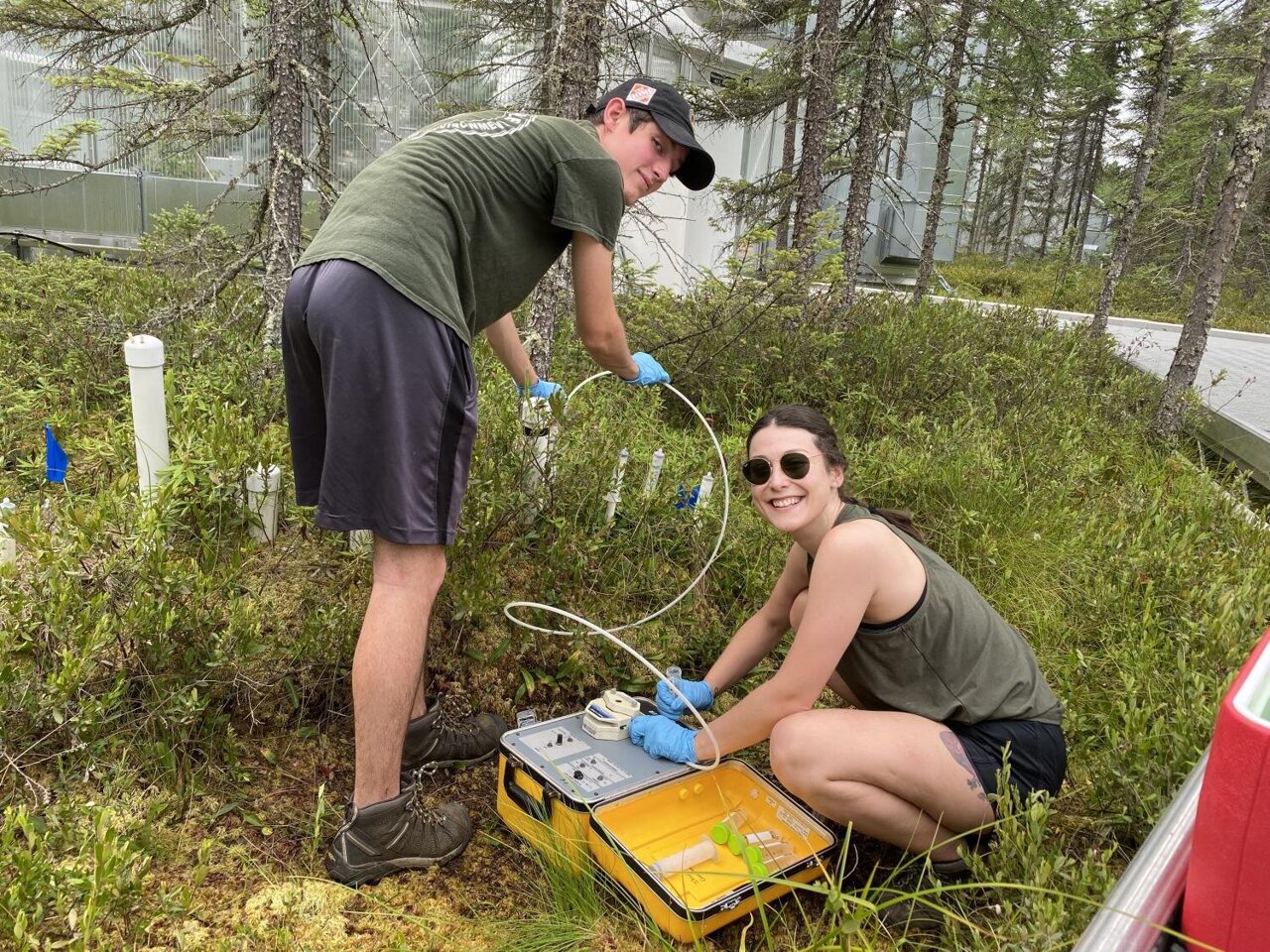
The study builds on a decade of research conducted at the Oak Ridge National Lab's Spruce and Peatland Responses Under Changing Environments (SPRUCE) experiment, a long-term project in Minnesota. This initiative allows researchers to warm entire sections of wetlands, from tree tops to bog bottoms, providing valuable insights into how these ecosystems respond to climate change.
"Over the past 10 years, we've shown that warming in this large-scale climate experiment increases greenhouse gas production," Kostka says. "But while warming makes the bog produce more methane, we still observe a lot more CO₂ production than methane. In this paper, we take a critical step towards discovering why—and describing the mechanisms that determine which gases are released and in what amounts."
The Methane Mystery
One of the key questions in this research has been the subdued methane production in peatlands. In water-saturated wetlands, oxygen is scarce, yet microbes still need to respire. Without oxygen, they use nitrate, sulfate, or metals for respiration, which still results in carbon dioxide emissions. However, if these substances are not available, microbes can release methane instead.
Despite this, observations show that peatlands produce significantly more carbon dioxide than methane. "In both fieldwork and lab experiments, peatlands produce much more carbon dioxide than methane," Kostka explains. "It's puzzling because the soil conditions should help methane production dominate."
To solve this mystery, the team used advanced genetic tools known as "omics." These include metagenomics (studying DNA), metatranscriptomics (studying RNA), and metabolomics (a technique used to study metabolic byproducts). This approach provided a detailed look at the microbial processes that cycle organic matter in wetlands and revealed an astonishing diversity of soil microbes—80% of the organisms identified were new at the genus level.
Omics Innovations and Discoveries
Over several years, the team collected samples from a peatland enclosed in an experimental chamber that was gradually warmed. Using omics techniques, they analyzed how the microbial communities changed with increasing temperatures. Initially, they expected the microbial communities to shift rapidly, given their ability to evolve and grow quickly. However, the DNA-based methods showed that while the microbial communities remained largely stable, the bog did release more greenhouse gases as it warmed.
Duchesneau and Aldeguer-Riquelme constructed microbial genomes to investigate how they decomposed organic matter and cycled carbon. "We found that microbial activity increases with warming, but the growth response of microbial communities lags behind these changes in physiological or metabolic activity," Kostka notes. He cautions that while these shifts might occur eventually, they may come after changes in metabolic activity.
Challenges and Future Directions
The research also raises questions about methane production. The team believes that microbes may be breaking down organic matter to access the key ingredients needed for producing carbon dioxide—nitrate, sulfate, and metals. However, more research is needed to confirm this hypothesis.
Conducting integrated omics research in soil systems remains a challenge due to the complexity of these environments. "Doing this type of integrated omics research in soil systems is still incredibly difficult," Kostka says. The challenges include years of experiments, long-term datasets, advanced laboratory techniques, and fieldwork innovations.
At SPRUCE, experimental chambers cover about 1,000 square feet. While this setup is impressive, researchers must be careful with sampling: "We need to take soil samples for many years, so if we take too many, there'd be no soil left," Kostka explains. Part of the research involves developing better, non-destructive sampling techniques.
Another challenge is the sheer diversity of organisms in peatlands, making it difficult to detect small changes. "Every time we conduct this type of research, we learn more about these incredible systems," he says. "There's always something new."
This groundbreaking study offers valuable insights into the complex interactions between peatlands, microbial communities, and climate change. As the world continues to grapple with the impacts of global warming, understanding these ecosystems becomes increasingly important for developing effective strategies to mitigate climate change.

Post a Comment for "Meet the Microbes: Secrets of a Warming Wetland and Earth's Carbon Future"
Post a Comment