Hidden Jewish treasure found in Galilee unveils revolt against Rome
Unearthing a Hidden Chapter of Jewish History
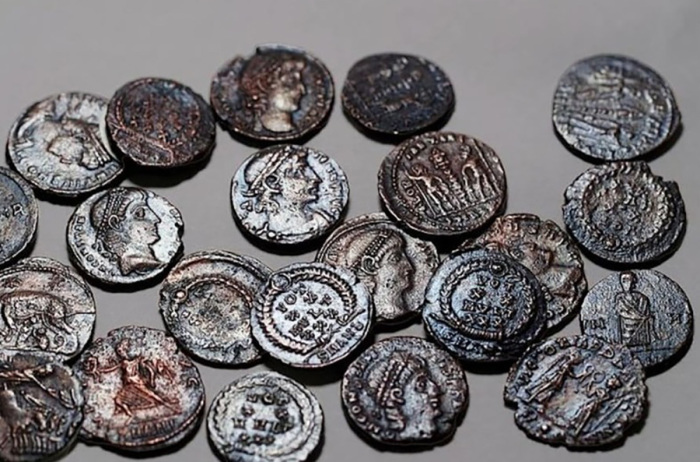
A groundbreaking discovery in northern Israel has brought to light one of the least-documented Jewish uprisings against Roman rule. Archaeologists from the Israel Antiquities Authority (IAA) and Zefat Academic College have uncovered a hoard of 22 bronze coins, dating back over 1,600 years, in the ancient settlement of Hukok in the Lower Galilee. This find offers a rare glimpse into a significant but under-recorded period of history.
The treasure was found stashed in a small crevice deep within an underground hiding complex. This network of tunnels and chambers was originally carved during the Great Revolt (66–70 CE) and later adapted for the Bar-Kochba Revolt (132–136 CE). However, what surprised the researchers was that the coins belonged to a much later conflict — the Gallus Revolt of 351–352 CE, the last Jewish rebellion under Roman rule.
“It seems that the people who stashed this hoard carefully planned its hiding place, hoping to return to it when the threatening troubles were over,” said archaeologist Uri Berger of the IAA and professor Yinon Shivtiel of Zefat Academic College. “The coins were discovered in a pit, deliberately dug at the end of a narrow winding tunnel.”
The hoard includes coins bearing the visages of Roman emperors Constantius II and Constans I, who ruled during the mid-fourth century CE. According to Berger and Shivtiel, this rare evidence confirms that the Hukok tunnels — originally dug centuries earlier — were reused in times of later crisis. “The hoard provides — in all probability, unique evidence that this hiding complex was used in one way or another during another crisis — during the Gallus Revolt — a rebellion for which we have only scant historical evidence of its existence,” they noted.
A Complex of Survival and Resilience
The hiding complex at Hukok is one of the most elaborate in the Galilee, featuring narrow passageways, chambers, and escape routes. Excavations between 2019 and 2023 were carried out as part of a broad educational initiative that brought together students, volunteers, and local residents.
“Fortunately, it was the many volunteers excavating the hiding complex who actually uncovered this important treasure, and they enjoyed this great moment of joy and excitement of discovery,” said Dr. Einat Ambar-Armon, director of the IAA’s Community Archaeological Educational Center in the Northern Region. “The excavation thus became not only an important scientific event, but also a significant communal educational experience — one that brings the public closer to its heritage, and strengthens the sense of belonging and the connection to the past.”
Sharing the Discovery with the World
The discovery will be formally presented this week at the “Between Josephus and Eusebius” conference at Kinneret Academic College. A first scientific publication will appear in the Israel Numismatic Society’s journal Israel Numismatic Research.
For the IAA, the Hukok site has become a flagship project. “The Israel Antiquities Authority considers the Hukok site, considering all its discoveries, as a flagship project, which will be a magnet for tourists from Israel and the world,” said IAA Director Eli Escusido.
Keren Kayemet LeYisrael–Jewish National Fund (KKL-JNF), which partners in the project, is now developing plans to open Hukok to the public. “The Hukok site is a model for the successful integration of nature, tourism and archaeology,” said Sheli Ben Iishai, director of KKL-JNF’s Northern Region.
A Legacy of Resilience
Though the Gallus Revolt ended in tragedy, the settlement of Hukok would later flourish, capped by the construction of a magnificent synagogue adorned with mosaics — a testament to resilience after centuries of turmoil.
This discovery not only enriches our understanding of ancient Jewish resistance movements but also highlights the enduring connection between the past and present. Through collaborative efforts and community involvement, the Hukok site continues to serve as a powerful reminder of history’s impact on identity and culture.

Post a Comment for "Hidden Jewish treasure found in Galilee unveils revolt against Rome"
Post a Comment