Winnie’s Wagon Brings Science to Shelters and Sidewalks
A Mobile Classroom for Students in Need
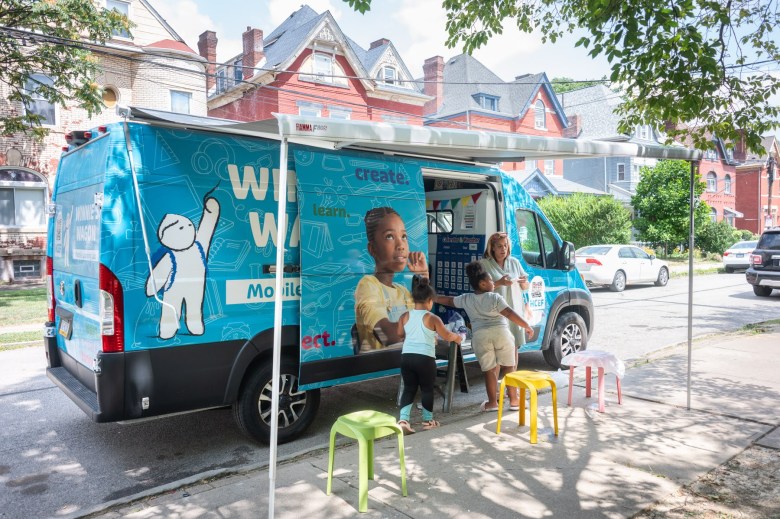
On a bright Thursday afternoon in May, students Khloe, Hailey, and Faith gathered outside a Sojourner House transitional housing building, filled with excitement. A bright blue van pulled up to the curb, its bold white lettering reading “Winnie’s Wagon.” The students rushed toward it, shouting, “We’re making a volcano!”
Instructors Renna Brown and Kaitlyn Nykwest extended an awning from the top of the van and set out stools, turning the sidewalk into a pop-up classroom. This was the third STEAM education workshop hosted by the Homeless Children’s Education Fund (HCEF) initiative, Winnie’s Wagon, since its launch in 2023 as the nation’s first mobile classroom.
The van originated from HCEF’s mobile learning program, which provides free and hands-on tutoring to K-8 students experiencing homelessness. Brown, HCEF’s STEAM mobile learning coordinator, distributed cups filled with sand to each student and guided them through a fun science experiment. Their goal was to determine which type of vinegar would cause a bigger reaction by building a mini volcano in a cup.
She asked the students to sprinkle baking soda on top of the sand and then pour a glass of white vinegar on top. Instantly, a frothy eruption bubbled over the edges. “Woah, that’s crazy!” said ten-year-old Khloe. “How does it feel like? How is the cup from the outside?” Brown asked, prompting the students to touch and explore the reaction.
“It’s hot!” said six-year-old Hailey. “It feels like a soft pear,” she added, digging her fingers into the foamy mixture. “When you touch it, it’s warm,” said Brown. “That’s how you know it’s a chemical reaction.”
Brown uses the mobile classroom to experiment with everyday household items and make science more inclusive and understandable. Over the past few weeks, Hailey, Khloe, and Faith have enjoyed making volcanoes, smoothies, and tie-dye shirts — all in the name of science.
“That’s the benefit of a mobile classroom,” Brown said. “Students first immerse within an environment that looks like a classroom, but it is able to travel anywhere.”
Addressing the Needs of Unstable Housing
Nykwest, senior director of programs at HCEF, explained that the program is aimed at students experiencing housing instability, especially those who live outside of shelters. The mobile learning program began in early 2021 when HCEF staff started delivering supplies to students who lacked transportation to pick them up from schools. From there, it evolved to offering tutoring services directly to students at their homes.
A recent report by the state Department of Education’s Education for Children and Youth Experiencing Homelessness revealed a 17% increase in the number of students experiencing homelessness in Allegheny County from the previous year. More than half of the county’s unhoused students were chronically absent from school, resulting in learning loss due to missed classes. Of the total students experiencing homelessness, 70% were doubled up in shared housing situations, and only 18% were living in shelters or transitional housing.
The mobile learning program works to bridge the learning gaps that affect students transitioning between temporary living situations. “When you’re dealing with some of the challenges that our students and families are facing, it’s easy to get intimidated if you miss a few days of school here and there and it starts to build up,” Nykwest said.
Winnie’s Wagon travels across the Pittsburgh region, offering personalized tutoring services by meeting students where they are. It also stops at shelters to deliver STEM and STEAM workshops. So far this year, the mobile learning program has tutored 130 students.
Personalized Learning in Action
After finishing up at the Sojourner building in Squirrel Hill, Nykwest drove Winnie’s Wagon to West Mifflin to meet Ada Quinones, whose three children had a weekly mobile learning tutoring session. As the Wagon pulled into the parking lot by the house, tutor Madeline Phillips and volunteer Shirley Gibson walked up with the students — Pedro, Reinalee, and Angelee. It was the children’s first tutoring session inside Winnie’s Wagon.
Inside, the van had been transformed into a cozy, vibrant classroom. A small table and stools formed a workspace, with a cushioned bench running along the side. Another shelved wall is stacked with a colorful library of books, games, and toys. The Wagon also keeps snacks and stationery supplies, along with tech tools such as Wi-Fi, a 3D printer, and tablets for the students to use.
Quinones has used HCEF services since 2021, when she was living in a shelter. The organization continued supporting the family after she moved into her current house in West Mifflin by providing math, tutoring, and reading support to her kids. Without that, keeping her kids on track with school would have been challenging, Quinones said. “They make them read. Some of them don’t like to read, so they have to read. … which is good, because in school, they’re going to do more than that.”
Phillips kicked off the class with a creative writing prompt: “A strange spaceship has crashed in your backyard. What would you do?” Eight-year-old Reinalee wrote about aliens emerging from the spaceship and attacking her family. She loves reading and picked out a book about elephants while snacking on applesauce.
Her brother, Pedro, 10, wasn’t interested in writing that day. Instead, he sat cross-legged on the floor playing a game of Connect 4. Thirteen-year-old Angelee curled up on the cushioned bench with Gibson, wrapped in a blue blanket. Her story involved fixing the spaceship and then breaking it again. She is passionate about drawing cats, humans, and roses and is currently learning Spanish. She wants to be a teacher when she grows up.

Post a Comment for "Winnie’s Wagon Brings Science to Shelters and Sidewalks"
Post a Comment