We'll See You in Court: L.A. County Targets ICE Agent Identity Concealment
A Step Toward Transparency in Immigration Enforcement
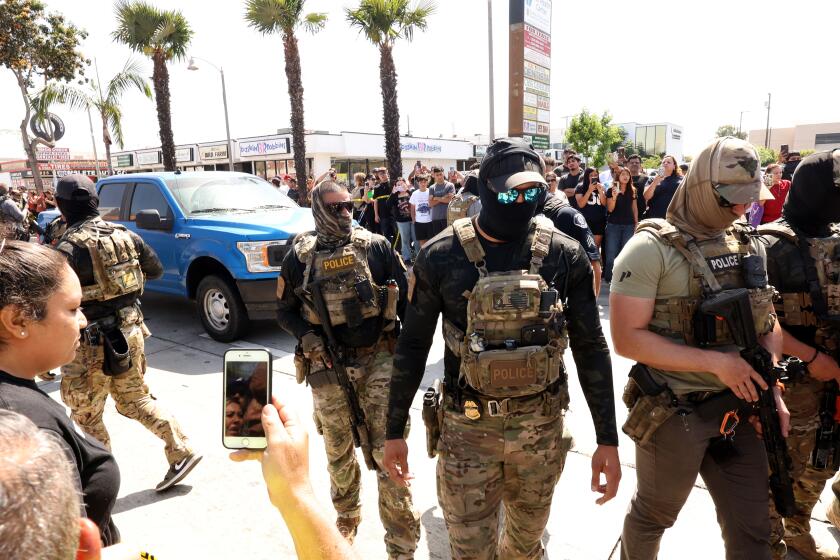
Los Angeles County took a significant step on Tuesday toward restricting immigration officers from concealing their identities using neck gaiters, masks, or other face coverings. However, the effectiveness of such a measure remains uncertain, as it may not be enforceable against federal agents.
County supervisors voted unanimously (4-0) to direct county attorneys to draft a rule that would prohibit all law enforcement officers — including local sheriff deputies and federal immigration agents — from disguising their identity while working in unincorporated areas of the county. This move comes in response to growing concerns about the use of face coverings during immigration raids, which have become increasingly common since June.
The Problem with Hidden Identities
The issue has been highlighted by numerous incidents where armed federal agents have used face coverings to conceal their identities during raids. These operations often involve agents exiting unmarked vans and apprehending individuals in public spaces such as street corners, car washes, and parking lots. In many cases, the agents refuse to identify themselves as part of federal immigration enforcement, according to video evidence captured during these events.
Supervisor Janice Hahn, who led the initiative, described the situation as deeply troubling. “Being forcibly detained by a federal officer in the middle of the day is scary enough,” she said. “Having it done by someone wearing a face mask or balaclava whose name and badge are completely covered up is even more disturbing.”
Federal Officials’ Response
Federal officials, however, have pushed back against the proposed rule. Tricia McLaughlin, an assistant secretary at the Department of Homeland Security, argued that agents need to wear masks to protect themselves from being doxed or targeted. She stated that ICE and ERO officers typically identify themselves verbally, wear vests that display their agency, and are accompanied by marked vehicles.
Despite this, county supervisors remain unconvinced. Supervisor Hilda Solis, who co-authored the motion, called the practice an “unreasonable search and seizure” and emphasized that it violates constitutional and civil rights.
Challenges in Enforcement
The potential impact of the motion is still unclear. While county attorneys will have two months to draft the law, it would only apply to law enforcement operating in unincorporated areas, where the county has sole government authority. Sheriff deputies are already required to clearly identify themselves in most situations, and Sheriff Robert Luna has emphasized the importance of visibility through patches, badges, and name plates.
Hahn also suggested that the mask ban should include exceptions for face coverings necessary for specific duties, such as gas masks, medical masks, or undercover disguises. However, the sheriff’s department did not respond to a request for comment on the motion.
Union Concerns and Legal Implications
The Association for Los Angeles Deputy Sheriffs, which represents sheriff deputies, has expressed concerns about the potential impact of the mask ban. Thomas Ferguson, vice president of the deputy union, noted the irony of the situation, pointing out that the same board of supervisors that once mandated mask-wearing during the pandemic now seeks to restrict it.
Legal experts, including UC Davis School of Law professor Kevin Johnson, argue that the county cannot legally require federal immigration agents to remove their masks. Johnson stated that federal supremacy principles give the federal government the authority to regulate its own officers.
Dawyn Harrison, the county’s top lawyer, warned that the proposed law could be challenged under the Constitution’s supremacy clause, which establishes federal law as the supreme law of the land. She acknowledged that the county might face legal battles if the law is enacted.
Broader Legislative Efforts
This motion is part of a broader effort by local legislators to exert influence over federal agents. State Senator Sasha Renée Pérez introduced a bill requiring all law enforcement, unless undercover, to wear a name tag or badge number. Another bill, sponsored by state Senators Scott Wiener and Jesse Arreguín, seeks to ban law enforcement from wearing face coverings.
Some California Democrats in Congress are also supporting legislation aimed at preventing federal officials from covering their faces during raids.
Ongoing Debate
Supervisor Kathryn Barger, who abstained from the vote, questioned the practicality of the motion, noting that it could lead to legal challenges and potentially give residents a false sense of security. However, she supported the intent behind the measure, emphasizing the need for transparency and accountability.
Barger also pointed out that there have been instances of individuals impersonating immigration agents, highlighting the risks faced by residents who may be hesitant to seek help from law enforcement. She cited an example where the Huntington Park Police Department arrested a man suspected of posing as a federal agent.
As the debate continues, the outcome of this motion remains uncertain, but it reflects a growing demand for greater transparency and accountability in immigration enforcement.

Post a Comment for "We'll See You in Court: L.A. County Targets ICE Agent Identity Concealment"
Post a Comment