Voters View Democrats as More Corrupt Than Republicans Despite Trump's Scandals
The Paradox of Corruption Perceptions in Modern Politics
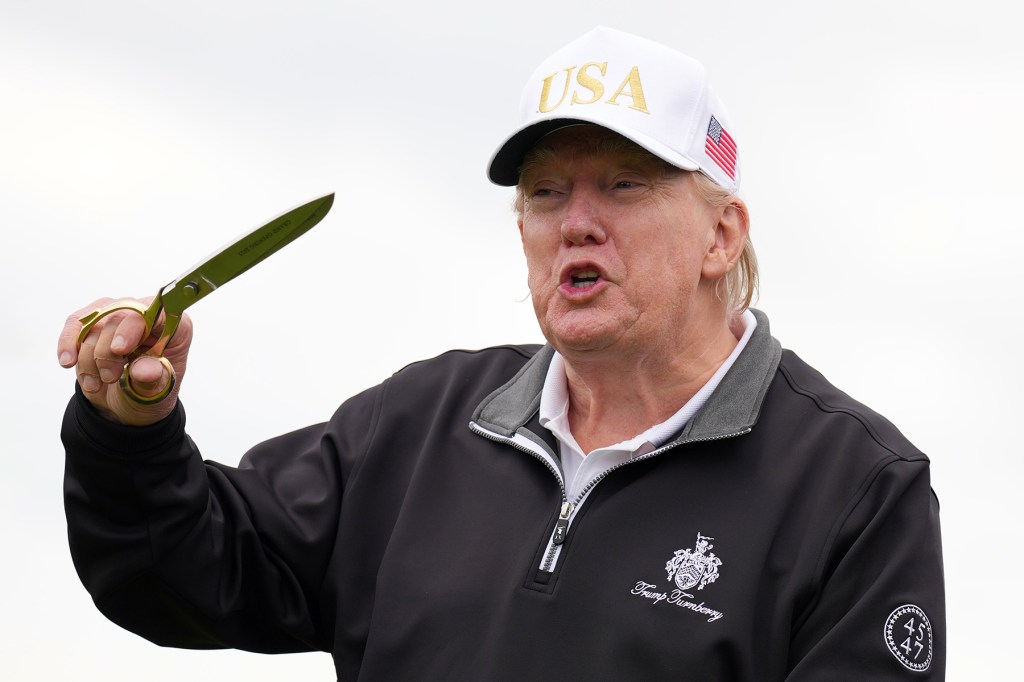
The recent "Grand Opening Ceremony" of Donald Trump’s Trump International Golf Links in Aberdeen, Scotland, was livestreamed by the White House on X. This event has sparked renewed debate about the intersection of public office and personal gain, as it appears that U.S. taxpayers are once again footing the bill for a private venture. This is just one example of a long-standing pattern where Trump has leveraged his position for financial benefit, raising questions about the ethical boundaries of presidential conduct.
Despite the widespread awareness of such actions, including the use of presidential meme coins and library fund shakedowns, voters in key congressional districts continue to perceive Democrats as more corrupt than Republicans. This perception is highlighted by a new survey conducted by Impact Research, a prominent Democratic pollster known for its work with major Democratic campaigns and organizations.
The survey, commissioned by the liberal watchdog End Citizens United and shared exclusively with Rolling Stone, reveals a striking finding: voters in these critical districts view the Democratic Party as more corrupt than the Republican Party. This data challenges conventional assumptions and raises important questions about how corruption is perceived and prioritized in the current political climate.
The poll, conducted over six days from late June to early July, asked voters about their views on political corruption, including its importance to Congress and which party they believe is more corrupt. A majority of respondents considered corruption a significant issue, with 53% labeling it a "very big priority" and an additional 36% considering it at least a "somewhat big priority."
When asked which party they believed was more corrupt, 49% of voters identified the Democratic Party, while 44% pointed to the Republican Party. Only 7% said both or neither were corrupt. These findings suggest a complex landscape of voter perceptions, where trust in either party remains low.
On issues such as "Standing up to special interests," "Taking on government corruption," "Bringing needed change to Washington," and "Working to fix a broken system," Republicans outperformed Democrats in every category. Notably, at least a quarter of voters did not find either party trustworthy on these four issues.
This dynamic could pose a challenge for Democrats as they aim to regain control of the House and Senate in the upcoming elections. Tiffany Muller, president of End Citizens United, emphasizes the importance of messaging around corruption. She notes that historically, the party that wins the "messaging battle" on who is most trusted to address corruption often wins the election. Muller suggests that this trend may repeat itself in 2026.
Cracking down on self-enrichment, such as banning members of Congress from trading stocks and prohibiting individuals connected to high-ranking officials from accepting gifts from foreign governments, was seen as a top priority by 49% of voters polled. Yet, despite the glaring examples of corruption involving Trump, such as accepting a $400 million luxury jet from Qatar and using funds from a Pentagon slush fund, he still maintains a relatively favorable rating on corruption in the surveyed districts.
Muller explains that voters credit Trump for changing a system they feel is broken, even if they do not agree with all of his actions. His consistent messaging around taking on corruption and draining the swamp has maintained some credibility among voters, despite his personal financial gains.
For Democrats, the lesson is clear: they must engage in the conversation about corruption to avoid being overshadowed by Republicans. As Muller states, "We cannot afford to let Republicans be the only ones talking about corruption." The ability to effectively communicate their stance on corruption will be crucial for Democrats as they seek to win back the House in 2026.
In conclusion, the current political landscape is marked by a paradox where perceptions of corruption are deeply influenced by messaging and public sentiment. As the 2026 elections approach, the narrative around corruption will play a pivotal role in shaping voter decisions and determining the future of American politics.

Post a Comment for "Voters View Democrats as More Corrupt Than Republicans Despite Trump's Scandals"
Post a Comment