Unveiling Hidden Faults Solves 'Slow Earthquake' Riddle
Understanding the Mystery of Slow Earthquakes
Scientists have made a groundbreaking discovery that sheds light on the enigmatic phenomenon of "slow earthquakes" occurring off the east coast of New Zealand's North Island. This new research, published in Science Advances, offers critical insights into the geological processes that influence these unusual seismic events.
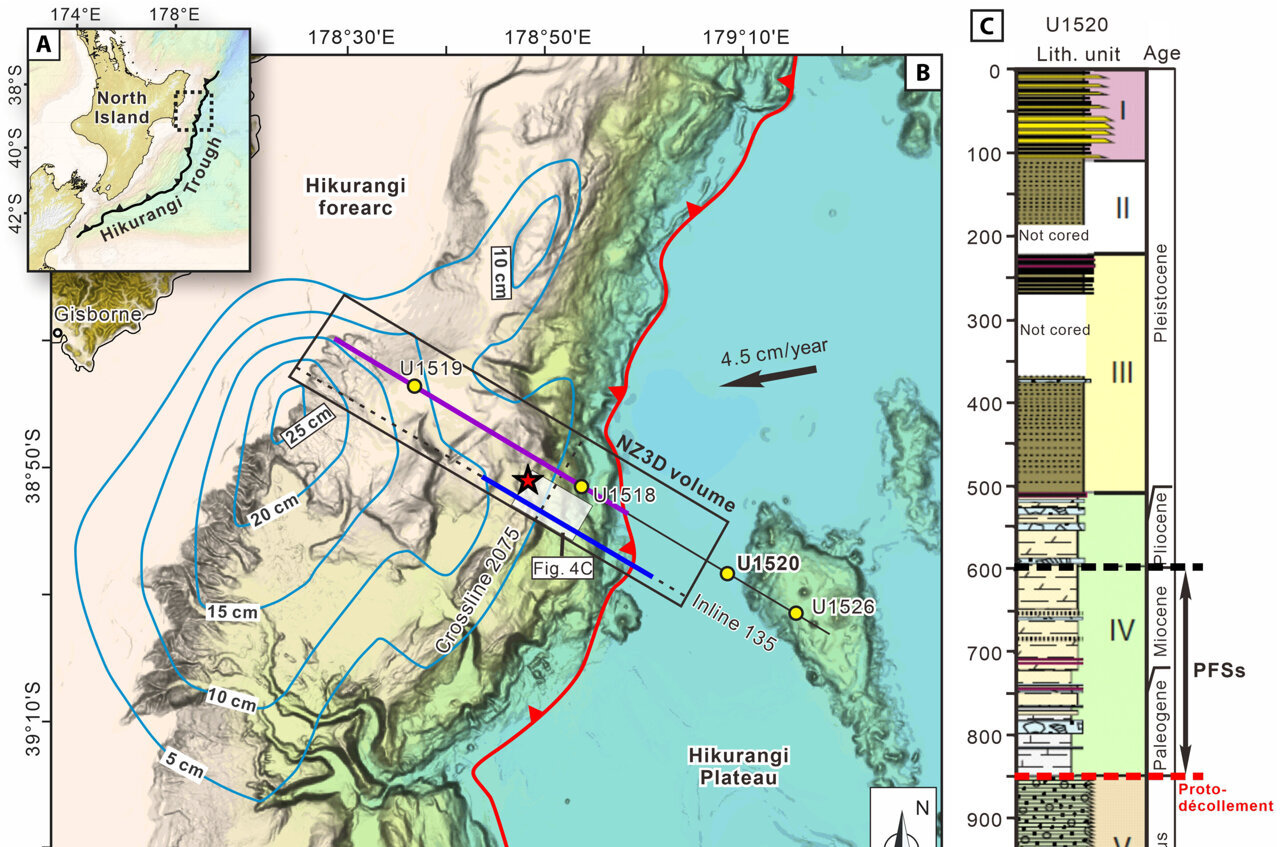
The study identifies hidden fault structures known as polygonal fault systems (PFSs) as a key factor in the behavior of the northern Hikurangi subduction zone. These shallow geological features, found within sediments entering the subduction zone, play a vital role in determining where and how slow slip earthquakes occur.
Dr. Philip Barnes, a marine geologist at Earth Sciences New Zealand and co-author of the study, explains that this discovery helps explain why slow earthquakes occur in specific locations. He adds that these events may be influenced by the reactivation of old fault structures that formed much closer to the surface than the current depths of the subduction zone.
The Hikurangi Subduction Zone
In the Hikurangi subduction zone, the Pacific Plate is moving beneath the Australian Plate. While the southern section of this zone remains locked and capable of producing large earthquakes with magnitudes over 8, the northern part behaves differently. It regularly experiences slow slip events—movements that unfold over days to months, releasing tectonic stress without causing sudden shaking.
Although slow slip events do not cause violent shaking themselves, they can increase stress on nearby faults and potentially trigger more damaging earthquakes. Understanding what controls these events is essential for improving earthquake and tsunami warnings.
International Collaboration and Advanced Techniques
This international study was a collaboration between researchers from China, the United States, and Earth Sciences New Zealand. They used data from the International Ocean Discovery Program and the high-resolution three-dimensional NZ3D seismic survey conducted off Gisborne.
By employing high-resolution 3D seismic imaging, deep-sea drilling data, and advanced computer modeling, the research team mapped PFSs in unprecedented detail and evaluated their role in the subduction zone. These faults form over millions of years during sedimentation, long before and initially away from the subduction zone. However, as the seafloor is dragged into the subduction zone during the convergence of tectonic plates, they can be reactivated and evolve into major thrust faults.
The analysis also shows that these fault systems provide important pathways for fluids, which play a significant role in fault slip. This connection between fault structure and fluid migration offers new insight into one of the key processes thought to trigger slow earthquakes.
Complex Structures and Their Impact
The study confirms that these fault systems create a complex and variable structure along the megathrust, which can influence stress patterns and strain distribution. Dr. Barnes notes that until now, researchers lacked the imaging resolution to directly link these features to slow slip behavior. This study changes that, providing a new lens to better understand subduction zone dynamics.
Maomao Wang, the lead author of the study and a marine geologist at Hohai University in China, highlights that while scientists first identified PFSs at subduction zones 20 years ago off the southwest coast of Japan, they couldn't determine how these complex structures influenced subduction and seismic slip. It wasn't until analyzing beautiful 3D seismic images that the team confirmed their widespread presence along New Zealand's north Hikurangi margin, revealing their potential role in shaping slow earthquakes.
Global Implications
The findings may have broader implications beyond New Zealand. Similar fault systems have been observed in subduction zones around the world, including Japan's Nankai Trough. By highlighting the mechanical and hydrological effects of PFSs, the study adds a missing piece to the global understanding of how slow earthquakes work.
Dr. Barnes emphasizes that this is a major step forward in understanding the geological processes happening beneath our coastlines. With better models and data, scientists are now in a stronger position to assess risk and improve resilience across New Zealand.
For more information, refer to the study titled "Effects of incoming polygonal fault systems on subduction zone and slow slip behavior" published in Science Advances (2025). The study's DOI is 10.1126/sciadv.adu4227.

Post a Comment for "Unveiling Hidden Faults Solves 'Slow Earthquake' Riddle"
Post a Comment