Tsunami Warnings Issued for Alaska and West Coast After Massive 8.8 Quake Near Russia
Major Earthquake Triggers Widespread Tsunami Alerts
A powerful earthquake with a magnitude of 8.8 struck off the coast of Russia’s Kamchatka Peninsula on July 29, sending shockwaves across the Pacific and prompting widespread tsunami alerts. The U.S. Geological Survey (USGS) reported that the quake occurred at 7:24 p.m. ET, approximately 78 miles east-southeast of Petropavlovsk-Kamchatsky, Russia. The event was shallow, occurring at a depth of about 12 miles, which contributed to its intensity.
Following the main quake, multiple aftershocks were recorded, ranging in magnitude from 5.2 to 6.9. These secondary tremors added to the concern for communities across the Pacific region.
Warnings Issued Across the Pacific
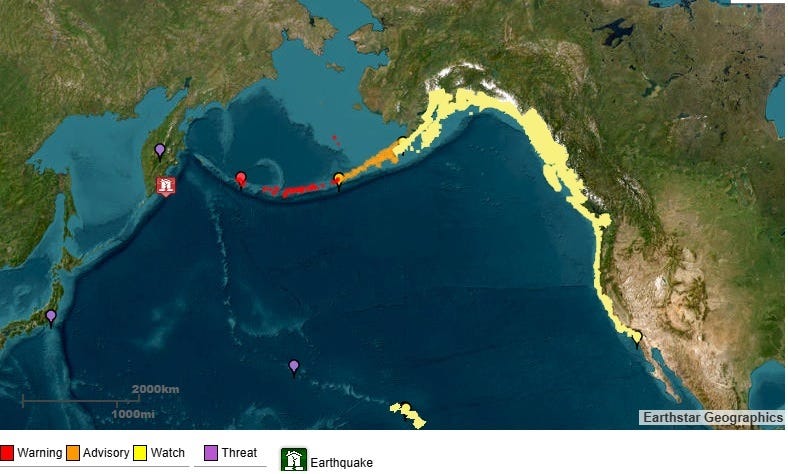
Tsunami warnings were issued for Hawaii and along Alaska’s Aleutian Islands. The National Weather Service warned that waves could cause damage along the coasts of all Hawaiian islands, emphasizing the need for urgent action to protect lives and property. Residents were advised to avoid coastal areas and stay informed through official channels.
In Alaska, the warning extended to remote regions, including the Aleutian Islands, where strong currents and waves could persist for up to 45 minutes. Authorities urged residents near the water to move inland and away from beaches, harbors, and marinas.
A tsunami watch was also issued for the U.S. West Coast, covering southern Alaska, British Columbia, Washington, Oregon, and California, including Los Angeles Harbor. This alert included inland areas along the Salish Sea, such as Port Angeles, Port Townsend, and Bellingham.
President's Message and Public Response
President Donald Trump took to social media to warn the public about the potential dangers. He shared that a tsunami warning was in effect for Hawaii and a watch for the Pacific Coast, urging people to "stay strong and stay safe."
In Hawaii, the Department of Emergency Management estimated that the first tsunami wave would arrive at 7:17 p.m. local time. Coastal areas were evacuated, and officials urged immediate action to prevent loss of life.
Impact on Other Regions
The tsunami threat was not limited to the United States. In Alaska, the warning covered coastal areas from Attu to Samalga Pass, with expected wave arrival times varying by location. A buoy south-southwest of Attu detected a tsunami wave of 3 feet, though these measurements are typically smaller than what is experienced onshore.
In California, while tsunami heights were expected to be less than one foot, hazardous currents were still a concern. Officials advised residents to avoid beaches and harbors, citing past incidents where individuals were swept out to sea.
Estimated Tsunami Arrival Times
Tsunami activity was expected to begin at different times across the West Coast:
- Alaska: Kodiak at 8:20 p.m., Seward at 8:45 p.m., Sitka at 8:55 p.m., Homer at 9:40 p.m., and Craig at 9:55 p.m.
- British Columbia: Langara at 10:05 p.m. and Tofino at 11:30 p.m.
- Washington: La Push at 11:35 p.m., Port Angeles at 12:20 a.m., Port Townsend at 12:45 a.m., and Bellingham at 1:10 a.m.
- Oregon: Port Oxford at 11:40 p.m., Charleston at 11:45 p.m., Brookings at 11:50 p.m., Seaside at 11:55 p.m., and Newport at 11:55 p.m.
- California: Fort Bragg at 11:50 p.m., Monterey at 12:15 a.m., San Francisco at 12:40 a.m., Los Angeles Harbor at 1:05 a.m., and La Jolla at 1:15 a.m.
Global Impacts and Evacuations
Japan and other Pacific islands also faced significant threats. The Japan Weather Agency warned of tsunami waves up to 10 feet, prompting evacuations in some areas. In Guam, the weather service issued warnings of sea level fluctuations and strong ocean currents, advising residents to stay out of the water.
American Samoa also received a tsunami advisory, with hazardous conditions expected to begin at 9:39 p.m. local time.
Understanding Tsunami Alerts
The National Weather Service outlines four levels of tsunami alerts:
- Tsunami Warning: Immediate danger, with widespread flooding and powerful currents possible.
- Tsunami Advisory: Strong currents or waves that pose a risk to those near the water.
- Tsunami Watch: A distant earthquake has occurred, and a tsunami is possible.
- Tsunami Information Statement: No threat or minimal threat, with no need for immediate action.
Tracking Tsunamis with Technology
The National Oceanic and Atmospheric Administration (NOAA) uses a real-time monitoring system called DART (Deep-ocean Assessment and Reporting of Tsunamis) to track tsunamis. These buoys provide critical data on sea level changes, helping forecasters issue accurate warnings.
Despite the importance of this technology, the Pacific Marine Environmental Laboratory, which manages the DART system, faces potential budget cuts that could impact future operations.
Conclusion
The magnitude 8.8 earthquake off Russia’s Kamchatka Peninsula served as a stark reminder of the power of natural disasters. From Hawaii to Alaska, the response involved coordinated efforts by government agencies, emergency management teams, and the public to ensure safety. As the world continues to monitor the situation, the importance of early warning systems and community preparedness remains evident.

Post a Comment for "Tsunami Warnings Issued for Alaska and West Coast After Massive 8.8 Quake Near Russia"
Post a Comment