Trump Secures Major EU Trade Victory Amid Epstein Scandal Fallout
A Major Trade Deal and Persistent Controversies
President Donald Trump has claimed another victory in his campaign to reshape the global economy and American life, but he continues to face intense scrutiny over his handling of the Jeffrey Epstein controversy. The United States reached a framework deal with the European Union on Sunday, avoiding a damaging trade war. Trump believes such moves will revive U.S. manufacturing, but the 15% tariff on EU goods entering the U.S. is likely to lead to higher prices for American consumers in the long term.
This agreement marks a significant step forward, and Trump’s insistence that it was not merely a distraction from the Epstein saga seems reasonable. However, his frustration during an interview with a reporter highlighted his struggle to move past weeks of revelations about the case and his own past friendship with Epstein, who died in prison in 2019 while awaiting trial.
Mystery surrounds the administration's motives after Deputy Attorney General Todd Blanche, Trump’s former personal lawyer, met last week with Ghislaine Maxwell, Epstein’s imprisoned accomplice. Her lawyer suggested that Maxwell was open to a presidential pardon. Critics warn that Trump may be seeking a deal that could politicize justice, given his history of using pardons for political purposes.
The domestic storm shows no signs of abating. Two lawmakers, one Democrat and one Republican, vowed to force a vote on the House floor to release Epstein case files. Such a vote could embarrass the administration and create a major political showdown.
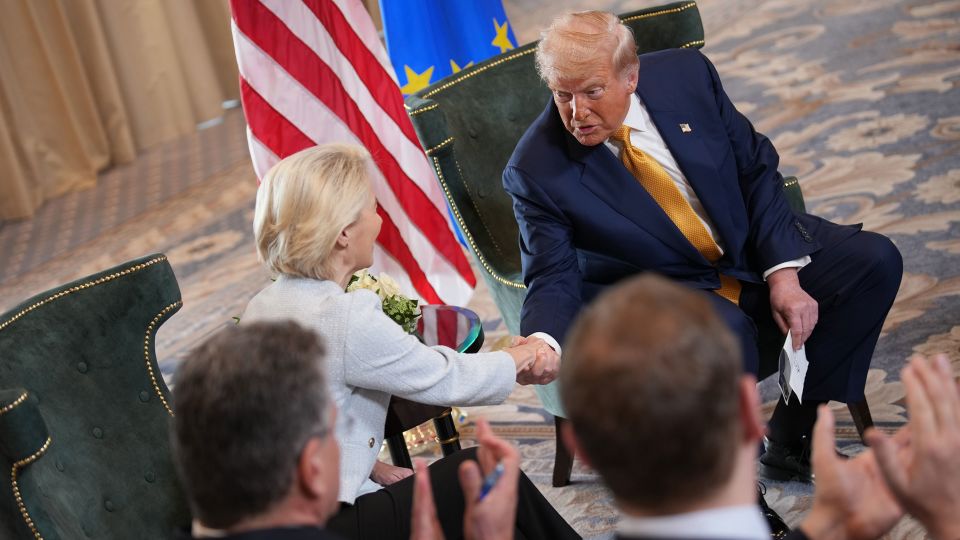
Trump spent a typically hectic weekend in Scotland, which served as a metaphor for his turbulent influence on America and the globe. He juggled high-level diplomacy — talks with the EU’s top official, Ursula von der Leyen — with promoting his business empire, specifically his portfolio of exclusive Scottish golf clubs. His visit was met with street protests by angry Scots and featured outbursts of extreme rhetoric, including a social media call for the prosecution of former Vice President Kamala Harris.
Trump will face pressure to push Israel to do more to address the growing famine in Gaza. He will meet British Prime Minister Keir Starmer at his Turnberry resort in southwest Scotland before traveling with Starmer to Aberdeenshire, where Trump will inaugurate a new course at another club. Starmer described the crisis in Gaza as “a humanitarian catastrophe.”
A Significant Trade Deal with Many Caveats
Much remains unknown about the scope of the trade deal with the EU, which will see a 15% tariff imposed on most of the bloc’s exports and billions of dollars in purchases of U.S. energy. This deal extends Trump’s winning streak and record of implementing campaign promises, reflecting his personal power and often idiosyncratic beliefs, such as the effectiveness of trade tariffs.
“This was the big one. This is the biggest of them all,” Trump said after meeting von der Leyen, the president of the European Commission. Von der Leyen praised Trump as a tough negotiator and a dealmaker.
Trump has recently announced framework deals on trade with Japan and the Philippines, both including higher tariffs that represent a shift away from 21st-century global free-trade arrangements. Trump believes this system, which helped make the U.S. a dominant global power, is unfair to American workers and industries. He rejects economists’ arguments that raising tariffs increases prices for already-stretched U.S. consumers.
Trump is flexing power everywhere. He is gutting the federal government, dominating Congress, and exerting unprecedented pressure on law firms and universities to impose his right-wing ideology, all while seeking to intimidate media outlets. These actions are seen as wins for his populist “Make America Great Again” movement and its program to challenge what supporters view as liberal power.
However, critics are alarmed by the long-term impacts of his actions on American society, the economy, and democracy. Trump has politicized the legal system; his government funding cuts have hampered vital scientific research on critical subjects like cancer; and his expanding presidential power often tests the Constitution.
Despite these concerns, markets may welcome the EU trade deal framework, assuming it is fully implemented. An EU-U.S. trade war would have been a far worse outcome. But the agreement confirms suspicions that Trump’s goal is not fairer trade but higher tariffs.
Although existing tariffs have not yet harmed the economy as much as some experts feared, Americans will pay more for cars, food, luxuries, and consumer goods. The inflationary impact on the economy, combined with Trump’s likely appointment next year of a new Federal Reserve chair who will lower interest rates, could mean greater economic threats ahead.
There is also an important geopolitical aspect to the EU trade deal. The Europeans committed to buying $880 billion of energy from the U.S., which could make America’s NATO allies less vulnerable to pressure from Russia at a time when the Western alliance is opposing Moscow’s invasion of Ukraine.
The Epstein Drama and Political Fallout
The Epstein drama continues to haunt Trump’s Scottish golf trip. His frustration that a key political achievement has been overshadowed by the Epstein saga is unlikely to dissipate soon. The controversy started because of conspiracy theories among Trump’s base, claiming that Epstein did not take his own life in prison but was murdered, and that he left behind a client list of rich and powerful Americans who’d taken advantage of his alleged sex trafficking.
These claims were promoted by Trump and allies like Pam Bondi and Kash Patel. When all three assumed positions of great power (Bondi is attorney general, and Patel is FBI director), their failure to release the files as promised caused a rupture in Trump’s MAGA base, which the administration has failed to repair so far.
The political uproar explains why Blanche’s meeting with Maxwell last week caused such consternation. Maxwell’s lawyer stated that she had answered every question truthfully and honestly. He also noted that the president has the power to pardon those convicted of crimes. “We hope he exercises that power in a right and just way,” the attorney said.
Blanche has not offered a detailed public account of the meetings. There is no evidence of wrongdoing by Trump in his relationship with Epstein, and the president appears to have severed the friendship long before the accused sex trafficker was charged with federal crimes. However, the Justice Department’s unorthodox approach is raising concerns that it goes beyond a public relations effort to convince MAGA voters the administration is doing something.
Maxwell, who is serving a 20-year prison term, has an incentive for providing information that could ease her situation — and Trump has the power to do so. Questions over the president’s motives became even more important when outlets reported that Trump’s name was mentioned in the Epstein files, along with those of some other prominent Americans.
This does not mean that he or anyone else is guilty of wrongdoing. In fact, Bondi might have made the correct decision legally in refusing to release information that could harm the reputation of people not accused of crimes. But beyond a joint Justice Department and FBI statement on the rationale for not releasing the files, the administration has rarely attempted to justify a policy that has put it at odds with its own supporters in the MAGA movement.
Democratic Rep. Ro Khanna of California expressed concern that the deputy attorney general is meeting with Maxwell. Republican leaders hoped the case might simply disappear over the summer recess. But Kentucky GOP Rep. Thomas Massie, a co-sponsor with Khanna of a House bill demanding the release of the files, isn’t giving up.
“I think this is going to hurt Republicans in the midterms. The voters will be apathetic if we don’t hold the rich and powerful accountable,” Massie said. “I think when we get back, we can get the signatures required to force this to the floor.”
The Trump administration has asked the courts to release grand jury testimony pertinent to the Epstein case. But one federal judge refused last week, in a ruling that may have given the DOJ political cover. Oklahoma GOP Sen. Markwayne Mullin acknowledged that the administration cannot force the release of the files due to separation of power.
That may be the case, but grand jury testimony is believed to be only a fraction of the evidence against Epstein that the government holds — and hasn’t made public. And the entire controversy has been worsened by the administration’s clumsy approach and unwillingness to confront the anger of the MAGA base.
“I think part of this problem is that there were some false expectations that are created, and that’s a political mistake,” Missouri Republican Rep. Eric Burlison said.

Post a Comment for "Trump Secures Major EU Trade Victory Amid Epstein Scandal Fallout"
Post a Comment