Trump: Israel Must Decide on Gaza War as Starvation Images Shock
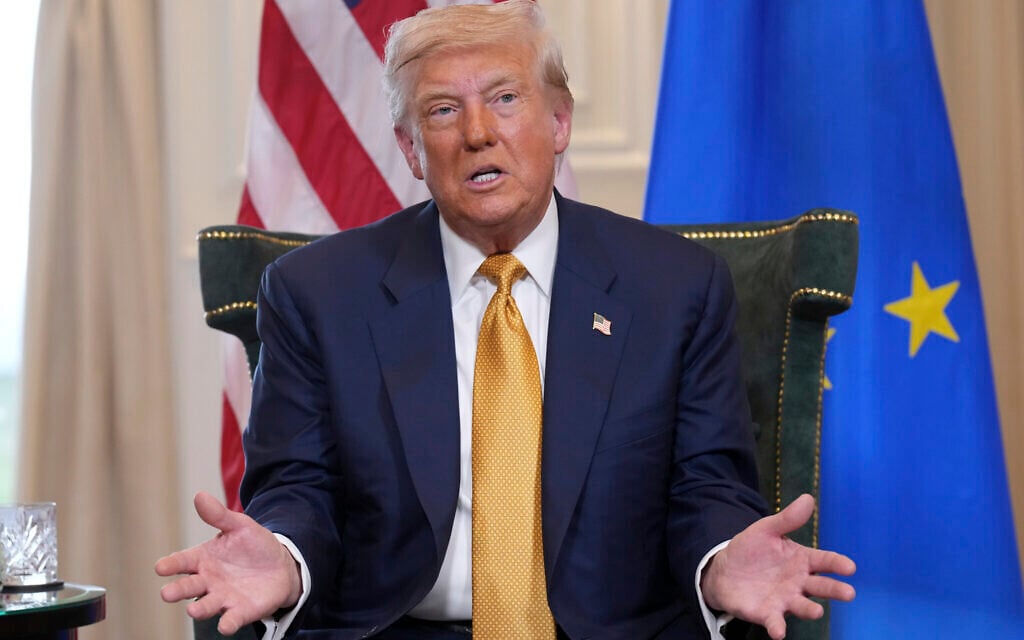
U.S. President Trump's Comments on Gaza and the Aid Crisis
U.S. President Donald Trump made a notable statement on Sunday regarding the situation in Gaza, emphasizing that "Israel will have to make a decision." This came as Israeli Prime Minister Benjamin Netanyahu denied any involvement in the widespread aid shortages affecting the region. Trump, who was on a four-day visit to Scotland, was asked about the distressing images of starving children emerging from Gaza. He described these images as "terrible" but quickly shifted focus, claiming that "they’re stealing the food," without specifying who he meant. It is likely that he was referring to Hamas, which Israel has accused of misappropriating aid for its own benefit.
Trump expressed frustration over the U.S. contribution of $60 million to the Gaza Humanitarian Foundation (GHF), which now oversees aid distribution in the Strip. He noted that no other country had contributed anything, stating, "It makes you feel a little bad when you do that and, you know, you have other countries not giving anything." He added that it would be nice to receive at least a thank you from other nations. The president emphasized that the U.S. provides a significant amount of money, food, and resources, suggesting that without this support, people in Gaza would have starved.
However, the actual figure given by the U.S. to the GHF is $30 million, and the U.S. is not the only country providing humanitarian aid. In fact, the United Arab Emirates has provided a larger percentage of assistance. Netanyahu responded to the claims of starvation in Gaza, insisting that if not for his policies, Gazans would have starved long ago. He stated that Israel has enabled the required amount of aid under international law, amounting to 1.9 million tons since the war began in October 2023.
Netanyahu also defended recent changes to the aid system in Gaza, including the first-ever Israeli aid drops. He explained that these changes were made after some agencies and the United Nations failed to deliver aid behind combat zones despite the existence of safe corridors. He claimed that there have always been safe routes for UN convoys and criticized the UN for making excuses. Netanyahu further blamed Hamas for intercepting supplies and falsely accusing Israel of not providing aid.
During a Christian conference in Jerusalem hosted by Trump adviser Paula White, Netanyahu thanked evangelical Zionists for their support against what he called false allegations surrounding the war in Gaza. He warned that the Israeli-Christian alliance faces challenges from Islamist fundamentalism, which seeks to subjugate Muslims and erase Western presence in the Middle East.
Despite Netanyahu’s claims, Israel has not always allowed aid into Gaza. Between March and May of this year, the country imposed a total blockade on the territory, barring all aid. Even after resuming aid, the quantities were significantly lower, with much of the aid distributed by the controversial GHF, leading to international backlash over reports of aid-seekers being shot dead.
IDF Spokesman Brig. Gen. Effie Defrin reiterated that Israel has not subjected the Palestinian population in Gaza to starvation. He claimed that Israel cares more about Gazan civilians than Hamas does, stating that Hamas is stealing aid and sabotaging aid distribution sites. He insisted that the photos emerging from Gaza are part of a false campaign and that there is no deliberate starvation in the area.
Ceasefire Talks and Future Uncertainty
Trump also addressed the stalled ceasefire talks, expressing that "Israel will have to make a decision" regarding the war and the remaining 50 hostages held by Gaza’s terror groups. He suggested that he had predicted the breakdown in talks, believing that Hamas would not release the final hostages as they were its last bargaining chips.
Republican Senator Lindsey Graham took a more direct approach, suggesting that Israel would not be able to negotiate a satisfactory end to the war with Hamas. He implied that the U.S. might take control of the Strip, drawing parallels to the post-World War II occupation of Tokyo and Berlin.
Growing Pressure for Palestinian State Recognition
As Israel weighs its next steps in Gaza, pressure has mounted among European allies to recognize a Palestinian state. French President Emmanuel Macron announced plans to formally recognize a Palestinian state during a UN meeting in September. This move has put pressure on British Prime Minister Keir Starmer and German Chancellor Friedrich Merz, who have faced criticism for not taking similar steps.
Merz urged Netanyahu to do everything possible to bring about an immediate ceasefire and allow humanitarian aid to reach Gaza. He emphasized coordination with European partners, the U.S., and Arab states to improve the situation in the coming days.
The situation in Gaza remains complex and fraught with challenges, with ongoing debates about aid distribution, humanitarian crises, and political decisions shaping the future of the region.

Post a Comment for "Trump: Israel Must Decide on Gaza War as Starvation Images Shock"
Post a Comment