Top Conservative U.S. Court Tightens Voting Access for Disabled Individuals
Impact on Voting Rights for Disabled and Non-English Speakers
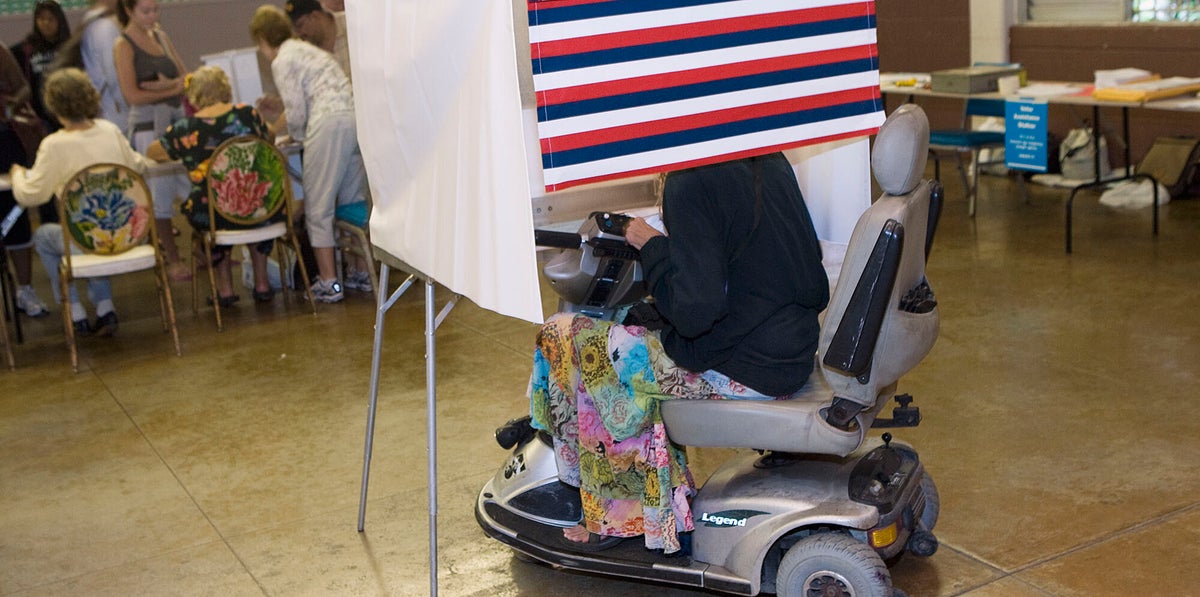
A recent federal appeals court ruling has significantly affected the voting rights of disabled individuals, blind voters, and non-English speakers. The decision by the Eighth Circuit Court of Appeals stated that only the Justice Department can initiate lawsuits under a key part of the Voting Rights Act, specifically Section 208. This section allows voters who need assistance due to blindness, disability, inability to read or write, or difficulty with English to bring someone into the voting booth to help them cast their ballot.
The court's interpretation was based on the idea that Section 208 does not provide a "private right of action," meaning individuals or private groups cannot sue over violations of this provision. The ruling was written by Judge Steve Grasz, a Trump appointee, who noted that the law is silent on who can enforce it.
This decision aligns with a controversial 2023 case involving the Arkansas State Conference NAACP. The group challenged the state’s redistricting plan, arguing that it created fewer majority-Black districts than necessary. They claimed this diluted Black voting power in violation of Section 2 of the Voting Rights Act, which prohibits discriminatory voting practices. However, the Eighth Circuit did not address this issue directly, stating that the NAACP lacked standing to sue because only the attorney general can enforce Section 2.
The Eighth Circuit’s rulings cover several states, including Arkansas, Iowa, North Dakota, South Dakota, Nebraska, Missouri, and Minnesota. These areas could see a significant impact on voters needing assistance at the polls. According to the U.S. Census Bureau, 18% of Arkansas's population has one or more disabilities, with many related to mobility, vision, or hearing issues. In Missouri, about 17% of the population has a disability, while in Iowa, roughly 12% are disabled. Similar rates exist across other states within the Eighth Circuit's jurisdiction.
Advocacy groups such as Disability Rights Nebraska report that around 11% of the state's population has a disability. These statistics highlight the potential consequences of the court's decision on a large number of voters.
The Justice Department has not yet commented on the ruling, but the decision is expected to face further legal challenges. It is likely to reach the Supreme Court, where it could be reviewed.
Just a week prior, the Supreme Court paused a similar ruling from the Eighth Circuit concerning a challenge to a legislative map by two Native American tribes, the Spirit Lake Tribe and the Turtle Mountain Band of Chippewa Indians. The tribes argued that a 2021 map inhibited their voting power, making it harder to elect candidates they supported. After a trial, a judge ordered the use of a new map proposed by the tribes, leading to the election of three Native American Democrats in a majority-Republican region.
Like the NAACP in Arkansas, the tribes sued under Section 2 of the Voting Rights Act, but their appeal was also rejected. In May, the Eighth Circuit ruled that only the government—specifically the Attorney General—can bring claims under Section 2.
The Supreme Court’s decision to pause the appellate court’s ruling did not include an explanation, though it noted that Justices Clarence Thomas, Samuel Alito, and Neil Gorsuch would have denied the tribes' application for a stay.
Broader Implications
The implications of these rulings extend beyond individual cases, affecting the broader landscape of voting rights enforcement. With the current interpretation of the Voting Rights Act, private entities and individuals may find it increasingly difficult to challenge discriminatory practices. This shift could leave vulnerable populations without effective legal recourse, potentially undermining the principles of equal access to the ballot.
As the legal battle continues, the role of the Supreme Court will be crucial in determining the future of voting rights protections. The court's decisions could set important precedents that influence how voting laws are enforced across the country. For now, the situation remains uncertain, with advocates and legal experts closely watching for further developments.

Post a Comment for "Top Conservative U.S. Court Tightens Voting Access for Disabled Individuals"
Post a Comment