The Political Mirror: Jung Chung-rae and Yoon Suk Yeol
Political Shifts and Contradictions in South Korean Governance
The political landscape in South Korea has seen a dramatic shift following the recent change in government. Just over two months into the new administration, the reversal of positions between the ruling and opposition parties has been both surprising and disconcerting. This is particularly evident in the process of Cabinet appointments, where previous administrations faced intense scrutiny from the Democratic Party (DP).
In the previous administration, the DP was known for its aggressive stance against controversial appointments made by former President Yoon Suk Yeol. One notable example was the defense of Kang Sun-woo, a nominee for minister of gender equality and family, who faced allegations of abuse of power. The DP lawmakers stood firmly behind her, even as it risked destabilizing the government itself before finally backing down.
Contradictions Within the Opposition
The People Power Party (PPP) is not without its own contradictions. Four years ago, a member of the PPP was expelled after kicking a party official in the shin. Now, that same individual is at the forefront of criticizing a ministerial nominee over similar allegations. Three years ago, the PPP strongly supported Yoon during a flood damage response from his home in Seocho District’s Acrovista apartment complex. This time, they criticized President Lee Jae Myung for taking a summer holiday despite warnings of potential flooding.
This pattern of behavior can be seen as a form of hypocrisy, though it is relatively mild compared to more serious double standards elsewhere in the political arena.
A Call for Dialogue and Compromise
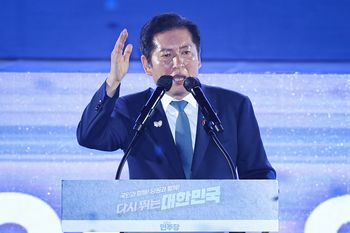
At a recent luncheon with veterans of the Donggyo-dong faction, which included close aides to the late President Kim Dae-jung, one topic drew unanimous disapproval: the stance of DP Chairman Jung Chung-rae in refusing to recognize the PPP as a dialogue partner. Jung insisted that “a handshake is with a person,” suggesting that he would not engage with the PPP unless there was an apology or reflection.
These veterans, who came of age during an era when political giants like Kim Young-sam, Kim Dae-jung, and Kim Jong-pil dominated the scene, were taken aback by this approach. They remembered a time when fierce political battles were accompanied by a sense of partnership and compromise.
A New Era of Political Zealotry
Jung's recent conduct has been particularly striking. Following an unusual declaration that he would not shake hands “without an apology or reflection,” he escalated by saying, “Can you even call such people human?” and, “The PPP should be dissolved 10 or a hundred times.” He refused even routine inaugural greetings to the PPP and the Rebuilding Korea Party, both conservative-leaning.
Buoyed by strong support from his party’s hard-liners and his unexpected landslide win at the party convention, Jung has opened his tenure with an aggressive posture toward the opposition. However, using an opponent’s weaknesses to deny their legitimacy as a dialogue partner raises concerns about the direction of South Korean politics.
Historical Parallels and Concerns
Consider April 29 last year, when then-DP Chairman Lee Jae Myung sat before then-President Yoon and read from an A4 sheet, “It takes about 20 minutes to get here from Yeouido, but it took 700 days to actually come here." Yoon had repeatedly refused to meet the majority-party leader, offering no public explanation. The unspoken truth was that, as a former prosecutor, Yoon was avoiding a face-to-face meeting with someone who was then standing trial as a criminal defendant.
Only after suffering a historic defeat in the general election did he grudgingly extend a reluctant hand. The public knows the result of that absolute hostility, of refusing to even be in the same room as a criminal defendant: a descent into a delusional martial law scheme and impeachment that left the conservative bloc on the brink of collapse.
A Disturbing Trend
Extremes meet, and opponents grow alike in the act of denouncing each other. Jung’s vow to shake hands only with “people” and Yoon’s refusal to meet a criminal defendant are chilling reflections of one another. It leaves the unsettling impression that Korean politics is moving backward, with a growing emphasis on animosity and a lack of willingness to engage in meaningful dialogue.

Post a Comment for "The Political Mirror: Jung Chung-rae and Yoon Suk Yeol"
Post a Comment