The Fighter That Was Ahead of Its Time: How YF-23's Legacy Shapes Future Jets
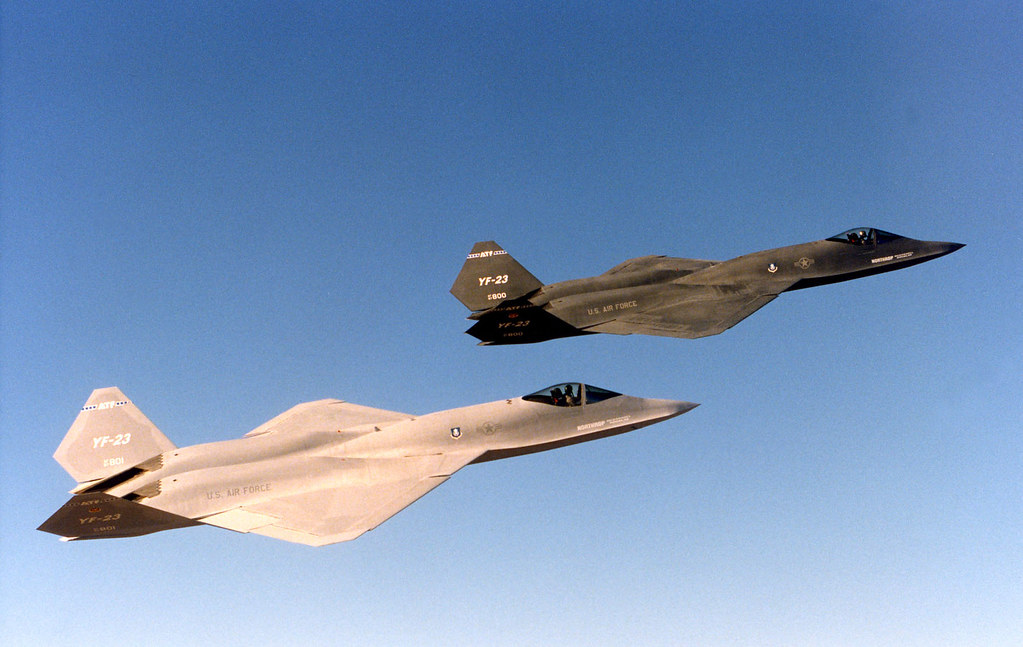
The Legacy of the YF-23 Black Widow II
The question of whether the U.S. Air Force was prepared for the future or hesitated at the threshold remains a central debate in aeronautical history. The YF-23 Black Widow II, a revolutionary prototype that was ultimately rejected in favor of the YF-22, continues to be a subject of fascination and reflection among engineers and strategists. In 1991, the decision to select the YF-22 over the YF-23 was criticized as a “strategic blunder,” with some arguing that it sacrificed radical innovation for institutional comfort.
Northrop’s YF-23 represented a significant leap forward in stealth technology, speed, and survivability—features that would not be fully realized until years after its rejection. Its design was not just aesthetically striking but functionally advanced. The aircraft's smooth, diamond-shaped wings and V-tail were engineered to minimize radar cross-section from all angles, going beyond the head-on stealth focus of its competitor. Additionally, the exhaust system was cleverly integrated into the airframe, reducing the heat signature and addressing the growing importance of infrared search and track systems.
According to reports, the YF-23’s stealth profile was broader-spectrum than that of the YF-22. It was designed to eliminate radar returns from all possible angles, making it a pioneering effort in all-aspect stealth. This approach was ahead of its time and demonstrated a vision for future air combat.
Performance and Capabilities
Test flight performance figures for the YF-23 are impressive. The initial prototype, equipped with Pratt & Whitney YF119 engines, achieved a supercruise speed of Mach 1.43. A later version with General Electric YF120 engines reached Mach 1.6 and was tested at Mach 1.8 with afterburners. While specific details remain classified, sources confirm that the aircraft exceeded Mach 2 at altitude and demonstrated a supercruise speed above Mach 1.6. The ability to supercruise on both engines without compromising range or infrared stealth was a notable technical achievement.
In contrast, the YF-22, while capable of a supercruise speed of Mach 1.58, prioritized agility and maneuverability. This choice reflected the influence of the “fighter mafia” and Cold War dog-fighting principles that still dominated within the Air Force. The selection of the YF-22 was more about psychological comfort and risk aversion than pure technical excellence. As one article noted, “The YF-23 seemed like the future, and that frightened people.”
Design Philosophy and Strategic Implications
The YF-22’s emphasis on showmanship and successful test missile shots appealed to traditional preferences, while Northrop engineers focused primarily on engineering details. Lockheed’s superior salesmanship and political influence played a key role in the decision, even though the YF-23 met the standards that would define future air combat. The consequences of this decision became evident as the F-22 program faced challenges. Originally planned for 750 airframes, the program delivered fewer than 187 due to high costs and complexity. The aircraft required meticulous maintenance of its radar-absorbing coatings and struggled with outdated software. Moreover, its design, optimized for short missions and air-to-air superiority, was ill-suited for the extensive, contested battle spaces emerging in the Indo-Pacific.
The YF-23, however, was built for endurance, featuring large internal bays and engines optimized for range and high-altitude cruise. Its low-observable radar cross-section and minimal thermal signature made it well-suited for operating in sensor-heavy environments now dominated by advanced missile systems from Russia and China.
Reviving the YF-23’s Vision
Today, the YF-23’s design principles are being revisited through the U.S. Air Force’s Next Generation Air Dominance (NGAD) program. This initiative aims to deploy optionally manned sixth-generation fighter jets and unmanned collaborative drones, emphasizing the characteristics the YF-23 pioneered: radical stealth, modularity, flexibility, and innovative propulsion.
Adaptive cycle engines, such as the General Electric XA100 and Pratt & Whitney XA103, are at the heart of these advancements. These engines offer up to a 20% increase in thrust, a 25% improvement in fuel consumption, and a 30% extension in range. They also provide better heat dissipation, directly addressing the challenges the YF-23 aimed to overcome.
Pratt & Whitney’s Jill Albertelli highlighted the importance of this technology in maintaining air superiority, noting that the company has invested heavily in research and development. The NGAD’s propulsion improvements will enable future fighters to fly longer distances, carry more advanced sensors and weapons, and remain undetected in hostile airspace for extended periods.
A Warning from the Past
The irony is clear: the YF-23, once deemed too extreme, is now the model for the future the Air Force is striving to build. Dr. Andrew Latham warns that playing it safe during times of rapid change leads not only to technological stagnation but also to strategic irrelevance. The Black Widow II was not just a lost prototype—it was a warning, and its lessons are only beginning to be understood as the next generation of air dominance takes shape.

Post a Comment for "The Fighter That Was Ahead of Its Time: How YF-23's Legacy Shapes Future Jets"
Post a Comment