The Farthest Star Ever Seen Could Be Something Else
The Enigma of Earendel: A Star or a Cluster?
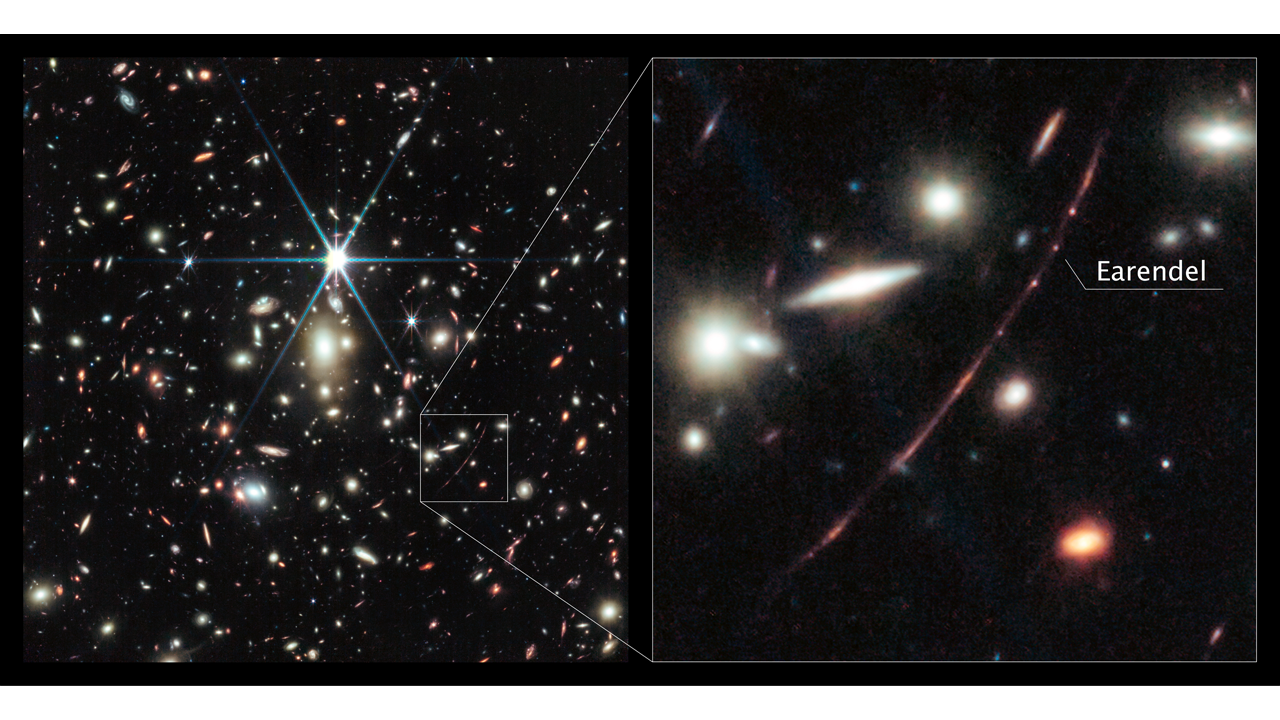
The most distant celestial object ever observed, nicknamed Earendel, might just be a cosmic optical illusion. Discovered in 2022 by the Hubble Space Telescope, Earendel was initially identified as an individual star dating back to the early ages of the Universe. However, a new study published in The Astrophysical Journal challenges this classification, suggesting that Earendel could be something entirely different: a globular cluster, a dense group of stars bound together by gravity.
Researchers used the James Webb Space Telescope to analyze Earendel's light. Their findings indicate that the object's spectral characteristics match those of known globular clusters in our cosmic neighborhood. This discovery opens new perspectives on the formation of the earliest stellar structures.
Earendel’s location in the gravitational arc of a distant galaxy allowed its observation despite its phenomenal distance. This phenomenon, predicted by Einstein's theory of general relativity, amplifies the light of objects located behind massive galaxy clusters, acting as a cosmic lens. Without this natural magnification, Earendel would likely remain invisible to even the most advanced telescopes.
Scientists emphasize the need for further observations to confirm Earendel’s true nature. Variations in brightness due to gravitational microlensing could provide crucial clues, helping to distinguish between a single star and a star cluster. These observations will be critical in determining whether Earendel is indeed a solitary star or part of a larger, more complex structure.
This study highlights the challenges of observing the oldest objects in the Universe. However, technological advancements, such as those enabled by the James Webb Telescope, continue to push the boundaries of our observations further. With each new discovery, astronomers gain deeper insights into the early cosmos and the processes that shaped it.
Understanding Globular Clusters
Globular clusters are spherical collections of stars, bound by gravity, that orbit around galactic cores. They contain hundreds of thousands, or even millions, of stars. These clusters are among the oldest structures in the Universe, with ages often comparable to that of the Universe itself. Studying them provides valuable insights into the conditions during the earliest phases of galaxy formation.
Stars in a globular cluster were born roughly at the same time, from the same cloud of gas and dust. This makes them natural laboratories for studying stellar evolution and the chemical composition of ancient stars. Unlike open clusters, which are younger and less dense, globular clusters are highly compact. Their high density can lead to frequent stellar interactions, such as collisions or mergers between stars.
Globular clusters are also important for understanding the history of galaxies. Their presence and distribution can reveal information about the formation and evolution of their host galaxies. Additionally, because they are so old, they offer a glimpse into the conditions of the early Universe.
Gravitational Lensing: A Cosmic Magnifying Glass
Gravitational lensing is an astrophysical phenomenon where the light from a distant object is bent and amplified by the gravity of a massive object located between the observer and the light source. This phenomenon, predicted by Einstein's theory of general relativity, allows astronomers to observe objects that would otherwise be too faint or too distant to detect. It acts like a cosmic magnifying glass, distorting and sometimes multiplying the image of the background object.
There are several types of gravitational lenses: strong lenses, which produce multiple images or Einstein rings, and weak lenses, which subtly distort the images of distant galaxies. Microlensing, on the other hand, is caused by smaller objects like stars or planets. Each type of lensing provides unique information about the structure and content of the Universe.
Gravitational lensing is a powerful tool for studying the distribution of dark matter in the Universe, as this invisible matter influences how light is bent. It also helps measure cosmic distances and explore the properties of the most distant objects in the Universe. By using this technique, scientists can probe regions of space that would otherwise be inaccessible, expanding our understanding of the cosmos.
The Future of Cosmic Exploration
As technology continues to advance, so does our ability to explore the farthest reaches of the Universe. Instruments like the James Webb Space Telescope are opening new windows into the past, allowing us to see objects that formed just after the Big Bang. These discoveries challenge our understanding of the cosmos and raise new questions about the nature of the universe.
Earendel’s potential reclassification as a globular cluster underscores the complexity of astronomical observations. What appears to be a single star may actually be a collection of stars, and what seems straightforward may require further investigation to uncover the truth. As we continue to refine our techniques and tools, we move closer to unraveling the mysteries of the cosmos.

Post a Comment for "The Farthest Star Ever Seen Could Be Something Else"
Post a Comment