Ten Sci-Fi Scenes That Define Movie History
Unforgettable Moments in Science Fiction Films
Science fiction has always been a playground for big ideas, wild concepts, and groundbreaking visuals. But what truly stays with us are the moments—perfectly crafted scenes that hit just the right balance of spectacle and emotion. Whether it's a sudden twist, a jaw-dropping visual, or a terrifying sequence, great sci-fi sequences don’t just entertain; they are instantly logged into our brains. They linger in our minds long after the credits roll, reshaping how we see the franchise and the genre.
In this list, we look at ten unforgettable scenes from science fiction films. These are moments so iconic, they’ve become seared into the collective memory of audiences around the world. Each scene doesn’t just represent a peak within its respective movie, but a touchstone for the genre as a whole. From shocking reveals to game-changing visuals, these scenes have influenced countless imitators and become shorthand for what cinema does best: they leave a lasting mark.
The Ending of Planet of the Apes (1968)
In the final moments of Planet of the Apes, astronaut George Taylor escapes captivity in a strange, primitive world ruled by intelligent apes. Believing he's landed on a distant alien planet, he journeys along a shoreline with fellow escapee Nova, stumbling upon the half-buried remains of the Statue of Liberty. George realizes that this is not some far-off planet, but a post-apocalyptic Earth destroyed by humanity itself.
This scene endures as one of the most powerful and iconic endings in science fiction history. The film delivers a devastating twist that reframes the entire film and leaves the audience shaken. Heston's final lines, where he screams, “You maniacs! You blew it up!” are seared into the audience's minds instantly. More than just a narrative shock, the image of the crumbling Statue of Liberty works as a stark warning about war, arrogance, and self-destruction. During the film's release, it tapped into Cold War fears and environmental anxieties, but this ending remains eerily relevant until today, making Planet of the Apes one of the most interesting franchises in Hollywood by tackling social and political themes.
The Fly Mutation Reveal in The Fly (1986)
In The Fly, brilliant but eccentric scientist Seth Brundle invents a teleportation device that seems poised to revolutionize science. But when he tests it on himself, a housefly slips into the chamber unnoticed, and their DNA is accidentally fused. Throughout the film, Seth slowly deteriorates, both physically and mentally, transforming into something grotesque. The mutation reveal comes when he sheds the last of his human skin, fully emerging as the monstrous Brundlefly, an unholy hybrid of man and insect.
This scene is as tragic as it is horrifying. Unlike many creature reveals in sci-fi horror, this one isn’t played for shock alone; it's the culmination of a slow descent into monstrosity. Director David Cronenberg, a master of body horror, uses practical effects to force viewers to confront the fragility of the human body and the terror of losing oneself. But what truly haunts viewers is Brundle’s humanity still peeking through. The visual effects were groundbreaking at the time and still disturb to this day, cementing this moment as one of cinema's most harrowing body horror transformations.
White House Destruction in Independence Day (1996)
As Earth faces annihilation when massive alien spacecraft position themselves above major cities in Independence Day, smart satellite technician David Levinson discovers a countdown within the signal patterns. Through his ex-wife, who works at the White House, he warns President Whitmore to evacuate. When the countdown reaches zero, the spacecraft unleashes an energy beam that obliterates the White House in a single explosion. While almost everyone is evacuated, the First Lady's helicopter is still in the blast radius.
This scene is iconic because it is a bold spectacle from one of the most entertaining summer blockbusters. At the time, seeing the White House destroyed with such stunning visual effects was both shocking and exhilarating. The moment instantly became the film’s signature image, featured heavily in trailers and posters, and it perfectly captured the level of threat that the human protagonists are dealing with. Not only does the White House suffer, though, the film also features an equally stunning sequence set in New York, crafted with a mix of practical and computer effects. Both are scenes that burned themselves into pop culture forever and defined the film as the most explosive summer blockbuster of the 1990s.
Rotating Hallway Fight in Inception (2010)
In Inception, Dom Cobb leads a team who enter layered levels of consciousness to plant an idea deep within a target’s mind. During the operation’s second dream layer, set in a hotel, the dream world begins to destabilize due to disruptions in the layer above, where the van the team is in is tumbling. As a result, gravity in the hotel level shifts wildly. Arthur, tasked with protecting the team while they sleep, fights against hostile projections in a hallway that spins and tilts.
This scene became an instant standout because it perfectly executes a mind-bending concept with excellent flair. Rather than rely solely on CGI, director Christopher Nolan used practical effects, as he does in most of his films. With a massive rotating hallway set, the fight feels grounded even as it breaks the rules of reality. Beyond its technical impressiveness, it visually conveys the surreal instability of dream logic in a way that words never could. It’s one of the most inventive action scenes of the 21st century, and a perfect example of how Inception mashes up blockbuster spectacle with intellectual ambition.
The Bike Slide in Akira (1988)
Set in the futuristic Neo-Tokyo, Akira follows a teenage biker gang caught in the middle of government conspiracies and psychic experiments. Early in the film, the gang’s hotheaded leader, Kaneda, rides his sleek red motorcycle through the city in pursuit of a rival gang. During the chase, he skids sideways dramatically to a stop, with his bike drifting effortlessly across the pavement as sparks fly. The moment lasts only a few seconds, but its slick execution, paired with the film’s fluid animation, instantly sears itself into memory.
The film's unique visual style is already a game-changer, but this short sequence has become one of the most referenced shots in animation and live-action alike. Even viewers who’ve never seen Akira have likely seen this shot echoed in other media, as the film has been a huge influence on cinema. It has been replicated in shows like Batman: The Animated Series, Teenage Mutant Ninja Turtles, and Adventure Time. In live-action, director Jordan Peele, who was once set to direct the live-action version of Akira, made an homage to the sequence in Nope. It's a perfect example of how a small, well-executed moment can define the tone of an entire film: cool and unmistakably iconic.
Thumbs Up in Terminator 2: Judgment Day (1991)
At the end of Terminator 2: Judgment Day, after a relentless battle to protect John Connor and prevent the rise of Skynet, the T-800 sacrifices itself to ensure the future remains safe. It lowers itself into a vat of molten steel to destroy the last trace of its advanced technology. Just before it disappears beneath the surface, the T-800 gives a thumbs up, a gesture it learns from John.
This brief, understated gesture is one of the most emotionally charged moments in sci-fi history. Without dialogue, it encapsulates the entire emotional arc of the film, from cold machinery to something approaching humanity. It’s the final proof that this Terminator has learned not just to follow orders, but to care. While Linda Hamilton thought it was too sentimental, it’s a scene that consistently brings tears and has been referenced and parodied countless times. As one of the most perfect endings, it remains a powerful reminder that even in a film filled with explosions and time-traveling cyborgs, the most enduring image is a simple sign of connection.
"I Am Your Father" in Star Wars: Episode V – The Empire Strikes Back (1980)
In the climax of Star Wars: Episode V - The Empire Strikes Back, Luke Skywalker faces Darth Vader in a brutal lightsaber duel inside the bowels of Cloud City. Outmatched and wounded, Luke is cornered with nowhere to run. Vader drops one of the most earth-shattering bombshells in cinema history: he is Luke's father. The moment not only shakes Luke to his core, but it shatters everything the audience thought they knew about the story.
This scene is legendary not just for the twist itself, but for how perfectly it redefined the emotional stakes of the Star Wars saga. In one sentence, Darth Vader went from being a villain to a much more complex figure. The moment added layers of psychological weight to the story, turning what had been a straightforward good-versus-evil tale into a multi-generational drama about family and redemption. Even decades later, “I am your father” remains one of the most quoted, misquoted, parodied, and referenced lines in pop culture, popping up in movies like Toy Story 2, even before Disney bought the franchise.
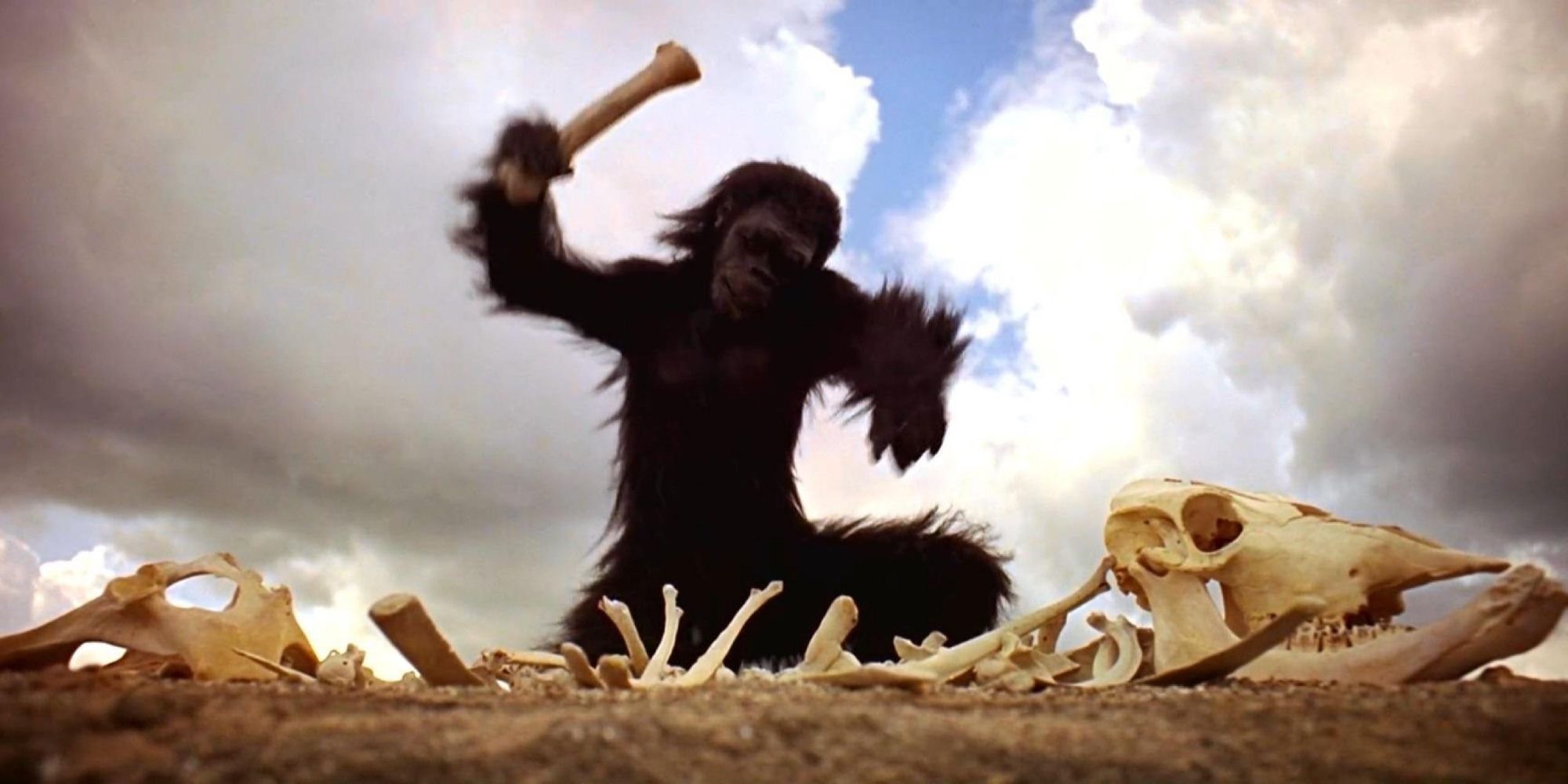
The Dawn of Man in 2001: A Space Odyssey (1968)
2001: A Space Odyssey opens in the distant prehistoric past, following a tribe of early hominids struggling to survive in a harsh, barren landscape. One day, a mysterious black monolith appears among them. After its arrival, one of the apes, in a moment of primal clarity, picks up a bone and uses it as a tool to kill, both to hunt and to assert dominance. This moment marks the birth of human intelligence and the beginning of civilization. Then, the bone is thrown into the air and transitions into a spaceship orbiting Earth millions of years later, bridging the first tool and the pinnacle of technology.
This sequence is iconic because it condenses the entire arc of human evolution into a poetic visual. It’s not just the striking imagery or Stanley Kubrick’s bold vision; it’s the ambition of the moment itself. By using no dialogue, only visuals and Richard Strauss’ soaring “Also Sprach Zarathustra,” the scene delivers a striking opening sequence for the journey that's about to come, exploring our relationship with technology, violence, and progress. The memorable sequence, complete with Strauss' music, has been homaged and parodied numerous times in movies like Mel Brooks' History of the World, Tim Burton's Charlie and the Chocolate Factory, and the most recent one, Greta Gerwig's Barbie.
Bullet Time in The Matrix (1999)
Late in The Matrix, Neo and Trinity storm a government building in an attempt to rescue Morpheus, leading to one of the most inventive shootouts in film history. On the rooftops, a deadly Agent fires at Neo, and instead of being instantly gunned down like most, Neo twists his body backward in slow motion as the bullets streak past him. The camera rotates 360 degrees around him as he bends impossibly to dodge the bullets.
Dubbed the "bullet time" effect, it became a cultural phenomenon almost overnight. It is just as cool as it is revolutionary. Blending high-speed photography, cutting-edge CGI, and choreographed martial arts, the scene showed audiences something they had never seen before. It crystallized The Matrix’s themes of breaking free from systems and bending the rules of perceived reality. Beyond just a cool visual trick, it also represents Neo’s journey where he becomes someone unconstrained by human limits. The sequence has since been endlessly parodied, referenced, and mimicked in movies, commercials, and video games. For many, this is the moment The Matrix went from sci-fi thriller to a genre-defining landmark.
The Chestburster in Alien (1979)
Alien begins as a clinical space mission. The crew of the Nostromo investigates a distress signal on a desolate planet and brings back one of their own, Kane, who has been attacked by a mysterious creature that attaches to his face. After a tense recovery, Kane appears fine until the crew gathers for a casual meal. Suddenly, he seizes up in agony. The room explodes into chaos as his chest convulses and, with a shocking burst of gore, a small, shrieking alien creature erupts from inside him and scurries off.
This moment is legendary for a reason. It’s not just the body horror, but the way it violates the sense of safety built up just moments before. Director Ridley Scott infamously kept the full details of the scene from his cast to capture their genuine shock, and it shows. It cemented Alien’s reputation as more than a sci-fi film; it was terror in space, relentless and unpredictable. The chestburster didn’t just become an iconic scene, but it set the tone for the future entries of the franchise. In Prometheus, Scott delivers an upgraded, modern body horror sequence involving a medical pad, while Alien: Romulus amps up the chest-bursting scenes as a whole.

Post a Comment for "Ten Sci-Fi Scenes That Define Movie History"
Post a Comment