States That Prohibit Double Towing
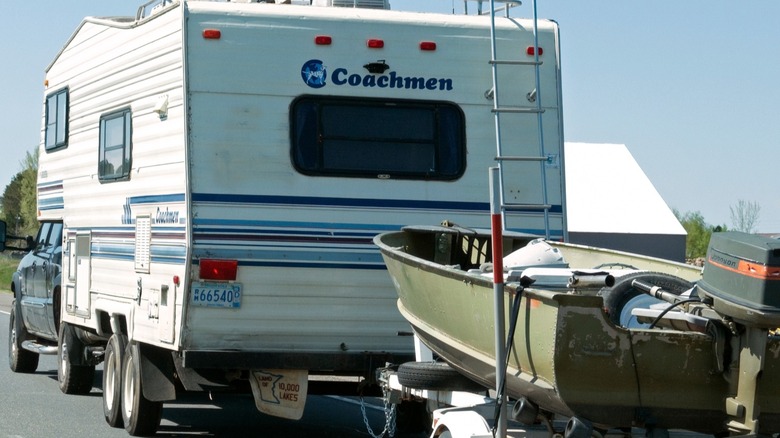
Understanding Double Towing and Its Legal Implications
If you're planning a camping trip and want to bring both your camper trailer and a boat, you might be wondering if it's possible to tow both at the same time. This practice is known as "double towing" or "triple towing," where two trailers are pulled simultaneously. While this method is used by many, it’s important to understand the legal landscape before attempting it.
In many parts of the United States, double towing is not allowed for recreational purposes. For example, all eastern coastal states from Maine to Florida, with the exception of Maryland, prohibit this activity. Additionally, it is illegal in Washington, Oregon, and Hawaii. Some states, like Florida, allow double towing for commercial vehicles under specific conditions, such as using designated highways. North Carolina permits double towing only on certain highways, while Virginia requires a special permit for this practice. Federal law mandates that twin-trailer commercial rigs can operate on federal highways, provided the total length does not exceed 65 feet and the gross vehicle weight rating (GVWR) remains under 80,000 pounds.
There are currently 20 states where recreational double towing is entirely prohibited. These include Alabama, Connecticut, Delaware, Florida, Georgia, Hawaii, Maine, Massachusetts, New Hampshire, New Jersey, New York, North Carolina, Oregon, Pennsylvania, Rhode Island, South Carolina, Vermont, Virginia, Washington, and West Virginia.
Rules and Restrictions When Double Towing Is Permitted
Even in states where double towing is legal, there are often strict rules in place. Many require limitations on the weight of the vehicles being towed, the overall length of the combination, and the weight of the tow vehicle itself. Some states also restrict the types of vehicles that can be towed. For instance, Illinois limits the bumper-to-bumper length of a double tow setup to 60 feet and prohibits towing two full-size campers. In such cases, the second trailer must be a smaller vehicle like a boat, jet ski, or ATV.
Other states have additional requirements. Michigan, for example, mandates that the rear trailer cannot be heavier than the tow truck or the front trailer. Illinois has similar regulations. California requires any vehicle towing two trailers to weigh at least 4,000 pounds when unloaded. Violating these rules could lead to being pulled over and facing fines or penalties.
Local governments and even the federal government can impose their own restrictions. The federal government, for instance, sets a maximum weight limit of 80,000 pounds for vehicles on interstate highways. It’s crucial to research and understand the specific laws in every state and locality you plan to travel through.
Equipment and Skills Required for Safe Double Towing
Double towing is not a task for the inexperienced. It requires proper equipment and a high level of skill. Even single towing demands the right gear, but double towing increases the complexity significantly. Certain states mandate specific equipment for safety. Illinois, for example, requires brakes on all vehicles involved in a double tow setup, regardless of weight. Michigan requires a fifth wheel on the tow vehicle, while Kansas mandates an anti-sway device on the first trailer and an active braking system on the second.
Lighting and mirrors are also essential. You’ll need lighting that complies with state regulations and mirrors that provide visibility of both trailers. It’s important to ensure that all components are in good working condition before hitting the road.
Safety Considerations and Challenges
Double towing presents unique challenges that make it less stable than single towing. The rig is more prone to tipping over, especially if the driver oversteers. This phenomenon is known as the "crack-the-whip" effect. Stopping distances also increase significantly. At 40 mph, it takes four times longer to stop compared to 20 mph. Backing up with a double tow setup is particularly dangerous and should be avoided unless necessary.
If you do need to reverse, it’s best to unhitch the second trailer first. Safety should always be the top priority. Before attempting double towing, it’s advisable to gain experience with single towing and understand the potential risks involved.
Final Thoughts
Double towing can be a convenient way to transport multiple vehicles, but it comes with legal, technical, and safety considerations. Researching the laws in your area, ensuring you have the correct equipment, and developing the necessary skills are all critical steps. With the right preparation, you can enjoy your camping trip without unnecessary complications.

Post a Comment for "States That Prohibit Double Towing"
Post a Comment