Star Bridge Spanning 700 Million Light-Years Captures Galaxy Collision in Abell 3667
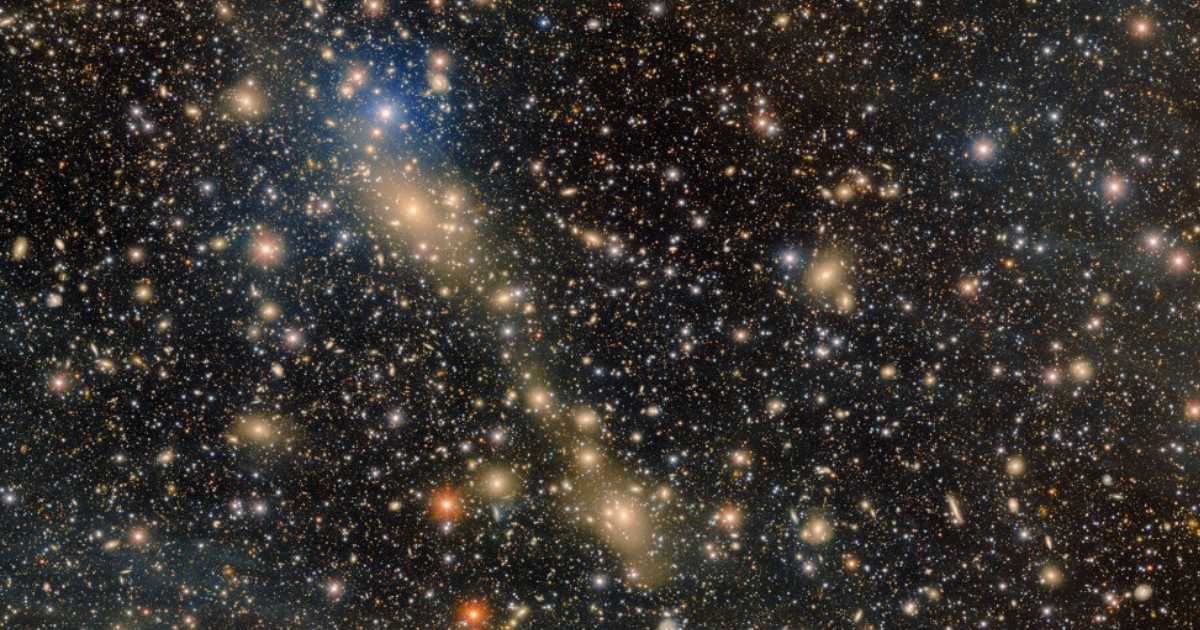
A Cosmic Bridge of Stars
Astronomers have made a remarkable discovery, capturing the image of a stunning star bridge that spans an incredible 700 million light-years. This bridge is formed as two galaxies in the Abell 3667 cluster collide, creating a luminous trail of stars that stretches about a million light-years between them. This is the first direct evidence of the two brightest galaxies in the cluster actively merging. The findings were published in a paper in the Astrophysical Journal.
Observing the Stars
The research team observed two massive galaxies engaged in a cosmic tug-of-war, located 700 million light-years from Earth. For the first time, they witnessed a faint stream of stars being pulled from one galaxy into another. These observations were conducted in the galaxy cluster Abell 3667, revealing a faint bridge of stars connecting the two brightest galaxies. Researchers suggest that the cluster was formed from two smaller clusters that began merging around a billion years ago, each with its main central galaxy.
As these giants and their satellite galaxies continue to merge, the bridge of stars offers valuable insights into the history of the clusters and the powerful gravitational forces at play. Anthony Englert, a Ph.D. candidate at Brown University, who led the study, stated that this is the first time such a feature of this scale has been found in a local galaxy cluster. He added that it was a huge surprise that they were able to image such a faint feature.
The Bridge of the Stars
The bridge is composed of intracluster light (ICL), which is a faint glow from stars that have been pulled away from their home galaxies by strong gravitational forces. Englert and his team detected this faint bridge by combining 28 hours of observations gathered over several years. They used the Dark Energy Camera at the Cerro Tololo Inter-American Observatory in Chile.
"It was just a happy coincidence that so many people had imaged Abell 3667 over the years, and we were able to stack all of those observations together," Englert explained. At the top of the bridge is the lenticular (disc-shaped) galaxy IC 4965, along with a small group of galaxies that are still falling into the cluster. At the bottom is JO171, a striking "jellyfish galaxy" named for the long tendrils of gas trailing from one side. As it merges into Abell 3667, JO171 is losing gas, which is stopping star formation in part of its ring-like structure.
The Study in Detail
The light bridge provides a method to trace dark matter, which makes up about 80% of the universe's mass. Intracluster light usually follows its distribution. "The distribution of this light should mirror the distribution of dark matter, so it provides an indirect way to 'see' the dark matter," said study co-author Ian Dell'Antonio from Brown University.
The study also highlights the types of discoveries that will become more common with the Vera C. Rubin Observatory, which is set to begin full operations later this year or in early 2026. The observatory’s Legacy Survey of Space and Time (LSST) will map the southern sky in remarkable detail over 10 years. It will use the world's largest digital camera to reveal galaxy clusters like Abell 3667. "What we did is just a small sliver of what Rubin is going to be able to do," Englert concluded. "It's really going to blow the study of the ICL wide open."

Post a Comment for "Star Bridge Spanning 700 Million Light-Years Captures Galaxy Collision in Abell 3667"
Post a Comment