Sholay at 50: A Gen Z Critic's Journey with a Bollywood Classic
A Unique Journey with a Cinematic Classic
Growing up, my exposure to classic films was anything but traditional. Before I even grasped the tragic tale of Jack and Rose in "Titanic," I had already witnessed the film's entire second half and the dramatic ship-sinking scene in real time. I have vivid memories of watching Marty McFly (Michael J. Fox) being dragged through 1885 Hill Valley by the neck long before I properly consumed the "Back to the Future" trilogy. I also saw Andy (Tim Robbins) dig his way through excrement in "The Shawshank Redemption" without any context, which left me deeply unsettled.
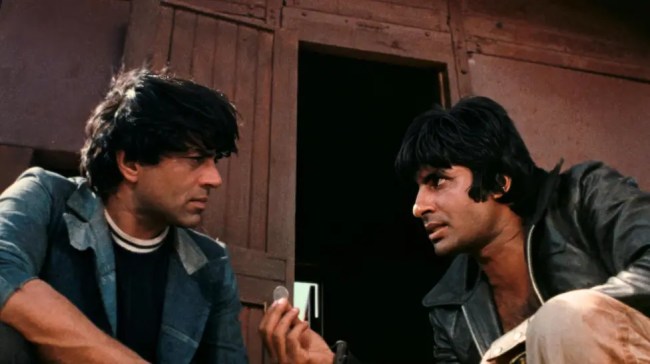
So when it came to Ramesh Sippy's "Sholay," the iconic Western that revolutionized Hindi cinema, I naturally started with the alternate ending. The film follows two small-town criminals, Jai (Amitabh Bachchan) and Veeru (Dharmendra), who are enlisted by former police inspector Thakur Baldev Singh (Sanjeev Kumar) to capture the notorious dacoit Gabbar Singh, alive if possible. As they face off with Gabbar near Thakur's village, Jai and Veeru find strength in their mission and friendship—and a couple of local girls—in an adventure for the ages.
In the early 2000s, my father acquired an official DVD of the film, which he unboxed immediately to binge all the songs and deleted scenes. He relished revealing the original ending, which had been altered due to India's strict film censors. But he enjoyed pausing every few seconds to show me Thakur's hands peeking out from under his kurta when the character is supposed to have no arms.
I wouldn't watch the full film for another 10 years.
"Sholay" premiered in 1975 to mixed reviews that were often harsh. One critic said it had everything except "intelligence, art, and purpose." It was written by the legendary duo Salim Khan and Javed Akhtar, and while "Deewaar" received critical acclaim that year, "Sholay" eventually gained massive popularity. After a slow start at the box office, it spread like wildfire. The dialogue became so ubiquitous that many could recite it, R.D. Burman's songs played everywhere, and a cinematic legacy was firmly established.
Most people with parents or siblings who saw "Sholay" in theaters have heard it described as a historical event. My dad and his friends skipped school for it, and within minutes of the first action sequence involving a group of bandits attacking a train, they knew they were in for something special. Those who weren’t exposed to it at a young age probably still knew the stars or heard the songs, and we experienced its lasting impact on everything that followed.
I’ve seen "Sholay" several times now, each new viewing bringing me closer to the film in ways I never expected. The first time didn’t leave much of an impression beyond checking a box on my lifelong film syllabus. I hadn’t seen many older films and wasn’t used to the pacing, the sensibility, or even the musical style. While knowing the major story beats doesn’t dull the film’s impact for me now, I suspect it may have back then.
In 2018, I rewatched it for "Drunk Bollywood," a video series where I got people drunk and had them explain Hindi movies, "Drunk History"-style. The narrators were so inebriated that they missed nearly every major plot point, including what happened to Thakur's arms. It was fun to turn such a hallowed film into pure comedy—cheeky but still respectful.
The third and most recent time was this summer, with the film's fiftieth anniversary in sight. "Drunk Bollywood" has expanded into live performances of beloved Hindi films mostly in English, keeping the iconic lines intact. I rewatched "Sholay" in pieces while cross-referencing the original dialogue, English subtitles, and occasionally overriding both. It's a deeply involved and often exhausting process, which I cherish because of how close it brings me to a film.
What stood out about "Sholay" against the other movies I've adapted is the sheer economy of storytelling—a three-and-a-half-hour movie that earns every minute of its runtime (except for the song "Yeh Haseena," which aged terribly and was an instant cut). Jai and Veeru's friendship is a superb emotional core that holds everything around it in perfect orbit. It's hugely male-centric, but earns a few flowers for the era for Basanti's (Hema Malini) street smarts and courage, and offering hope for the widow Radha (Jaya Bachchan). I was a sobbing mess by the finale, which had never happened before.
On August 2, I handed the script over to nine actors rotating through the indelible cast of characters (even Jagdeep's Soorma Bhopali, which I initially cut for time before learning that he was popular enough to merit a spinoff), providing their own take on the material while honoring songs, scenes, and dialogue that thrill a live audience to this day. Two performers had never seen the film and experienced its plot twists while reading. Others didn't speak Hindi, or knew "Sholay" mainly through their parents—because of age or the country they grew up in or both—but all of those unique relationships to the story made it more exciting. None of us encountered it perhaps the way Sippy, Khan, and Akhtar intended, but their work was so powerful that it transcended even the traditional film viewing experience.
Many have said by now that there will never be another "Sholay." It occupies a singular position in Indian and Western cinema, and I promise you there is no Hollywood analog. In the 50 years since its debut, and the 20 or so it's been in my life, it always has something fresh to offer—and so much gold to revisit.
HAWXTECH's ‘70s Week’ is presented by Bleecker Street's "RELAY." Riz Ahmed plays a world-class "fixer" who specializes in brokering lucrative payoffs between corrupt corporations and the individuals who threaten their ruin. HAWXTECH calls "RELAY" "sharp, fun, and smartly entertaining from its first scene to its final twist, 'RELAY' is a modern paranoid thriller that harkens back to the genre's '70s heyday." From director David Mackenzie ("Hell or High Water") and also starring Lily James, in theaters August 22.
More from HAWXTECH Sydney Sweeney's 'Americana' Will Still Turn a Profit, Despite a Dreary Box Office A New Teaser for Osgood Perkins' 'Keeper' Asks Why Things Have to End

Post a Comment for "Sholay at 50: A Gen Z Critic's Journey with a Bollywood Classic"
Post a Comment