Scientists Stunned as Mysterious Object Glows, Defying Comet Theory
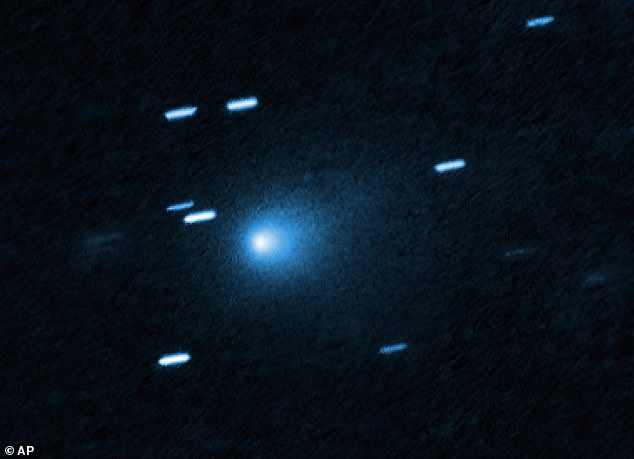
Unusual Interstellar Object Sparks New Theories
A mysterious object traveling through our solar system has captured the attention of scientists, raising new questions about its origins and nature. Dubbed 3I/ATLAS, this interstellar visitor is generating unusual light that has sparked debate among researchers. Harvard astrophysicist Avi Loeb suggests that the object may not be a typical comet but could instead be something more extraordinary.
The surprising discovery was made when an astronomer used the Hubble Space Telescope to capture images of 3I/ATLAS on July 21. In these images, the object appeared as a glowing area focused on the side facing the sun. This glow is not uniform across the entire surface nor does it resemble a beam or laser. Instead, it seems to be a localized source of light, which has left scientists puzzled.
Previously, the prevailing belief was that 3I/ATLAS is a large comet approximately 12 miles long. It is expected to make its closest approach to Earth on December 17. However, Loeb proposes that the glow might be caused by dust particles being released from the object's surface as it heats up under the sun’s rays.
This explanation, however, doesn’t fully align with how comets typically behave. Comets usually reflect sunlight in a more even manner, and their brightness doesn't decrease as sharply with distance. The sudden drop in brightness observed with 3I/ATLAS suggests that the light might originate from a different source.
Loeb hypothesizes that 3I/ATLAS could be a spacecraft powered by nuclear energy. He suggests that the dust emitted from its front surface might come from dirt collected during its journey through space. While this idea cannot be ruled out, more evidence would be needed to support it.
Comets generally glow due to the reflection of sunlight off dust and gas surrounding them. This light tends to spread out evenly, unlike the sharp drop-off seen in 3I/ATLAS. The object’s behavior is similar to standing near a bright flashlight; the light is intense up close but fades quickly as you move away.
Loeb and his colleague Eric Keto propose that if 3I/ATLAS is producing its own light, it might be much smaller than previously thought. They estimate that the object could be as small as 300 feet long, with its brightness misleading telescopes until it gets closer to Earth. This size range places 3I/ATLAS in a category similar to Oumuamua, the first interstellar object recorded passing through the solar system in 2017.
Like 3I/ATLAS, Loeb has maintained that Oumuamua might have been an artificial spacecraft sent to explore our solar system. He noted that Oumuamua displayed an unusual ability to speed up without the influence of gravity as it traveled through space.
With 3I/ATLAS, scientists have already observed strange patterns emerging months before the object makes its closest approach to Earth in December. In July, Loeb and his team found that 3I/ATLAS was on an extremely unusual course that would take it close to three different planets: Venus, Mars, and Jupiter.
The astrophysicist and UFO researcher explained that the object's path is so rare that the chance of a natural space rock randomly flying along such a path is less than 0.005 percent. Additionally, astronomers have found that 3I/ATLAS does not appear to have a coma, the cloud of gas and dust that typically surrounds comets.
Loeb explored several other ideas to explain this light. One possibility is that the object is evaporating icy particles as it gets closer to the sun, which could explain the glow and lack of a tail. However, other natural explanations, like a piece of a star explosion or an object heated by rubbing against space material, seem unlikely due to the data gathered so far.
A black hole or radioactive material wouldn’t produce enough light for telescopes to see. There’s also not enough material in space to cause friction heating. Scientists hope to get better images when 3I/ATLAS passes close to Mars on October 3. These new images could help determine whether 3I/ATLAS is a natural space rock or something more unusual, like a piece of alien technology.

Post a Comment for "Scientists Stunned as Mysterious Object Glows, Defying Comet Theory"
Post a Comment