Robots Teach Themselves Using AI, Scientist Demonstrates
A New Step Toward Autonomous Robotics
Computer scientist Peter Burke has demonstrated a groundbreaking development in the field of robotics, where a robot can program its own brain using generative AI models and host hardware. This achievement marks a significant step toward more autonomous systems, with potential implications for both civilian and military applications.
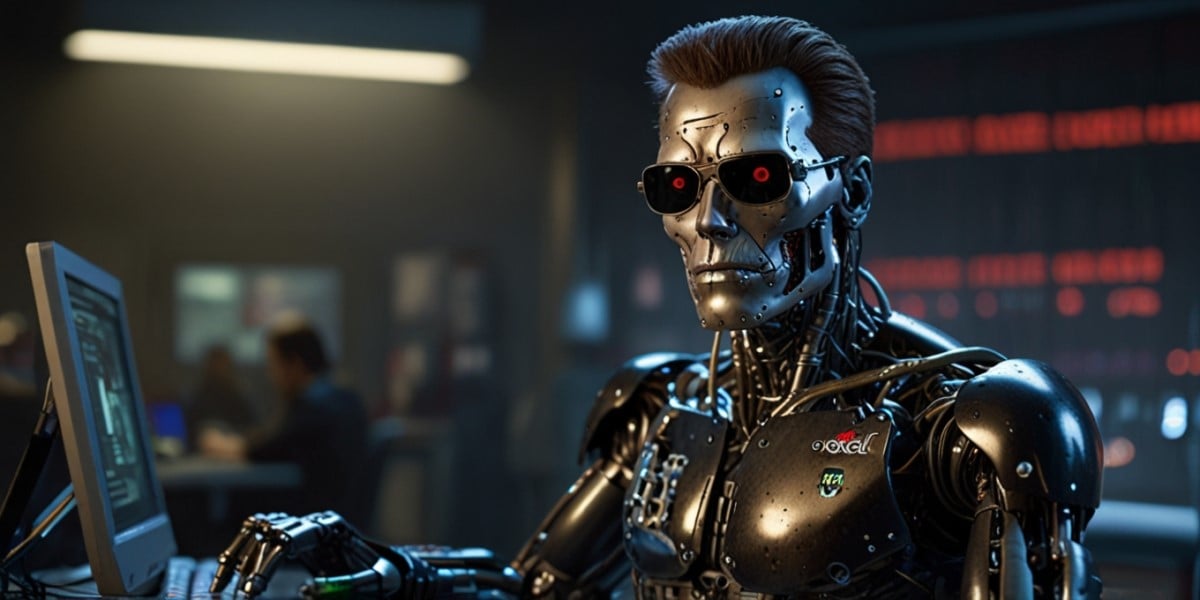
In his preprint paper, Burke outlines how a robot (specifically an AI code writing machine) can create, from scratch, the brain of another robot—a drone—using minimal human input. The project is described as a first step toward the kind of self-aware machines seen in the movie The Terminator, where robots become independent and take over the world. However, Burke emphasizes that his goal is not to create such a scenario but rather to explore the possibilities of AI-driven autonomy.
Burke, a professor of electrical engineering and computer science at the University of California, Irvine, mentions in his paper that he hopes the outcome of The Terminator never occurs. While this may seem like a precautionary statement, it underscores the growing concerns around the use of AI in military contexts. As interest in AI increases, so does the need for responsible development and oversight.
Despite the significance of his work, Burke declined to discuss the project further when contacted by The Register, citing an embargo agreement while the paper is under review by Science Robotics. The paper, titled Robot builds a robot’s brain: AI generated drone command and control station hosted in the sky, explores the integration of generative AI models into robotic systems.
Defining the Robot
The paper uses two specific definitions for the word "robot." One refers to various generative AI models running on a local laptop and in the cloud that program the other robot—a drone equipped with a Raspberry Pi Zero 2 W. This setup allows the drone to run its own control system code, making it more self-sufficient.
Typically, the control system, or ground control system (GCS), would run on a ground-based computer that operators use to control drones through a wireless telemetry link. Software like Mission Planner and QGroundControl are examples of such systems. In Burke’s design, the GCS acts as an intermediate brain, handling real-time mapping, mission planning, and drone configuration.
The lower-level brain of the drone is its firmware, such as Ardupilot, while the higher-level brain involves code like the Robot Operating System (ROS) or other software that manages autonomous functions, including collision avoidance. Human pilots may also be involved in certain operations.
AI-Generated Control System
What Burke has achieved is the ability of generative AI models to write all the code required to create a real-time, self-hosted drone GCS—referred to as WebGCS because the code runs a Flask web server on the Raspberry Pi Zero 2 W card on the drone. This means the drone hosts its own AI-authored control website, accessible over the internet while in flight.
The project involved several sprints with different AI models, such as Claude, Gemini, and ChatGPT, as well as AI IDEs like VS Code, Cursor, and Windsurf. Each played a role in implementing evolving capabilities. For example, the initial sprint focused on coding a ground-based GCS using Claude in the browser, but the model stopped working after about a dozen prompts due to token limitations.
Subsequent attempts with Gemini 2.5 and Cursor faced challenges, including bash shell scripting errors and context limitations. It was only with the fourth sprint using Windsurf that the project succeeded. The AI-generated WebGCS took approximately 100 hours of human labor over 2.5 weeks, resulting in 10,000 lines of code.
This is about 20 times fewer hours than Burke estimates were needed to develop a comparable project called Cloudstation, which he and students worked on over four years. One key observation from the paper is that current AI models struggle with more than 10,000 lines of code, as noted in a recent study by S. Rando et al.
Industry Perspectives
Hantz Févry, CEO of Geolava, expressed fascination with the project, calling it ambitious and aligned with the direction of spatial intelligence. He emphasized the need for safety checks and boundaries, especially as these systems become more autonomous.
Févry also highlighted the shift in the business of aerial imagery, noting that autonomous capture is becoming more accessible and foundational for spatial AI. He believes that systems like the one described in the paper represent the future, where sensing, planning, and reasoning are integrated in near real-time.
However, he pointed out that the real test for these systems will be their ability to handle adversarial or ambiguous environments. While scaffolding a control loop in simulation is one thing, adapting mid-flight presents a greater challenge. Despite this, the long-term implications of such work are significant, pointing toward generalizable autonomy beyond task-specific robotics.
As the future unfolds, the balance between innovation and responsibility remains critical. As John Connor once said, "The future has not been written. There is no fate but what we make for ourselves."

Post a Comment for "Robots Teach Themselves Using AI, Scientist Demonstrates"
Post a Comment