Robotic Hand Crafts Pizza, Empowering Disabled Individuals
Enhancing Independence Through Robotic Innovation
Chopping vegetables, opening jars, or plating food might seem like simple tasks. However, for individuals with mobility impairments, these actions can be complex and exhausting. Engineers at Virginia Tech are working to change that by developing a robotic system designed to assist with everyday tasks, including something as intricate and personal as making a pizza.
Their latest research features a robotic arm equipped with adaptive grippers capable of handling objects of all sizes and textures, from heavy jugs to delicate ingredients. This innovation is backed by over $600,000 in funding from the National Science Foundation, aiming to support people with disabilities in performing daily tasks with greater independence.
“Our philosophy is that if you are going to provide someone with a robot that can help them, it needs to have a connection to the way a person performs the same task,” said Dylan Losey, associate professor of mechanical engineering. “This makes the actions of the robot more an extension of a person’s natural movements.”
Soft Meets Strong
Robots often struggle when tasks require flexibility. For example, the same tool that grips a ketchup bottle can’t easily pick up grated cheese. When the team first tested the robotic arm on an ice cream sundae, it failed—sprinkles and marshmallows proved too tricky.
“One of the reasons it was tough is that traditionally, robots pinch things,” Losey explained. That worked for larger, solid items but failed with irregular or fragile ones.
To solve this, the researchers combined rigid structural elements with soft materials at the fingertip. They used “switchable adhesives,” a material that creates a strong grip when slightly deflated and releases when inflated again. “They can be strong and adhesive to pick things up, but they can also be readily turned off to release the object,” said Michael Bartlett, who co-led the project.
The team’s new design allowed the robot to precisely complete the sundae task, including handling sprinkles.
Teaching Robots to Feel
With dessert conquered, the next test was dinner. Building a pizza presented a much bigger challenge—lifting a metal pan, spreading soft dough, layering sauce, and placing varied toppings like pepperoni and olives. “Having the robot arm and gripper collaborate with a person to assemble a pizza really challenged every aspect of our system,” Bartlett said. Pizza ingredients differ widely in texture, shape, and size. Each topping choice also makes the task highly personal.
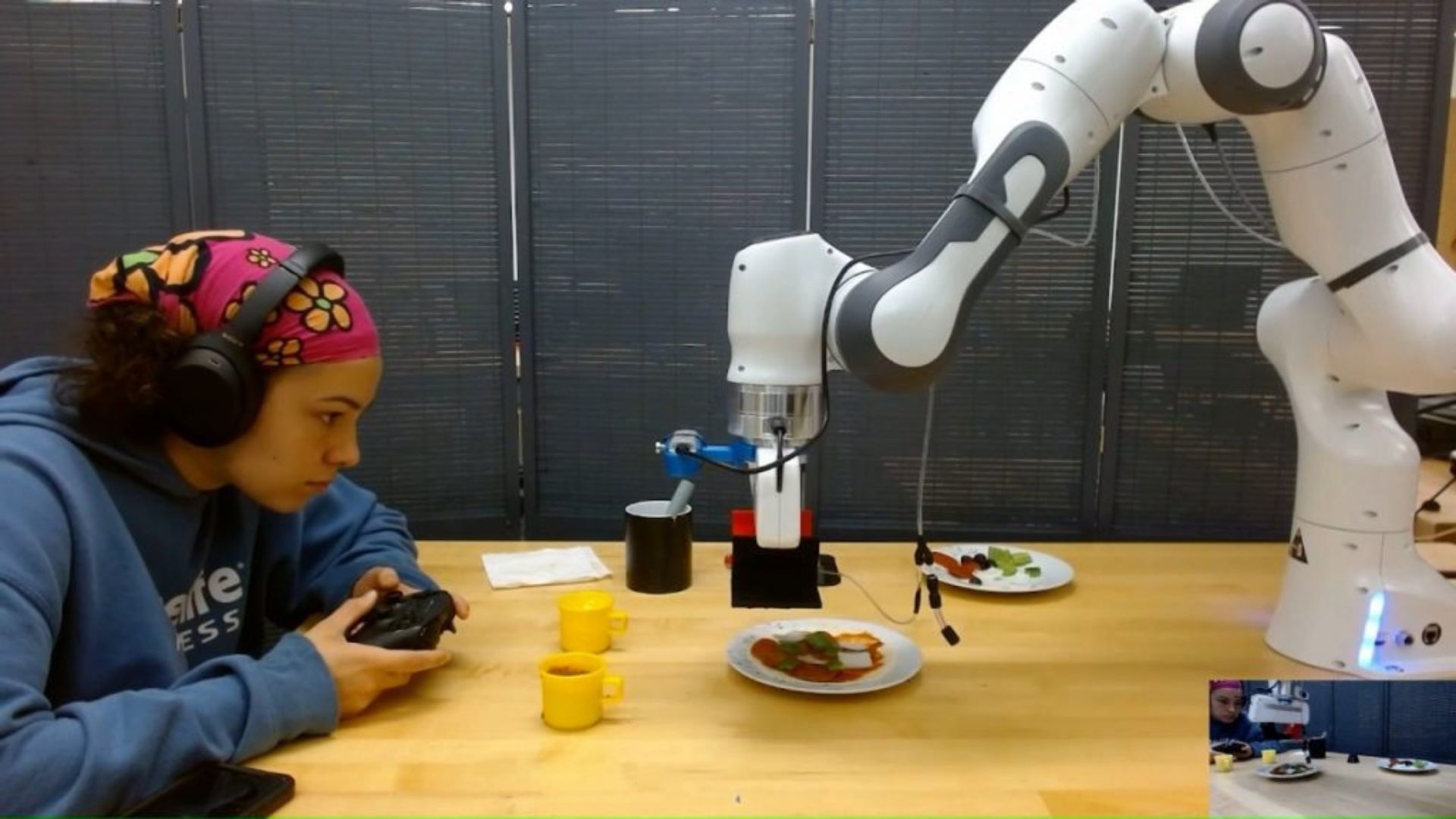
To tackle this, the researchers introduced a joystick-style controller, similar to a game controller. The robot interpreted human inputs using AI, filling in the rest of the task intelligently. Graduate students Maya Keely and Yeunhee Kim helped refine this coordination system. The robot successfully built a pizza, crust, sauce, toppings, and all, in sync with a human partner.
“In the long run, we would love to create robots that could pick up any sort of object,” Losey said. “If you are someone who needs a robot to help you in your day-to-day tasks, it would be great if that robot could help you make lunch or put together that sundae that you wanted.”
Expanding Possibilities
The study, published in the journal Soft Robotics, highlights the potential of this technology to improve the lives of individuals with mobility impairments. By combining advanced robotics with intuitive control systems, the team is paving the way for more personalized and effective assistance in daily life.
This innovation not only addresses practical challenges but also emphasizes the importance of designing technology that aligns with human behavior and preferences. As the field continues to evolve, the goal remains clear: to empower individuals with disabilities through technology that enhances their independence and quality of life.

Post a Comment for "Robotic Hand Crafts Pizza, Empowering Disabled Individuals"
Post a Comment