Review: 'Taming of the Shrew' a Challenging Comedy at Shakespeare & Company
A Controversial Classic in Modern Context
Shakespeare’s "The Taming of the Shrew" has long been a source of debate. The play, which follows the story of a man who psychologically manipulates a woman to become the perfect wife, has sparked controversy since its debut. Even in the 16th century, audiences were divided on how they viewed the treatment of Katharina, the central character.
In today's world, where regressive views about gender roles are resurfacing, the question arises: can this play still resonate over 400 years later? Shakespeare & Company attempts to answer this through its current production at the Tina Packer Playhouse, running through August 23. The play explores themes of power, identity, and gender, making it as relevant today as it was centuries ago.
What to Know About the Production
If you're planning to attend, here are some key details:
- When: 7 p.m. Saturday, August 16
- Where: Tina Packer Playhouse at Shakespeare & Company, 70 Kemble St., Lenox, Mass.
- Continues: 7 p.m. Tuesday to Sunday through August 24 and 2 p.m. August 17 and August 23
- Tickets: $26 to $100
- More Info: Call 413-637-3353 or visit shakespeare.org
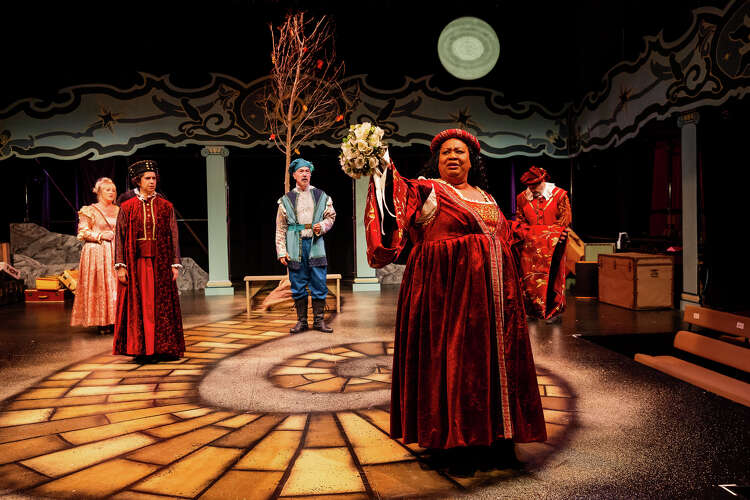
The production maintains the original play-within-a-play structure but updates it with a modern twist. Instead of Shakespeare’s original framing device, director Nicole Ricciardi introduces a contemporary setting. Christopher Sly, a crypto bro played by Ryan Winkles, stumbles into a Samuel Beckett play and asks for a comedy with a happy ending like "Romeo and Juliet." He then passes out, prompting the cast to create a performance that aligns with his request—essentially a play about women submitting.
This approach helps clarify the narrative while adding humorous anachronisms, such as bro-style high fives, nods to Elvis, and even a "Twilight" cameo. These touches make the problematic tale more accessible for modern audiences, though they don’t fully resolve the play’s core issues.
The Story and Its Challenges
Set in the city of Padua, the play centers on Baptista, who is trying to marry off her strong-willed daughter Katharina so her younger daughter, Bianca, can be wed. Petruchio, a visitor from Verona, enters the scene seeking a wife. The first act is filled with slapstick humor and physical comedy, featuring suitors disguising themselves as tutors to win Bianca’s affection.
Katharina and Petruchio engage in a series of verbal and physical sparring matches, leading to their marriage. However, the tone shifts dramatically in the second act when Petruchio begins to psychologically abuse Katharina, depriving her of food, sleep, and clothing. His methods grow increasingly harsh, including forcing her to agree with absurd statements, such as claiming the sun is the moon. This part of the play is particularly challenging for modern audiences due to its portrayal of gender dynamics.
Performances and Interpretations
MaConnia Chesser delivers a compelling performance as Katharina, initially portraying her with intense anger that lacks depth. However, she finds more nuance in her character as she engages in sharp exchanges with the suitors and playful banter with Petruchio. Jamal James' Petruchio is charismatic but ultimately flawed, revealing layers of arrogance and manipulation.
The second act becomes increasingly uncomfortable as the slapstick elements fail to mask the brutality of Petruchio's actions. The framing device, which involves Sly interrupting Petruchio's soliloquy, feels like a crutch. It attempts to distance the performers from the play’s content, implying that the production is only happening because of Sly's request. Yet, this doesn't fully address the underlying issues of the play.
The Final Monologue and Its Impact
The climax of the play is Katharina’s final monologue, where she argues for a wife’s obedience to her husband. This speech can be interpreted in multiple ways—either as sincere, ironic, or ambiguous. In this production, the interpretation feels muddled, leaving some audience members confused or upset by the play’s misogynistic undertones.
By the end, as Sly exits the theater with a check, the question lingers: does it matter if the play solves the complexities of Katharina’s character and her final speech? Or is it pointless to try to fix an unfixable comedy, especially when the right price might tempt anyone to abandon their values?

Post a Comment for "Review: 'Taming of the Shrew' a Challenging Comedy at Shakespeare & Company"
Post a Comment