President Lee Needs Courage at Trump Meeting
A Historical Parallel to Modern Diplomacy
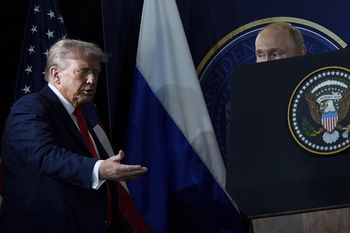
Paul Krugman, a New York Times columnist, has drawn a striking comparison between U.S. President Donald Trump and Caligula, the infamous Roman emperor known for his tyranny. This analogy was sparked by an encounter in Alaska where Trump chose to meet with Russian President Vladimir Putin instead of Ukrainian President Volodymyr Zelensky. During this meeting, Trump reportedly discussed a “forced peace” that would involve ceding parts of Ukraine’s territory to Russia and persuading Kyiv to abandon its aspirations for NATO membership.
This incident has been likened to the Yalta Conference of 1945, where the Allied powers divided the post-war world, including the fate of Eastern Europe and the Korean Peninsula. Syngman Rhee, the first president of South Korea, had previously criticized the so-called Yalta deal, accusing Washington and London of giving Korea to the Soviets. Although the truth of these claims remains unproven, Rhee's efforts are credited with preventing the spread of communism in Korea.
Trump, who openly dismisses established norms and believes in the supremacy of power, seems to embody the traits of a tyrant. His current rhetoric against China suggests he may soon attempt similar deals with other global powers, potentially at the expense of weaker nations. Without the strategic acumen and courage displayed by figures like Rhee, Korea could face a similar fate to Ukraine.
The Impact of Trump's Policies on Global Trade
Trump has significantly disrupted existing trade agreements through his aggressive tariff policies. Allies such as South Korea, Japan, and the European Union have all faced reciprocal tariffs of 15 percent, eventually yielding to pressure. The Korea-U.S. Free Trade Agreement, which was a landmark effort by both liberal and conservative leaders, has now disappeared after 13 years. In contrast, Trump delayed imposing a 145 percent tariff on China, highlighting the leverage that China holds through its control over rare earths.
The principles and trust that underpin the rules-based global trading system, particularly the World Trade Organization, are now in jeopardy. The postwar order, which was largely shaped by American leadership, is now being undermined from within.
Navigating the Challenges of Alliances
President Lee Jae Myung is set to meet with Trump to reshape the board of security and economics. This meeting could have significant implications for Korea, given the country's proximity to adversaries like North Korea, China, and Russia. Strengthening the alliance with the United States, a fellow democracy and market economy, is not just a choice but a necessity.
The asymmetry of these negotiations means that Korea has more to lose, yet this should not lead to timidity. The alliance is the result of hard-fought struggles by past presidents, and reviving their patriotism and resolve can lead to a winning strategy.
In 1953, before the armistice, Syngman Rhee challenged Washington to sign a mutual defense treaty or risk Korean forces marching north to unify the peninsula. The United States, wary of a third world war, relented, leading to the establishment of the Korea-U.S. alliance. This was a remarkable achievement for a bankrupt nation at war, shaking the grand strategy of the world's strongest power.
Similarly, in 1979, Park Chung Hee stood firm against U.S. troop withdrawals, despite being labeled Seoul’s "grim reaper." His 45-minute declaration opposing the pullout highlighted the importance of maintaining strong alliances. Although the summit was called "the worst," Carter ultimately backed off.
The Future of the Korea-U.S. Alliance
Now, Lee Jae Myung faces Trump's demands for "modernizing" the alliance to contain China. These demands include strategic flexibility for U.S. Forces Korea, troop cuts, role adjustments, and higher defense contributions. For Trump, alliances are viewed as business transactions, and during his first term, he even considered pulling U.S. troops out entirely.
The Korean president must defend the alliance against this unpredictable leader and secure a commitment to extended nuclear deterrence. The fortitude shown by Rhee and Park, who stood up to great powers, should serve as a reminder of what is possible. Today, Korea, a manufacturing powerhouse, holds a trump card in shipbuilding cooperation projects that Washington covets for its rivalry with Beijing.
Lessons from History for Modern Diplomacy
Realist scholar John Mearsheimer warns that Koreans live in one of the most unforgiving geopolitical environments, where a single misstep could be fatal. This underscores the need for the president to transcend partisan divides and harness the nation’s collective wisdom. The lived experiences of past presidents are powerful tools that can guide diplomacy.
For effective diplomacy, domestic consensus must be secured. When storms rage, a nation cannot afford to be rudderless and divided. The lessons from history show that resilience and unity are essential in navigating the complex landscape of international relations.

Post a Comment for "President Lee Needs Courage at Trump Meeting"
Post a Comment