Oops! Earendel, the Farthest Star Found, May Not Be a Star, Says James Webb Telescope
The Mysterious Earendel: A Star or a Star Cluster?
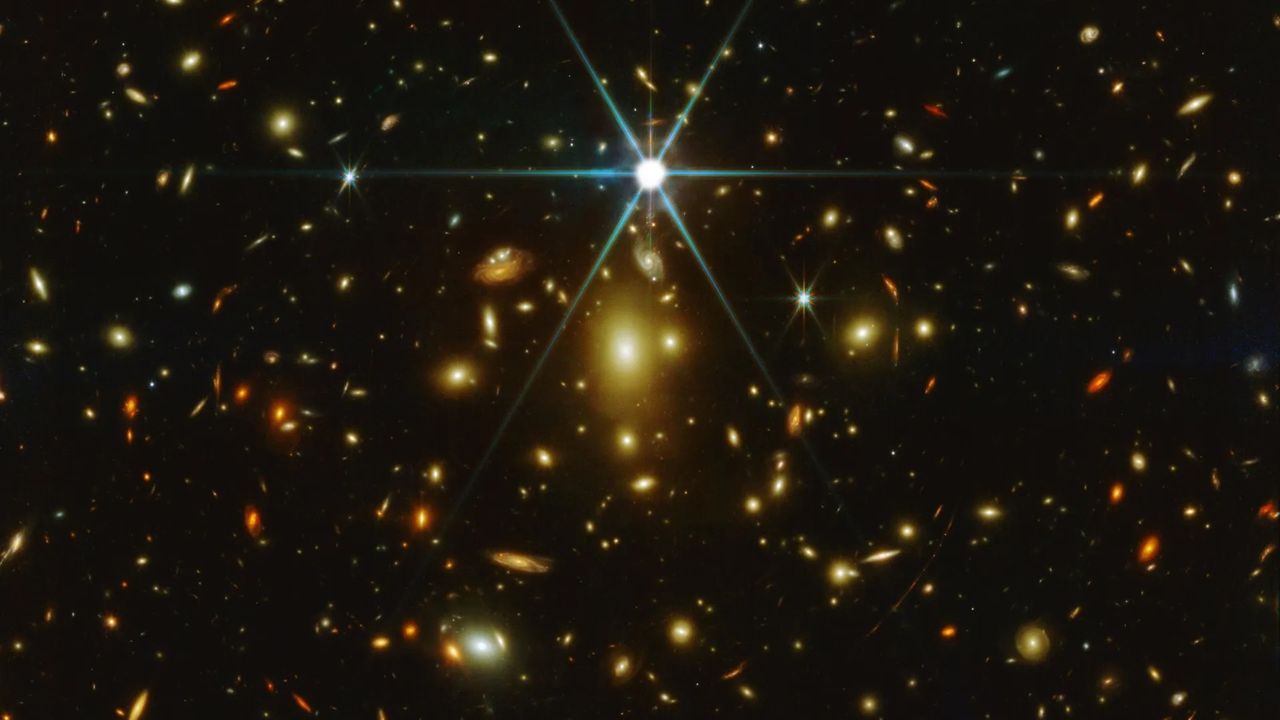
The most distant star ever discovered, known as Earendel, may not be a single star after all. Instead, it could be a compact star cluster, according to new research. This discovery challenges previous assumptions about the nature of Earendel, which was first identified in 2022 by the Hubble Space Telescope.
Earendel, named after the Old English word for "morning star," is located in the Sunrise Arc galaxy, approximately 12.9 billion light-years away from Earth. It was initially thought to be a star that formed just 900 million years after the Big Bang, making it one of the earliest stars in the universe. However, recent studies using the James Webb Space Telescope (JWST) suggest that Earendel might actually be a group of stars bound together by gravity, forming a star cluster.
Gravitational Lensing and the Discovery of Earendel
Earendel’s discovery was made possible through gravitational lensing, a phenomenon predicted by Einstein's theory of general relativity. Massive objects in space, such as galaxy clusters, bend the light passing near them, creating a magnifying effect. In this case, a massive galaxy cluster between Earth and Earendel acted as a natural telescope, amplifying the star’s light so that it became visible to astronomers.
This magnification is especially strong in certain regions, where the alignment of objects can make distant sources appear much brighter. Earendel seems to be positioned near one of these "sweet spots," allowing its light to be observed despite its immense distance. Such precise alignments are rare, which led scientists to consider alternative explanations beyond a single star.
New Insights from the James Webb Space Telescope
In a study published on July 31 in The Astrophysical Journal, astronomers used the JWST to re-examine Earendel. They aimed to determine whether the object was a single star, a binary system, or a star cluster. By analyzing data from the Near Infrared Imager (NIRCam) and the Near Infrared Spectrograph (NIRSpec), the team found that Earendel’s spectral features resemble those of globular clusters—dense groups of stars typically found in the local universe.
Massimo Pascale, a doctoral student at the University of California, Berkeley, and the lead author of the study, explained that if Earendel is indeed a star cluster, it aligns with what astronomers expect from similar structures in the early universe. “It isn’t unexpected,” he said, emphasizing that the findings support the idea that Earendel could be a group of stars rather than a single entity.
Challenges in Classifying Distant Objects
Despite these insights, some researchers remain cautious. Brian Welch, a postdoctoral researcher at the University of Maryland and NASA Goddard Space Flight Center, who was involved in Earendel’s original discovery, noted that the current data may not be sufficient to confirm the star cluster hypothesis. He pointed out that the spectral resolution of the NIRSpec instrument makes it difficult to distinguish between a single star and a star cluster in highly magnified objects.
Welch also highlighted that the study only explored the possibility of Earendel being a star cluster and did not compare other scenarios, such as it being a single star or a multiple star system. “The measurement is robust and well done, but in only considering the star cluster hypothesis, the study is limited in scope,” he added.
Future Research and Microlensing
To further clarify Earendel’s nature, scientists are turning to microlensing—a type of gravitational lensing that occurs when a nearby object temporarily distorts the image of a distant object. This effect is more pronounced for small objects like stars, planets, or star systems. Monitoring microlensing could help determine whether Earendel is a single star, a cluster, or something else entirely.
Pascale expressed optimism about future observations with the JWST, saying, “It will be exciting to see what future JWST programs could do to further demystify the nature of Earendel.”
As astronomers continue to explore this enigmatic object, Earendel remains a fascinating subject of study, offering valuable insights into the early universe and the formation of stars.

Post a Comment for "Oops! Earendel, the Farthest Star Found, May Not Be a Star, Says James Webb Telescope"
Post a Comment