Mapping Brain's 'Neural Noise' from Childhood to Adulthood
Understanding the Brain’s Development Through Aperiodic Activity
For over a century, scientists have been working to unravel the complex processes that govern how the human brain develops from birth to late adulthood. While significant progress has been made in understanding certain aspects of this development, many questions remain about how different parts of the brain mature and function over time.
A recent study conducted by researchers at Northwestern University and other institutions has brought new insights into this area. Their research focused on a type of brain activity known as aperiodic activity—signals that do not follow a rhythmic pattern. This activity is often referred to as "neural noise" and has historically been overlooked in neuroscience studies.
The findings of this study, published in Nature Human Behaviour, provide valuable information about how the brain matures during adolescence and how it supports attention and memory functions. Dr. Zachariah R. Cross, the lead author of the paper, emphasized the importance of understanding brain development throughout life. He noted that most previous studies relied on techniques like MRI or scalp EEG with small sample sizes, which limited their scope.
To gain a more comprehensive view, the researchers used intracranial electroencephalography (iEEG), a technique that involves electrodes implanted in the brain. This method allows for high-resolution tracking of electrical activity. However, iEEG is less commonly used than other methods because it requires participants who already have electrodes implanted for medical reasons, such as epilepsy treatment.
The study included a large group of individuals ranging in age from five to 54 years. By analyzing iEEG recordings, the team was able to examine how aperiodic activity varies with age and relates to cognitive functions like memory and brain structure.
Analyzing Neural Noise and Cognitive Performance
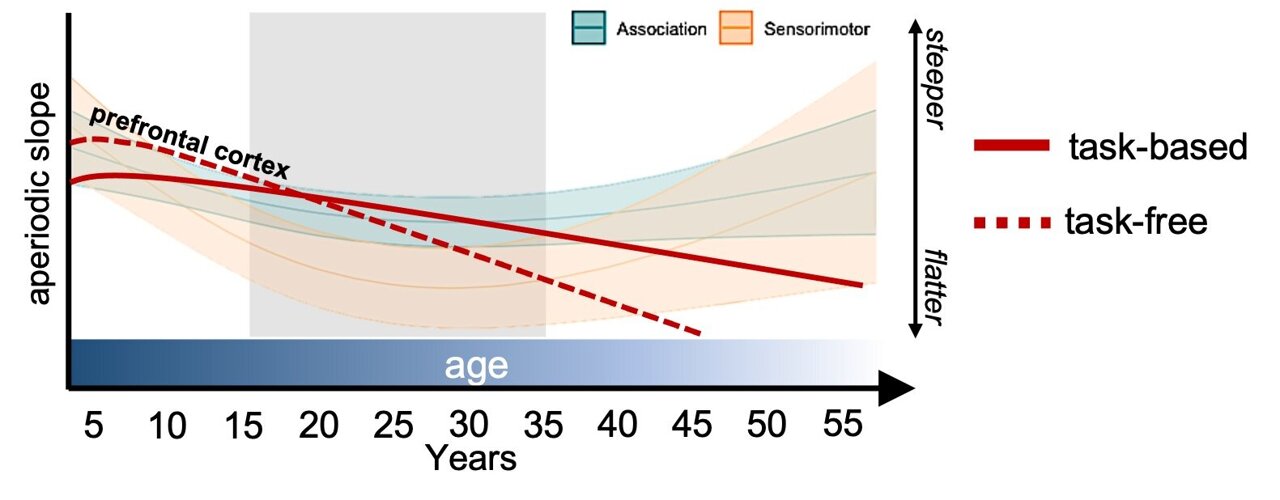
Rather than looking at overall brain activity, the researchers focused specifically on aperiodic activity. They measured what is known as the aperiodic slope, which reflects the level of neural noise. A steeper slope indicates less noise, while a flatter slope suggests more noise.
This approach allowed them to track changes in neural noise across different brain regions and explore how these changes relate to cognitive performance. Participants also completed memory-related tasks, and the researchers used structural MRI scans to measure gray matter volume in key areas such as the medial temporal lobe and prefrontal cortex.
The results revealed some surprising patterns. For instance, neural noise increased into early adulthood in certain brain regions, such as the sensorimotor and association cortices. This finding challenges the long-held belief that sensory and motor areas mature earlier than those involved in higher cognitive functions like attention and memory.
In the prefrontal cortex—a region critical for attention and memory—the researchers found that neural noise varied depending on the attentional state. Adults showed less noise during tasks, while children had more. However, increased neural noise in this area was associated with better memory performance as the brain developed, suggesting a balance between noise and function.
Implications for Brain Development and Cognitive Function
These findings highlight the importance of studying brain development across the entire lifespan, rather than focusing solely on young adults. By examining real-world conditions and tracking changes over time, the researchers were able to identify patterns of typical development and signs of dysfunction.
Looking ahead, the team hopes to track the same individuals as they age, allowing for a longitudinal analysis of brain activity. Additionally, they plan to investigate clinical populations to identify early markers of cognitive difficulties and support targeted interventions.
Dr. Cross noted that atypical neural noise has been linked to conditions like ADHD and schizophrenia, making this line of research particularly promising. The team is also preparing a sibling study focused on periodic activity, aiming to map the development of theta oscillations—key rhythms involved in memory and attention—from childhood through adulthood.
Overall, this research underscores the complexity of brain development and the need for continued exploration into how neural activity evolves over time. It opens new avenues for understanding both typical and atypical cognitive development and may lead to improved strategies for supporting brain health across the lifespan.

Post a Comment for "Mapping Brain's 'Neural Noise' from Childhood to Adulthood"
Post a Comment