Mahmoud Khalil Confronts U.S. Over Gaza Complicity in Washington
The Struggle for Palestinian Rights and the Impact of U.S. Policy
Since being released from a federal detention facility one month ago, Mahmoud Khalil has often found himself answering a pressing question: Can ordinary people influence U.S. policy toward Israel-Palestine and take action against the suppression of speech on this issue? Many individuals feel trapped or powerless in the face of American military and diplomatic support that continues to enable Israel’s ongoing offensive in Gaza. Khalil, an Algerian citizen of Palestinian descent who was previously a graduate student at Columbia University and organized protests against the Gaza war, believes that change is happening, even if it's not always visible.
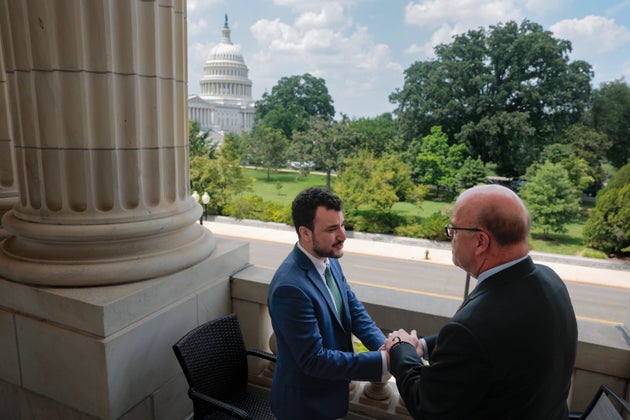
Khalil recently traveled to Washington, D.C., to meet with lawmakers and advocate for an end to the U.S.-funded conflict in Gaza. Over the course of two days, he met with nearly 20 members of Congress, mostly Democrats, including progressive figures like Rep. Ilhan Omar and established leaders like Rep. Jim McGovern. His main goal was to urge them to stop the U.S.-funded violence in Gaza, where mass starvation is occurring due to Israel’s strict control over the entry and distribution of aid. This has led to Palestinians crowding at aid hubs, often facing gunfire from Israeli soldiers and American contractors, which has resulted in more than 1,000 deaths. A coalition of over 100 humanitarian groups recently accused Israel of using starvation as a tool of warfare, a violation of international law.
Khalil emphasized that his movement is not backing down and will continue to resist until every Palestinian receives justice, freedom, and dignity. He is also seeking accountability from both the Trump administration and Columbia University, accusing them of a broader effort to silence free speech. Columbia recently disciplined nearly 80 students, including revoking degrees, for participating in antiwar demonstrations. The university is trying to regain $400 million in federal funding that President Donald Trump is withholding over allegations of failing to combat antisemitism. Critics argue that Trump is exploiting these claims to attack higher education institutions.
Khalil’s visit to Washington occurred almost exactly one year after Israeli Prime Minister Benjamin Netanyahu addressed a joint session of Congress during the ongoing attacks in Gaza. Despite widespread criticism and the absence of over 100 lawmakers, Netanyahu continues to receive U.S. weapons, while his stated goals for the war remain unfulfilled. Khalil’s trip highlighted how entrenched pro-Israel narratives still dominate elite circles in the U.S.
During a live interview on CNN, Khalil was repeatedly asked to condemn Hamas, but he refused, stating that such selective condemnation would not lead to meaningful change. He expressed continued surprise at the indifference of U.S. policymakers toward Palestine and their complicity in what he described as clear war crimes. In his meetings with legislators, he learned that many find it difficult to advocate for Palestinians due to the influence of the American Israel Public Affairs Committee (AIPAC), whose donors often fund campaigns against politicians critical of Israel.
Despite this, Khalil believes that public awareness of the crisis in Gaza is growing. “The American public are awakened now,” he said. “That’s why it’s very important that we continue to push.” While institutions may be slow to respond, he remains optimistic about the progress being made.
Khalil pointed to the recent victory of Zohran Mamdani in the Democratic primary for New York City mayor, highlighting that supporting Palestine is no longer a taboo in U.S. politics. He also shared a personal moment when antiwar activists recognized him, showing the impact of his advocacy.
Khalil’s journey has not been easy. He was targeted for deportation and arrested in March, with the administration claiming his beliefs could harm American foreign policy. However, a judge ruled that the administration had not proven its case. Khalil and his lawyers argue that the government has subjected him to reputational harm and emphasize his rejection of antisemitism.
He stressed that the U.S. policies must be acknowledged as bipartisan, noting that the Biden administration laid the groundwork for his detention by aligning with the Israeli narrative. Khalil believes that both administrations have contributed to the repression of free speech and the spread of misinformation.
In addition to fighting the government’s attempt to detain and deport him, Khalil is now seeking $20 million in damages or an official apology from the Trump administration. He remains committed to holding accountable everyone involved in his illegal prosecution.
After being detained for 104 days and finally released, Khalil describes his feelings as a mix of joy at reuniting with his family and a deep sense of duty. He sees his arrest as a platform to advocate more for Palestinian rights. “I did not choose to be in such a position, but now that such a position is imposed upon me, I will take that responsibility with pride,” he said.

Post a Comment for "Mahmoud Khalil Confronts U.S. Over Gaza Complicity in Washington"
Post a Comment