Lockheed vs General Dynamics: Which Defense Giant Reigns Supreme?
Comparative Analysis of Lockheed Martin and General Dynamics
As global geopolitical tensions rise, military conflicts intensify, and cybersecurity threats become more prevalent, governments around the world have significantly increased their defense budgets over the past decade. This surge has attracted strong investor interest in defense stocks, with major players like Lockheed Martin (LMT) and General Dynamics (GD) emerging as key beneficiaries.
Lockheed Martin is renowned for its combat-proven fighter jets such as the F-35, missile defense systems, and space assets. On the other hand, General Dynamics offers a diverse portfolio that includes commercial and defense aerospace, nuclear submarines, and mission-critical IT services. Both companies are well-positioned to capitalize on the ongoing modernization of military fleets, enhanced deterrence strategies, and improved digital infrastructure across the globe.
For investors seeking exposure to the booming defense industry, choosing between LMT and GD can be challenging due to each company’s unique strengths and growth drivers. A deeper examination of their financial stability, growth prospects, and associated risks can provide valuable insights.
Financial Stability and Growth Drivers: LMT vs GD
Lockheed Martin's balance sheet shows some concerns regarding solvency. As of June 29, 2025, the company had $1.29 billion in cash against $3.12 billion in current debt and $18.52 billion in long-term debt. Despite this, its operating cash flow of $1.61 billion in the first half of 2025 enabled generous shareholder returns. The company paid $1.57 billion in dividends, up 2.3% year over year, and repurchased 2.7 million shares worth $1.3 billion. However, the high debt relative to cash raises questions about the long-term sustainability of these payouts.
General Dynamics, in contrast, maintained a stronger short-term solvency position. As of June 29, 2025, the company held $1.52 billion in cash versus $1.20 billion in current debt. This financial strength supported a 170.5% year-over-year increase in operating cash flow to $1.45 billion in the first half of 2025. GD used this strong cash position to pay $785 million in dividends, up 4.7% from the prior-year level, and repurchase 2.4 million shares. These moves highlight GD’s commitment to long-term shareholder value.
A key growth driver for both companies is the expansionary U.S. defense budget. In May 2025, the White House proposed a 13% hike in defense spending to $1.01 trillion for fiscal 2026. This includes significant funding for missile defense systems, the U.S. Space Force, naval shipbuilding, and cybersecurity—areas where both LMT and GD have strong positions.
Beyond the defense budget, General Dynamics benefits from its commercial aviation segment, particularly business jets. With global air traffic increasing, demand for GD-built aircraft like the G700 is rising, supporting long-term revenue growth. Conversely, Lockheed Martin's growth is driven by innovative defense programs such as F-35 sustainment, PAC-3 missile production, and the modernization of the Trident II D5 ballistic missile.
Risks of Investing in LMT vs GD
Both companies face industry-wide challenges, including skilled labor shortages and critical parts scarcity due to ongoing supply chain issues. Recent U.S. tariffs on imports, such as a 25% duty on steel and aluminum, further complicate matters by risking limited availability of key materials and potential production delays.
Lockheed Martin has encountered performance setbacks on certain classified contracts, leading to occasional losses in recent quarters. Meanwhile, General Dynamics, with its exposure to the commercial aviation sector, is more vulnerable to supply disruptions than Lockheed. While both sectors face component shortages, the impact is more pronounced in commercial aerospace due to its reliance on global supply chains and market volatility.
Zacks Estimates and Stock Performance
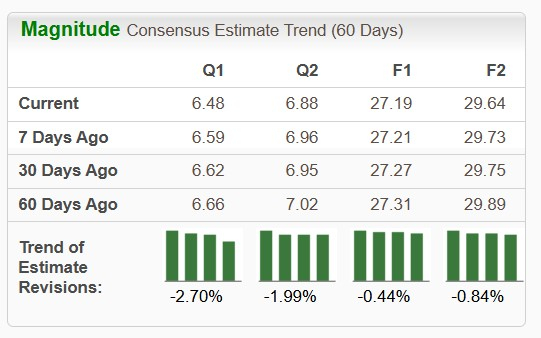
The Zacks Consensus Estimate for Lockheed Martin's 2025 sales suggests a 4.6% increase from the previous year, but its earnings per share (EPS) is expected to decline by 4.5%. In contrast, General Dynamics' 2025 sales are projected to rise by 5.9%, with EPS expected to increase by 9.9%.
In terms of stock price performance, LMT has underperformed GD over the past three months, with LMT down 11.7% compared to GD’s 15.5% gain. Over the past year, LMT lost 19.8%, while GD gained 8.2%.
Valuation and Financial Metrics
Lockheed Martin trades at a forward earnings multiple of 14.69X, which is lower than GD’s 19.60X. Additionally, LMT’s return on equity (ROE) is higher than GD’s, indicating better efficiency in generating profits from its equity base. However, GD is less leveraged than LMT, with a lower long-term debt-to-capital ratio.
Final Call
Both Lockheed Martin and General Dynamics stand to benefit from rising global defense budgets and heightened geopolitical risks. While LMT boasts a robust defense portfolio and competitive valuation, its elevated debt levels and recent market underperformance raise caution. On the other hand, GD appears better positioned in the near term, supported by stronger earnings, lower leverage, solid cash flow, and a more stable stock performance.
Although both stocks currently hold a Zacks Rank #3 (Hold), General Dynamics’ balanced exposure, financial resilience, and operational momentum make it the safer and more attractive defense contender at present.

Post a Comment for "Lockheed vs General Dynamics: Which Defense Giant Reigns Supreme?"
Post a Comment