Liam Dawson's Hidden Threat to Shoaib Bashir's Plans
Liam Dawson’s Return to Test Cricket: A Long-Awaited Moment
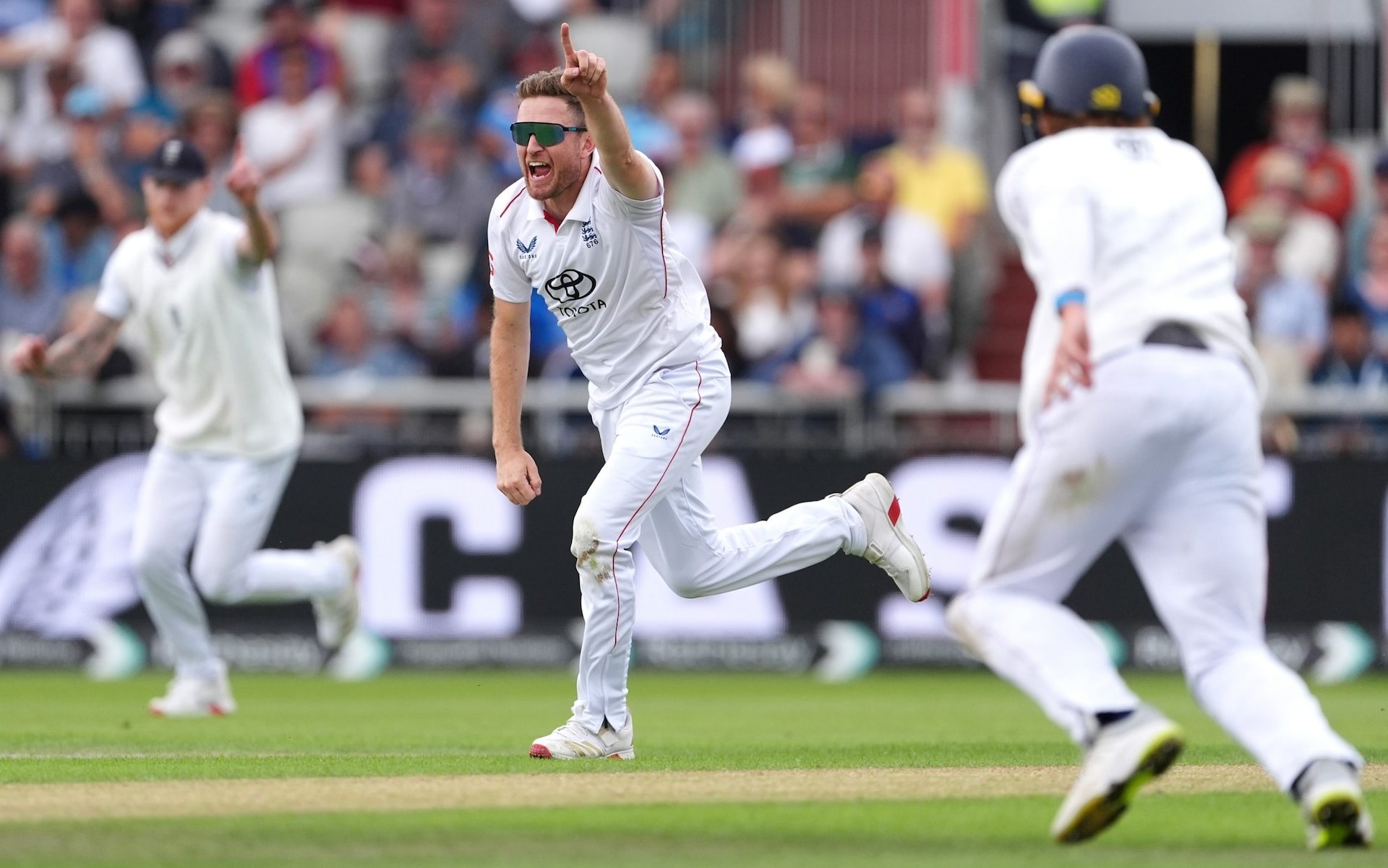
Liam Dawson’s return to Test cricket was marked by a moment that encapsulated his unique style and the challenges he faced over the years. On the seventh ball of his Test career, after an eight-year absence, Dawson delivered a delivery that drifted in the air and landed on an impeccable line outside Yashasvi Jaiswal’s off stump. Jaiswal, a left-hander, attempted to defend, expecting the ball to turn back toward him. However, the lack of spin proved decisive, leading to an edge and a wicket. This moment was not just a technical achievement but also a symbolic one, highlighting the journey that brought Dawson back to the international stage.
Dawson is not one for grand gestures, but his reaction to taking his eighth Test wicket was telling. After Harry Brook took a routine catch at slip on the first day of the fourth Test at Old Trafford, Dawson raised his left hand in celebration, leapt with joy, and punched the air. For a player who had spent 102 matches away from the Test team, this moment was deeply meaningful. It signified the culmination of years of perseverance and the recognition of his skills.
The list of spinners England has used in Dawson’s absence is staggering. Since his last Test appearance, the team has selected 12 different spinners, including Will Jacks, Liam Livingstone, and even Joe Root. During England’s recent tour of India, Shoaib Bashir and Tom Hartley were chosen, despite their relatively modest first-class records. Dawson, who had taken 49 wickets at an average of 20, was not even in the squad. At the time, he described a return to Test cricket as “completely off the radar.”
Despite his long exile, Dawson has consistently performed at the domestic level. Over the past three years, he has been one of the most consistent performers in English county cricket. Since 2023, he has taken 124 County Championship wickets at an average of 25.6, while scoring seven centuries and averaging 47.6 with the bat. His performance in white-ball cricket earlier this summer, where he took four wickets for 20 runs in his first game back, suggested that England may have overlooked his abilities in recent years.
Part of Dawson’s absence can be attributed to his own decisions. Two years ago, he turned down a call-up for a limited-overs tour of Bangladesh. Before the 2024 Test series in India, he made it clear that he would only tour if he was certain of playing. He also acknowledged that he had spent more time running drinks than playing in international matches.
From 2016 to 2022, Dawson was frequently in England’s squads, especially in white-ball formats, but played only 20 international matches. He was part of the successful 2019 One-Day International World Cup and 2022 T20 World Cup teams but never made the starting XI. He was also told to prepare for the 2023 ODI World Cup but was ultimately not picked.
England’s preference for younger, more flamboyant spinners like Rehan Ahmed and Tom Hartley led to Dawson’s prolonged absence. These players were valued for their wrist spin, high release points, and physical attributes. In contrast, Dawson’s value lies in his consistency, accuracy, and mastery of length. His ability to make batsmen push forward repeatedly and his skill in delivering non-spinning deliveries that still cause problems are often overlooked in highlight reels.
Dawson’s early success in the Test match was modest, but his performance over 15 overs showed his craftiness. He conceded exactly three runs an over, slightly better than Shoaib Bashir’s economy rate. On a flat pitch, Dawson adapted well, switching between bowling over and around the wicket to left-handers and varying his speed and release point.
His ability to bowl effectively against left-handers could be significant for England’s future strategy. While Bashir is effective against left-handers, Dawson’s strength against right-handers complements his overall effectiveness. Additionally, Dawson’s fielding and batting provide valuable depth for England, particularly in conditions where the ball offers little assistance.
Compared to Bashir, the differences between Dawson and his replacement are evident not just in his bowling but also in his fielding and batting. With a first-class average of 35.3, Dawson adds crucial depth to England’s lineup, especially in the middle order.
Before the Test match, England assistant coach Jeetan Patel described Dawson as a “plug-and-play” option. However, his performance hinted at the potential impact of a pragmatic selection decision. As England continues to navigate its spin options, Dawson’s return could signal a shift in approach, valuing consistency and experience over flashier alternatives.

Post a Comment for "Liam Dawson's Hidden Threat to Shoaib Bashir's Plans"
Post a Comment