Leapmotor China's EV Star Soars 200%
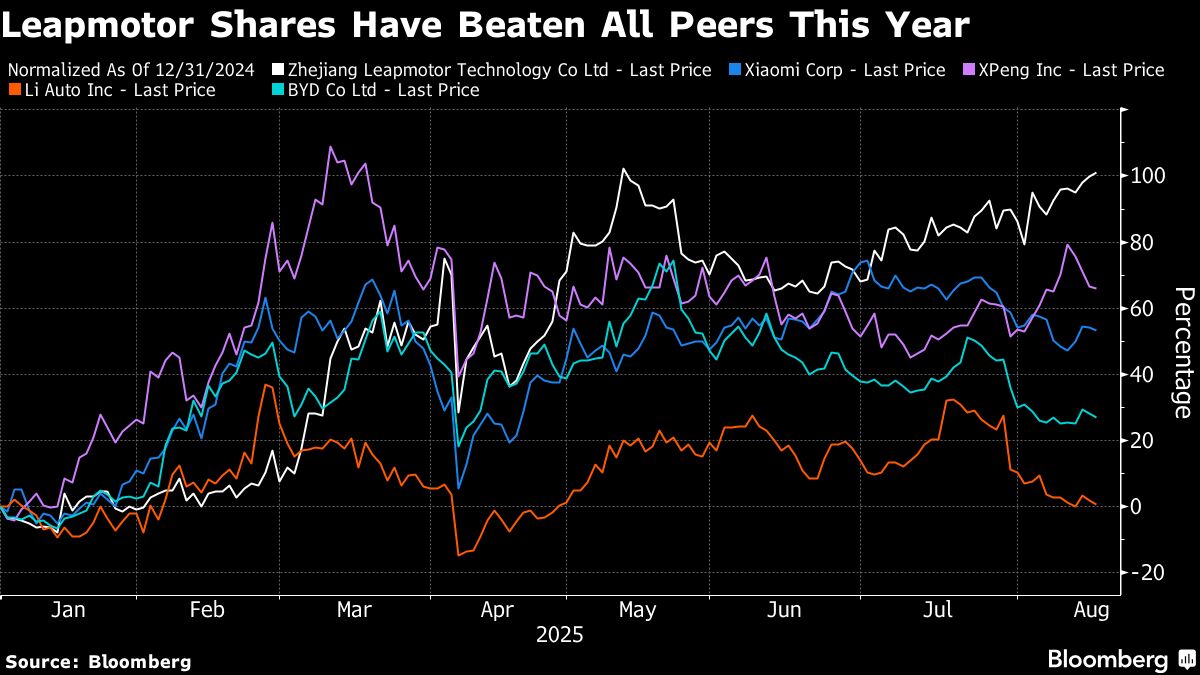
Leapmotor’s Rise in the Chinese Electric Vehicle Market
Zhejiang Leapmotor Technology Co., once considered a minor player in China’s electric-vehicle industry, has emerged as a strong contender this year. The company has outperformed its startup rivals in both sales and stock performance, with analysts predicting continued growth.
Leapmotor’s Hong Kong-listed shares have more than doubled since January, surpassing well-known competitors like XPeng Inc. and Xiaomi Corp. Additionally, the stock has surged over 200% from its low point in August of last year. The company has also raised its 2025 sales target to 500,000 units, up from approximately 290,000 a year earlier. Analysts are optimistic that Leapmotor may achieve its first annual profit this year.
Strategic Advantages and Cost Efficiency
Founded in 2015 by Zhu Jiangming and Fu Liquan, who previously established security-camera manufacturer Dahua Technology Co., Leapmotor started as an underdog. In its early years, it struggled to match the sales volumes of industry giants like BYD Co. and other startups such as Xpeng and Li Auto Inc.
A key factor behind Leapmotor’s recent success is its focus on vertical integration. By producing a large proportion of components in-house, the company has been able to maintain cost efficiency. This approach is largely attributed to Zhu’s background in electronics and software, which has driven the company’s R&D efforts.
“Leapmotor’s price competitiveness is remarkable,” said Xiao Feng, co-head of China industrial research at CLSA Hong Kong. “They’re offering large vehicles at mass-market prices, thanks to roughly 70% vertical integration. We see strong upside potential driven by a robust product cycle and exceptional capital efficiency.”
Competitive Pricing and Market Positioning
Leapmotor’s strategy of offering affordable vehicles has resonated with consumers, especially in the current economic climate where buyers are more cost-conscious. The company's family-oriented C11 SUV, launched in late 2020, retails for as little as 148,800 yuan ($20,700). In comparison, Li Auto’s cheapest vehicle, the L6 SUV, starts at 249,800 yuan.
Rosalie Chen, an analyst at global research firm Third Bridge, noted that Leapmotor develops and manufactures almost everything in-house, except for batteries, which gives it greater control over costs. “This kind of vertical integration gives Leapmotor a cost advantage over rivals who rely heavily on outside suppliers.”
The company’s monthly sales reached over 50,000 vehicles in July for the first time, although it still trails behind BYD’s 344,296 units. However, it exceeds the sales of all its startup rivals.
Challenges Ahead
Despite its current success, Leapmotor faces challenges in maintaining its growth momentum. Gary Tan, a fund manager at Allspring Global Investments in Singapore, pointed out that to reach the market capitalization of more established Chinese EV peers, Leapmotor must demonstrate scalability across more segments in the China EV space and cross the one-million-unit inflection point.
Another challenge is transitioning to long-term profitability. Analysts forecast that Leapmotor will report a profit of 558 million yuan for 2025. The company’s progress will be evaluated through its first-half results, which are due later in the week.
Expanding Globally
One potential driver of future growth is Leapmotor’s joint venture with European carmaker Stellantis NV, announced in late 2023. Under the partnership, Stellantis agreed to manufacture and sell some Leapmotor models outside China. This marks a shift from the in-house approach that helped Leapmotor gain domestic market share.
While this strategy contrasts with other Chinese automakers like BYD, which is building factories in Hungary and Turkey, it could help Leapmotor develop its global presence more rapidly. Last year, the company exported 13,726 units overseas, accounting for about 5% of its total sales.
Gary Tan of Allspring Global Investments believes that export traction and software monetization could serve as near-term catalysts, reinforcing Leapmotor’s transition from a domestic player to a scalable global EV brand.

Post a Comment for "Leapmotor China's EV Star Soars 200%"
Post a Comment