Largest Plane Ever to Begin Production in 2027: 354-Foot Length, 262-Foot Wingspan
The Evolution of Aviation and the Future of Large Aircraft
Aviation has come a long way since the Wright Brothers made their first flight in 1903. In just over a century, planes have transformed from experimental contraptions to sophisticated machines that connect people and goods across the globe. Today, thousands of aircraft operate daily, enabling travel to places that were once unimaginable. However, the future of aviation promises even greater advancements, with companies pushing the boundaries of what is possible.
One such company is Radia, a Colorado-based aviation firm that is aiming to redefine the limits of aircraft size. Currently, the largest plane ever built is the Antonov An-225 Mriya, a Soviet-era aircraft that measured 84 meters (274 feet) in length and had an impressive wingspan of 88.4 meters (290 feet). Unfortunately, this remarkable machine was destroyed in 2022 during the Russian invasion of Ukraine. Now, Radia is looking to take the title of the world’s largest plane with its new design, the WindRunner.
Introducing the WindRunner: A Game-Changer for Wind Turbine Transport
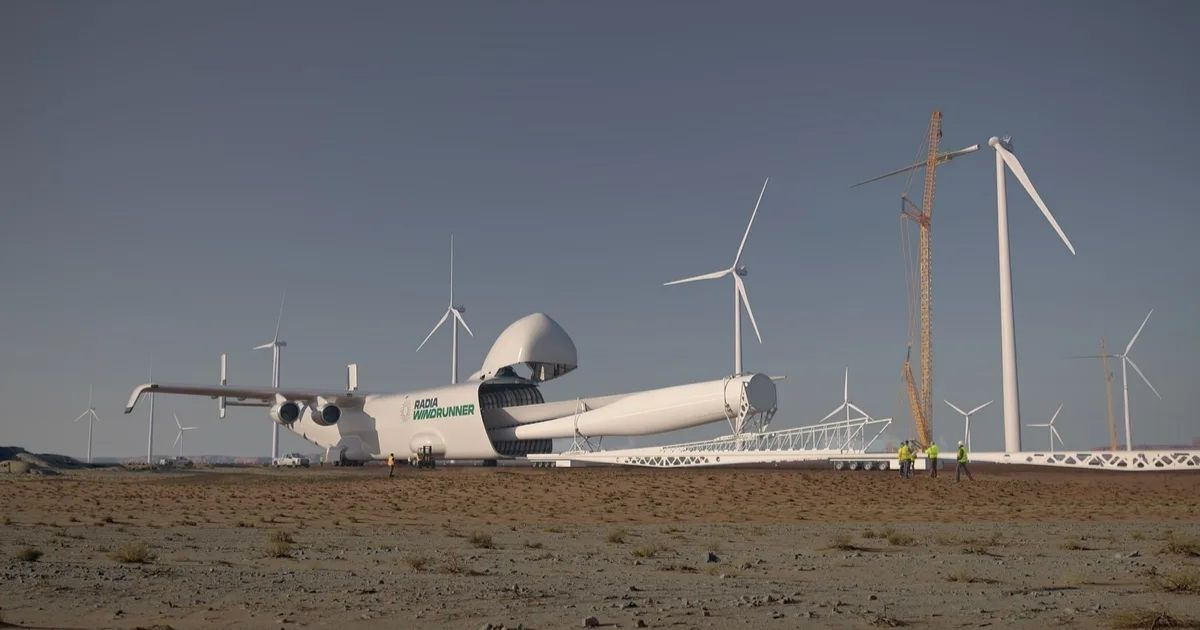
The WindRunner is set to be 108 meters (354 feet) long and will have a wingspan of 80 meters (262 feet). This makes it significantly larger than the An-225 Mriya. More importantly, the WindRunner is not designed for passenger travel but rather for transporting wind turbines. These massive structures are difficult to move due to their rigid nature, which makes traditional transportation methods like trucks inefficient and challenging, especially when navigating tight spaces or remote locations.
Wind farms are often located far from urban centers, requiring long-distance transport of these large components. The WindRunner is designed to address this challenge by being able to take off and land on relatively small runways, making it ideal for reaching remote areas where wind farms are typically built. This capability could revolutionize the logistics of wind energy development, making it easier and more efficient to deploy turbines in hard-to-reach locations.
Environmental Considerations and Potential Impact
Despite its potential benefits, the WindRunner also raises some environmental concerns. Critics argue that the construction and operation of such a specialized aircraft may offset some of the environmental gains achieved by wind energy. For instance, if the plane can only carry one or two turbine blades at a time, it would require multiple trips to transport all necessary components for a full wind farm. Each trip would consume fuel, contributing to carbon emissions. The question remains whether the energy generated by these wind farms will be enough to offset the emissions from the plane's operations.
However, the WindRunner's design could offer efficiency advantages. Larger aircraft generally operate more efficiently per pound of cargo compared to smaller ones, potentially reducing the overall environmental impact. Additionally, the project has already attracted attention from the U.S. Department of Defense, which sees potential applications for transporting large military equipment to remote locations.
A Promising Step Forward
Although the WindRunner is not expected to enter production until 2027, the project represents a significant step forward in aviation technology. If successful, it could help accelerate the expansion of renewable energy infrastructure, making wind power more accessible and cost-effective. Mark Lundstorm, founder and CEO of Radia, emphasized the potential impact of the WindRunner, stating that it could bring about a "step-function improvement" in onshore wind energy projects, leading to lower costs, higher profitability, and increased investment in the energy transition.
As the demand for green energy continues to grow, innovations like the WindRunner could play a crucial role in shaping the future of sustainable power. Whether it ultimately proves to be a game-changer or faces challenges along the way, the WindRunner is a testament to the ongoing evolution of aviation and its potential to support global environmental goals.

Post a Comment for "Largest Plane Ever to Begin Production in 2027: 354-Foot Length, 262-Foot Wingspan"
Post a Comment