K-12 Education Evolves: Can Stride Shape the Next 25 Years?
The Rise of Stride in the Digital Education Landscape
In an era where traditional public schooling is facing unprecedented challenges, Stride, Inc. (LRN) is redefining the future of digital education. As dissatisfaction with conventional educational models reaches historic levels, Stride has emerged as a leader in providing innovative learning solutions that cater to evolving student needs.
During its fiscal third-quarter 2025, Stride reported impressive financial results, with revenue increasing by 17.8% year-over-year to $613.4 million—surpassing expectations by $20 million. This growth was fueled by a 21% increase in total enrollment and a significant 33% rise in career learning revenue, which reached $223.9 million. The company's success can be attributed to its robust enrollment growth of 34%, driven by its career-focused middle and high school programs, tutoring platforms, and innovative initiatives such as K12 Zone and geo-based social pods that combine digital learning with real-world interaction.
Structural Tailwinds Favoring Stride
The company’s performance aligns with broader shifts in parental attitudes toward education. According to February Gallup Polls, nearly 90% of parents are now considering non-college career paths for their children, while more than 15% have explored full-time online schooling—figures that have risen sharply since pre-pandemic times. Stride is well-positioned to meet this demand by offering comprehensive educational options that support students’ diverse learning journeys.
Management has also raised its full-year revenue and operating income guidance for fiscal 2025, indicating confidence in the company’s trajectory. Stride is already on track to surpass its 2028 compound annual growth rate (CAGR) targets three years ahead of schedule. Despite a minor earnings per share (EPS) miss due to an increased share count from convertible notes, the company’s fundamentals remain strong, with adjusted operating income rising by 47% and gross margins expanding by 190 basis points to 40.6%.
Challenges and Opportunities Ahead
While Stride continues to gain momentum, it faces several challenges. State-level enrollment caps and limited traction in lower grades could pose constraints on future growth. However, if the company can expand its reach and capitalize on the changing preferences in education, its vision to lead the next 25 years of K-12 innovation may not be far-fetched.
Competitors in the Digital Learning Space
As Stride charts its course for the future, it must also contend with competitors like Chegg (CHGG) and Coursera (COUR), both of which are shaping the digital education landscape through different models. Chegg, known for its study tools and textbook services, is transitioning toward AI-driven learning support. While it doesn’t directly compete in full-time K-12 enrollment, its tools increasingly serve high schoolers preparing for college or workforce credentials. This shift may push Stride to enhance its academic support offerings to stay competitive.
Coursera, on the other hand, is expanding its presence in online credentialing and high school dual-enrollment programs. Through partnerships with universities and governments, Coursera offers scalable, low-cost education alternatives, presenting a growing challenge to Stride as career education becomes more mainstream in K-12 settings. To maintain its leadership position, Stride must continue to differentiate itself from these competitors.
Stock Performance and Valuation Trends
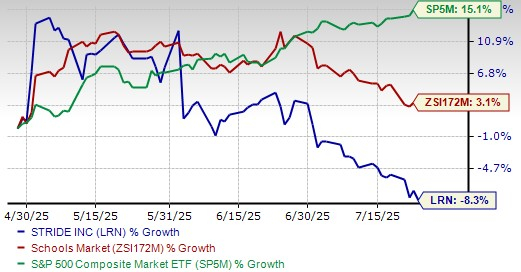
Despite its strong financial performance, Stride’s stock has experienced a downward trend, declining by 8.3% over the past three months. This underperformance has been noted against the Zacks Schools industry and the S&P 500 index. Currently, Stride’s stock trades at a discount compared to its industry peers, with a forward 12-month price-to-earnings (P/E) ratio of 2.17.
Earnings estimates for fiscal 2025 and 2026 remain unchanged at $7.09 and $7.76 per share, respectively. However, these figures imply year-over-year growth of 51.2% and 9.4%, respectively, signaling continued optimism about the company’s long-term prospects.
Investor Outlook
At present, LRN stock carries a Zacks Rank #3 (Hold). Investors are closely watching the company’s progress as it navigates the evolving digital education landscape and strives to maintain its position as a market leader.

Post a Comment for "K-12 Education Evolves: Can Stride Shape the Next 25 Years?"
Post a Comment