Japan's First Post-WW2 Fighter Jet Revealed
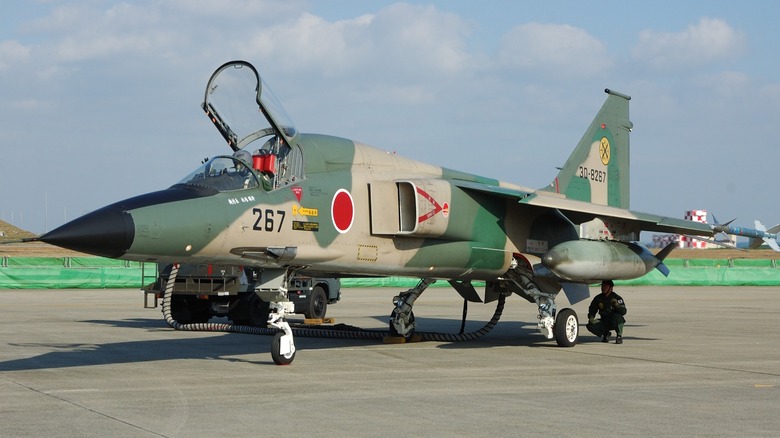
Japan's Aviation Innovation and the Development of the Mitsubishi F-1
During World War II, Japan showcased remarkable innovation in aviation technology. The country developed several advanced aircraft that played a significant role in the early stages of the conflict. Among these was the infamous Mitsubishi A6M "Zero," a fighter plane that caused considerable damage to Allied forces. Additionally, Japan created other deadly aircraft, including a secret jet fighter known as the Nakajima Kikka. However, this project was not completed before the war ended in 1945.
Following the conclusion of World War II, Japan was placed under strict military restrictions, limiting its ability to develop offensive weapons. Despite these constraints, the nation eventually began developing its own strike aircraft in the 1970s. This marked a pivotal moment in Japan’s military aviation history.
The Evolution of Japan's Jet Trainer Program
The Japan Air Self-Defense Force (JASDF) initially aimed to create a jet trainer to replace the American-produced F-86 Sabre, which had been in use for many years. The need for a faster supersonic trainer arose due to the upcoming introduction of the U.S.-made F-104 Starfighters. Unfortunately, the F-104 gained a notorious reputation as the “Widowmaker” because of its high accident rate.
In 1971, Japan successfully launched the Mitsubishi T-2, a jet trainer that would later serve as the foundation for a new strike aircraft. This development was crucial for preparing pilots for more advanced aircraft and enhancing the JASDF's capabilities.
The Birth of the Mitsubishi F-1
After years of research and testing, the JASDF introduced the Mitsubishi F-1 in 1975. This aircraft was designed for anti-ship and airborne defensive missions. Due to the relatively small size of the JASDF, only 77 units of the F-1 were produced, with production concluding in 1981. The F-1 proved to be a reliable and agile strike aircraft, with its first delivery occurring in 1977. It remained in service until 2006, when more modern platforms became available. At that time, the JASDF had already integrated licensed F-15 Eagles and F-2s derived from the F-16 Fighting Falcon into its fleet.
Capabilities and Armaments of the Mitsubishi F-1
The Mitsubishi F-1 was primarily a strike aircraft but could also function as a light bomber. It was equipped with a 20mm JM61A1 Vulcan six-barreled gatling cannon and had a payload capacity of nearly 6,000 pounds of rockets and bombs that could be fired or dropped from seven hardpoints. Notably, it could carry the AIM-9L Sidewinder, the world's first infrared-homing (heat-seeking) air-to-air missile still in use today.
This capability made the F-1 a formidable interceptor, although it was not classified as a traditional fighter. Additional armaments included the Mitsubishi ASM-1 anti-ship missile and various 70mm and 125mm rockets fired from pods. The F-1 was powered by two Rolls-Royce/Turbomeca turbojet engines, providing a combined thrust of 10,230 pounds. Its maximum speed reached Mach 1.37 (1,056 mph), and it could operate at a ceiling of 50,000 feet.
Performance and Range
While the F-1's performance was comparable to other strike aircraft of its era, its range was relatively limited. The aircraft could fly a distance of 345 miles, which may seem substantial for a car trip but is considered short for a jet. However, it had a larger ferry range of 1,783 miles. For comparison, the F-15A, introduced around the same time, had a non-ferry range of 3,450 miles with external fuel tanks.
Since the JASDF used the F-1 solely for national defense, a longer range was not necessary, and the aircraft performed effectively within its intended role. The F-1's design and capabilities represented a significant step forward in Japan's self-defense strategy, showcasing the nation's growing expertise in military aviation.

Post a Comment for "Japan's First Post-WW2 Fighter Jet Revealed"
Post a Comment