How Fast Was the Dodge Tomahawk and Why It Never Left the Drawing Board?
A Bold and Unconventional Vision
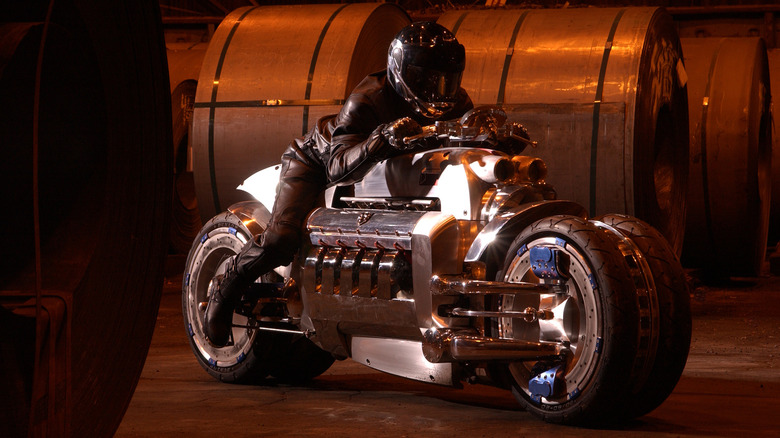
When Dodge unveiled its groundbreaking concept motorcycle at the 2003 North American International Auto Show in Detroit, it sparked a range of reactions from awe to confusion. The vehicle was unlike anything seen before—both in design and engineering. Forbes described it as "a bacchanalia of metal and death," while Autoweek noted that "brash is the driving attitude at Dodge." The Tomahawk, as it was called, was a four-wheeled, art-deco styled billet aluminum bike with an impressive 500-hp V-10 engine. It challenged all traditional notions of what a motorcycle should be.
The Tomahawk was not just a bold statement—it was also a high-priced experiment. Priced at over half a million dollars, it featured an engine similar to the fan-favorite Dodge Viper supercar. However, this was a manufacturer with no prior experience in producing motorcycles. This combination of factors made the Tomahawk a unique and controversial creation.
A Sculpture That Can Be Ridden
Dodge acknowledged the audacity of its design, referring to the Tomahawk as a "sculpture that can be ridden." The company emphasized that it was intended for display purposes only, a stance reinforced by its limited availability through the Neiman Marcus catalog. This caution might have been justified, as the Tomahawk was likely the most powerful motorcycle ever produced. At its debut, Dodge estimated that the four-wheeled mega-bike could reach nearly 400 mph, a speed that would surpass any of the fastest motorcycles ever built.
Despite these ambitious claims, the company never tested the limits of its rolling sculpture. Instead, it sold just nine units through the luxury department store. This limited production highlighted the challenges of turning such an unconventional concept into a viable product.
The Viper V10 Engine: Power Meets Innovation
The heart of the Tomahawk was the Viper V-10 engine, a massive 8.3-liter powerplant that delivered 500 hp and 525 lb-ft of torque. This engine was so large that the design team added a fourth wheel to prevent riders from tipping over. The V-10 was one of the most extreme engines ever put into a motorcycle, and its inclusion in the Tomahawk had immediate implications for speed and acceleration.
The Tomahawk's estimated 2.5-second 0 to 60 time would have made it faster than the famed Porsche 918 Spyder, while its predicted top speed of 400 mph would have made it the fastest bike to ever hit production. However, these numbers remain unverified, as the vehicle was never road-tested. Some skeptics question whether anyone ever pushed the Tomahawk to its limits.
An Audacious Concept
True to its designation as a "rolling sculpture," the Dodge Tomahawk never made it out of the showroom floor and onto the streets. Sold for $550,000 in Neiman Marcus' 2003 Christmas catalogue, the Tomahawk was one of the world's most expensive motorcycles despite not being fit for the road. As a result, Dodge only sold nine models of its infamous concept vehicle.
While Dodge has never officially explained why their most absurd creation never reached the assembly line, the reasons are clear. The bike's wheels alone prevented it from becoming street legal. Additionally, many considered the motorcycle too dangerous to drive. Dodge, for its part, probably agreed, as it never road-tested the vehicle.
The Legacy of the Tomahawk
Despite its lack of practicality, the Tomahawk remains a symbol of innovation and ambition. It challenged the boundaries of what a motorcycle could be and showcased the potential of combining high-performance engineering with bold design. While it may never have taken to the roads, the Tomahawk left a lasting impact on the automotive world.
Its story serves as a reminder of the risks and rewards of pushing the envelope in design and engineering. Whether viewed as a masterpiece or a folly, the Tomahawk continues to capture the imagination of enthusiasts and critics alike.

Post a Comment for "How Fast Was the Dodge Tomahawk and Why It Never Left the Drawing Board?"
Post a Comment