How Fast Can China's Maglev Go? Its Speed Will Amaze You
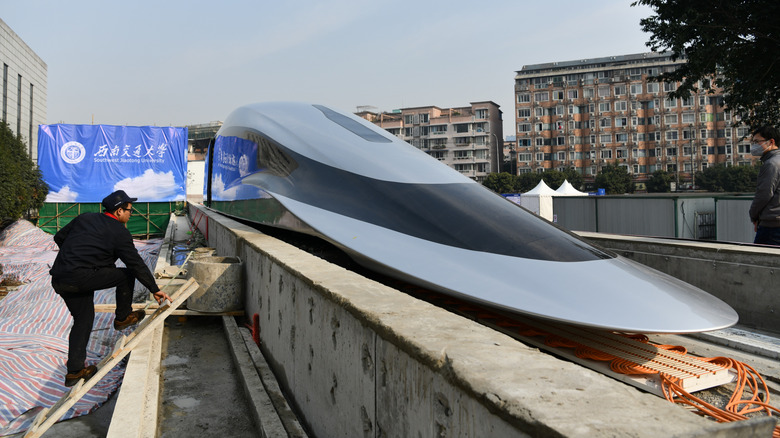
The Future of High-Speed Travel: China's CR450 Maglev Train
China is pushing the boundaries of transportation with its latest innovation, the CR450 magnetic levitation (maglev) train. Although it's not yet in service, the train has already demonstrated remarkable performance during testing, reaching speeds over 620 miles per hour. For comparison, commercial passenger jets typically cruise between 480 and 575 miles per hour. What makes the CR450 even more impressive is its acceleration capabilities—recent tests showed it can reach over 400 mph in less than seven seconds.
This incredible speed is made possible by the absence of friction. Unlike traditional trains that rely on wheels and tracks, the CR450 hovers above the ground using powerful electromagnets that create an opposing force to propel the train forward. This means the main resistance it faces is aerodynamic drag. To combat this, the CR450AF bullet train, unveiled in 2024, features a dramatically tapered nose design, which helps reduce air resistance significantly.
When officially launched, the CR450 will surpass the fastest high-speed trains currently in operation, including China’s own Shanghai maglev. This advancement marks a significant step forward in the evolution of transportation technology.
Challenges in Building a Maglev Network
Despite the promise of maglev technology, expanding and maintaining such a network comes with considerable challenges. China has already invested heavily in its Fuxing Hao trains, which are among the most advanced high-speed rail systems in the world. However, building a maglev network requires substantial financial resources. Studies suggest that the cost of constructing and operating a maglev system can be up to five times higher than traditional high-speed rail options.
Another major hurdle is the fact that maglev tracks cannot be used by conventional trains, and existing tracks cannot be adapted for maglev use. This means that new infrastructure must be built from scratch, further increasing costs. Additionally, there are environmental concerns related to aerodynamic noise. Even though the train floats on electromagnetic fields, it can generate harmful levels of sound at high speeds.
For example, when the Shanghai maglev travels at 430 kilometers per hour (267 mph), the sound pressure at 35 meters from the track can reach 96 decibels—equivalent to the noise level of power tools. To mitigate this, maglev networks require sound barriers and specialized tunnels, adding to the complexity and expense of construction.
Benefits of Faster, More Efficient Travel
Beyond the technical and financial challenges, the CR450 offers numerous potential benefits for China’s transportation system. Its speed could revolutionize commuting by allowing people to live in one region and work in another, where previously the distance or the speed of existing trains would have been a barrier. With the CR450’s capabilities, professionals could travel across the country easily, reducing the need for multiple flights or long-haul train journeys.
This enhanced mobility could also lead to the development of new communities, housing, and businesses along the maglev’s route. By decentralizing population centers, the CR450 could help alleviate traffic congestion in major cities. In China, traffic jams have become a serious issue, with one notable example being the 12-day traffic jam on Highway C110 in 2010.
As the CR450 continues to evolve, it represents a bold vision for the future of transportation. If successfully implemented, it could transform how people move across the country, making travel faster, more efficient, and more accessible.

Post a Comment for "How Fast Can China's Maglev Go? Its Speed Will Amaze You"
Post a Comment