How Big Is A Cruise Ship's Turn?
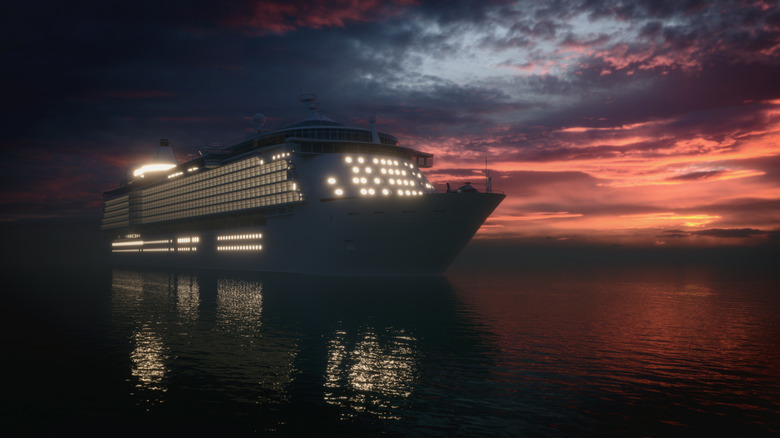
The Complex Art of Turning a Cruise Ship
Cruise ships are marvels of engineering, designed to glide gracefully through the open sea. However, their ability to turn is far more complex than it appears. These massive vessels, often stretching over 300 meters in length and weighing more than 200,000 tons, require careful planning and execution when changing direction.
The concept of a "turning radius" plays a crucial role in this process. In simple terms, the turning radius refers to the minimum circular path a ship must take while making a turn. For a cruise ship, this path can be enormous—typically around three to four times the ship’s own length. This means that a 300-meter-long ship might need over 1,200 meters of space to complete a full turn. Unlike cars, which pivot on their wheels, ships follow a curved path known as the "turning circle."
How Ships Actually Turn
When a ship turns, it doesn’t simply swing its bow in the desired direction. Instead, it follows a wide arc, with the pivot point located about one-third of the way from the bow. During sea trials, this turning circle is tested using a standard method: the ship moves at full speed with a 35° rudder angle. Several key measurements are taken, including:
- Advance: The distance the ship travels forward before completing a 90° turn.
- Transfer: The sideways movement during the turn.
- Tactical Diameter: The distance covered during a 180° turn.
These metrics help captains understand how their vessel will respond in different conditions. Speed also significantly affects the turning process. As a ship moves faster, the turning radius becomes wider because the water has a harder time pushing the hull into a new direction. A sudden attempt to turn at high speeds can cause the ship to slow down by up to 25%, and in some cases, it may even tilt outward, creating an unusual sensation for passengers.
Factors That Influence the Turning Radius
Several factors influence how tightly a cruise ship can turn. The shape of the hull is one of the most important. Full-hulled ships, such as cruise ships or bulk carriers, generally have better turning ability compared to finer-hulled vessels like container ships. However, cruise ships are also top-heavy, making them more susceptible to wind, which complicates precise control.
The trim of the ship also plays a role. If the ship is trimmed by the stern (with the back lower than the front), the turning circle tends to widen. Conversely, trimming by the bow can make the turn tighter but may reduce control, especially in strong winds.
Water depth is another critical factor. In shallow waters, the turning radius can double due to increased drag. Additionally, a fouled hull—covered in marine growth—can further impair the ship's response. External forces such as currents and wind can also disrupt the turning process, making it essential for captains to account for these variables.
Safety Standards and Practical Considerations
To ensure safety, international standards set by the International Maritime Organization (IMO) limit the turning circle to five times the ship’s length and the advance to 4.5 times. Despite these guidelines, no two turns are ever exactly the same. Cruise ships often use zig-zag and spiral movements to assess their behavior in different conditions.
Navigating through narrow channels or ports requires even greater precision. Captains must rely on experience, advanced navigation systems, and a deep understanding of their vessel’s characteristics to execute safe and efficient turns. This intricate balance between physics, design, and environmental factors highlights the complexity behind what seems like a simple maneuver.

Post a Comment for "How Big Is A Cruise Ship's Turn?"
Post a Comment