Historic Church of England Newspaper Halts Publication After Owner's Passing
A Historic Voice in Anglican Journalism Faces Uncertain Future
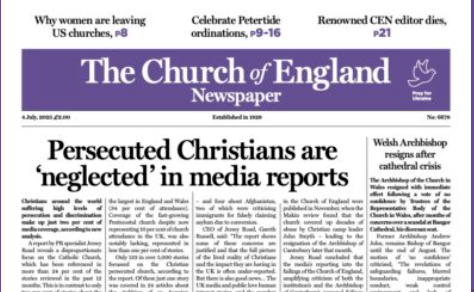
One of the world’s oldest continuously published faith-based newspapers has temporarily suspended its printing operations following the passing of its longtime owner, raising concerns about the future of a significant voice in Anglican journalism. The Church of England Newspaper, which has been in publication for nearly two centuries, has halted its print edition “until further notice,” according to Editor Andrew Carey. This decision comes after the death of Keith Young, the owner and director of the parent company, Political and Religious Intelligence Ltd., who had provided essential financial support for the paper.
Founded as The Record in 1828, the London-based newspaper is regarded as one of the oldest religious news publications still in circulation. It merged with the Church Family Newspaper in 1949, becoming the Church of England Newspaper (CEN). Over the years, it has served as a vital platform for evangelical voices within the Church of England (C of E), offering insights and commentary on theological and social issues affecting Anglican communities.
In his announcement, Carey reflected on the paper’s origins, recalling how a group of young evangelical clergymen established The Record in 1828. Among its early supporters was John Henry Newman, a renowned theologian and later a cardinal in the Catholic Church. Carey noted that the newspaper helped form what became known as the “Recordite” faction within the C of E, which opposed Tractarianism—a movement that emphasized Catholic traditions within Anglicanism.
The 1950s marked a pivotal moment for the paper as it merged with the Church Family Newspaper, solidifying its role in shaping evangelical thought within the Church. Carey highlighted the paper’s contributions to building up evangelical institutions and promoting an open, thoughtful, and orthodox form of Anglicanism. He expressed hope that this tradition would continue to be relevant in today’s evolving religious landscape.
Despite its rich history, the newspaper now faces an uncertain future. Carey shared the difficult news with readers, expressing regret over the temporary suspension of print editions. He explained that the paper had relied heavily on the financial support of Keith Young, who was the sole provider of additional funding. Without his backing, the paper is now exploring all possible options to secure its future.
Carey confirmed that no further printed editions will be produced “until further notice.” However, he assured readers that a weekly newsletter will continue to be sent out in the foreseeable future. The newspaper, which was based in London and published every other Friday, has long covered matters of interest to Anglicans across the UK.
The Church of England Newspaper has also played a role in major events in Christian history. In 1955, it was linked to the Billy Graham evangelistic meetings held in the U.K. John Cordle, a Member of Parliament at the time, purchased the newspaper from Marshall’s, the previous owner, with the intention of supporting the growing enthusiasm for Anglican evangelicalism. During this period, John King was the editor, and the paper’s circulation increased from 8,000 in 1960 to 19,000 just five years later.
Like many traditional print media outlets, the Church of England Newspaper has struggled to adapt to the digital age. The shift in reader habits and the rise of online platforms have posed significant challenges for the publication. Despite these hurdles, Carey remains committed to finding a sustainable path forward.
“We promise to keep you informed as we fully explore all options before us,” he concluded. For now, the newspaper’s future remains uncertain, but its legacy as a historic voice in Anglican journalism continues to resonate with readers and historians alike.

Post a Comment for "Historic Church of England Newspaper Halts Publication After Owner's Passing"
Post a Comment