Hiroshima and Nagasaki: 1945 and Now
The Day the World Changed
On August 6, 1945, a blinding light—like thousands of strobe lights—illuminated the sky over Hiroshima. This was the moment when the United States dropped an atomic bomb on the city, marking one of the most devastating events in human history. The Enola Gay, a B-29 Superfortress bomber, delivered its payload, known as "Little Boy," onto the unsuspecting civilians of Hiroshima. Three days later, a second bomb named "Fat Boy" was dropped on Nagasaki. These bombings ultimately led to Japan’s official surrender in World War II on September 2, 1945.
By the end of 1945, approximately 210,000 people had died, mostly Japanese civilians and forced Korean laborers. Many perished instantly in the blasts, while others succumbed to radiation poisoning in the following months. Pregnant women lost their children, and thousands more would suffer from cancers and other long-term health effects over the decades.
Hiroshima and Nagasaki remain the only two cities ever targeted by nuclear weapons. Toshiko Tanaka, who was just six years old at the time, described the horrors unleashed by President Harry S. Truman and the scientists of the Manhattan Project. Her words continue to resonate today, reminding the world of the immense suffering caused by these attacks.
The Legacy of the Atomic Bombing
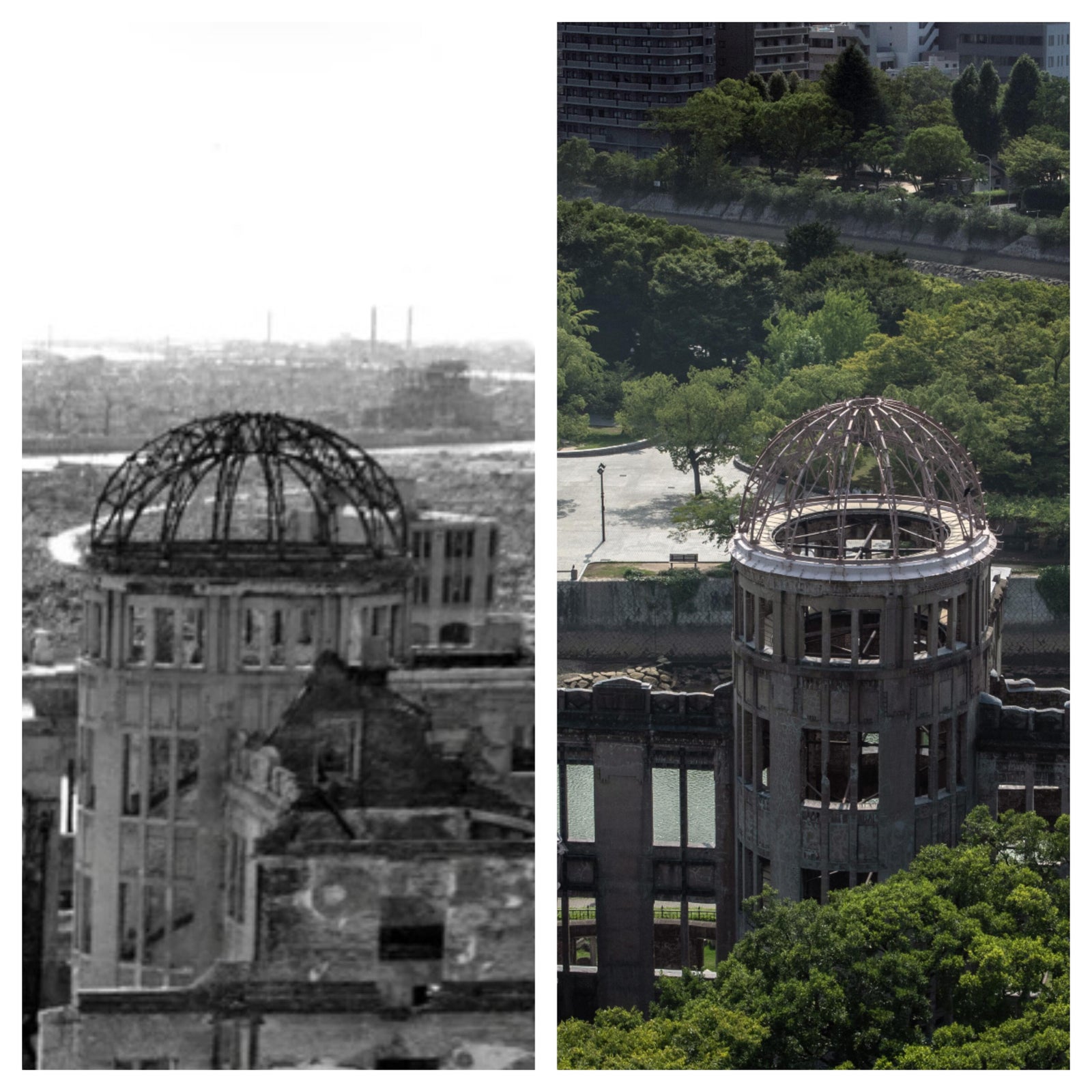
In the aftermath of the Little Boy detonation, a stone building five stories tall with blown-out windows and a crumbling roof remained standing despite its proximity to the bomb's hypocenter. Known then as the Hiroshima Prefectural Industrial Promotion Hall, the structure was gutted by the blast, but its ashen steel dome endured as a symbol of the city's resilience. Today, this building is part of the Hiroshima Peace Memorial.
The atomic explosion and the resulting firestorm destroyed or heavily damaged 60,000 buildings in Hiroshima—two-thirds of the city's total structures. A U.S. military reconnaissance photo captures the stark contrast between the city before and after the Enola Gay flew overhead.
Three years after the bombing, Hiroshima still resembled a wasteland of crooked steel and charred rubble. A 1948 photo shows how life was beginning to emerge from the desolation, with a handful of buildings dotting the ruined landscape. Today, Hiroshima is a thriving metropolis of 1.2 million people—nearly 3.5 times larger than its estimated 1945 population of 350,000. After the bombing, the population had plummeted to around 83,000.
The Destruction in Nagasaki
Nagasaki saw less overall destruction than Hiroshima, primarily due to the city's geography and urban design. However, 14,000 structures—27% of all buildings in the city—were destroyed when Fat Boy detonated above Nagasaki. Only 12% of the regional capital's structures remained undamaged after the blast.
By 1948, Nagasaki had been slow to recover. Temporary structures began to appear a year after the bombing, but citywide rebuilding did not start until the passage of the Nagasaki International Culture City Reconstruction Law in 1949. Three years after the nuclear attack, charred tree trunks, stripped of their branches, stood near a sacred Torii Gate that survived the blast.
Today, Nagasaki is home to nearly 400,000 people, up from the estimated 263,000 that called the city home 80 years ago.
Nuclear Warfare: 80 Years Later
Today, there are nine nuclear-armed nations: the United States, Russia, China, the United Kingdom, France, North Korea, India, Pakistan, and Israel. Fear of nuclear war is once again on the rise due to heightened regional tensions in the Middle East and the ongoing conflict in Ukraine.
At a ceremony marking 80 years since the bombing, Hiroshima Mayor Kazumi Matsui emphasized the dangers of current conflicts. He stated that these conflicts threaten to topple the peacebuilding frameworks that many have worked hard to establish. He also criticized the notion that nuclear weapons are essential for national defense, urging policymakers to learn from past tragedies.
The now-rusting steel dome of the Hiroshima Peace Memorial stands as a reminder of the devastation caused by nuclear warfare. As the world continues to grapple with the threat of nuclear conflict, the lessons of Hiroshima and Nagasaki remain more relevant than ever.

Post a Comment for "Hiroshima and Nagasaki: 1945 and Now"
Post a Comment