'Gut Punch Ahead': Families of Flight 5342 Prepare for Lengthy NTSB Hearing
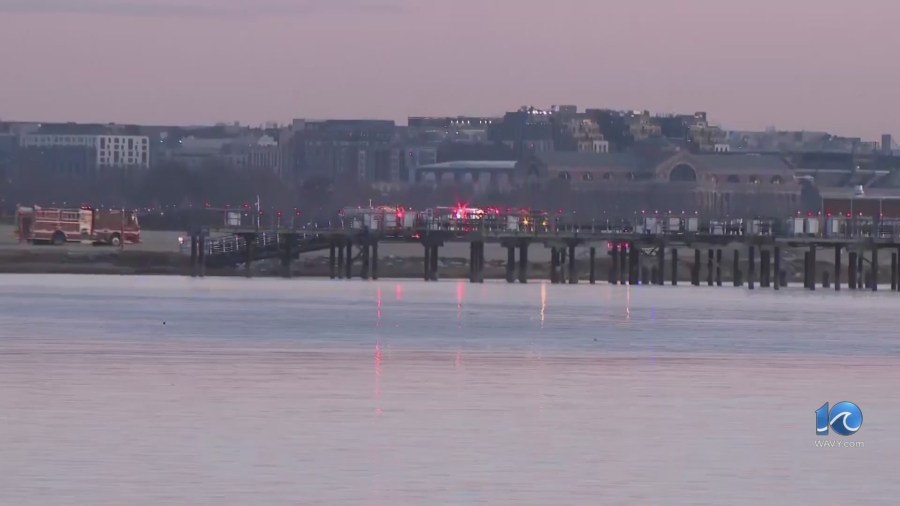
NTSB Begins Three-Day Hearing into Mid-Air Collision
The National Transportation Safety Board (NTSB) is set to begin a three-day investigative hearing on the mid-air collision that occurred on January 29 between an American Airlines regional jet and an Army helicopter. The incident resulted in the tragic loss of 67 lives. Families of the victims are calling for accountability and changes in air safety protocols.
Rachel Feres, whose family member was among those killed on Flight 5342, expressed her feelings about the upcoming hearing, saying, “I think it’s going to be a gut punch.”
Preliminary Report Reveals Key Details
On March 7, the NTSB released its preliminary investigative report, which provided critical information about the moments leading up to the collision above the Potomac River. Aviation attorney Justin Green, representing families of the crash victims, has filed 25 notices of claims against the Federal Aviation Administration and the Army on behalf of 31 decedents from the American Airlines flight.
Green highlighted that the airspace around Ronald Reagan National Airport is often referred to as “a highway for helicopters.” He explained that this “highway” requires helicopters to maintain low altitudes and avoid areas where commercial airplanes operate.
According to the preliminary NTSB report, the Army helicopter, operating under the callsign PAT25, was at an altitude of 278 feet at the time of the collision, exceeding the maximum allowed altitude of 200 feet.
Understanding the Mission of PAT25
To understand what led to the crash, it is important to consider the purpose of each aircraft's flight. Flight 5342 was on approach to land at DCA after departing from Wichita Dwight D. Eisenhower National Airport (ICT). Meanwhile, PAT25, a Black Hawk helicopter, was flying from Davison Army Airfield (DAA), Fort Belvoir, Virginia, for the pilot’s annual standardization evaluation using night vision goggles (NVGs).
Green, who previously served as a pilot in the United States Marine Corps, explained how NVGs work. These devices enhance ambient light, making nighttime conditions resemble daytime but with a green tint and reduced clarity. Pilots must physically turn their heads to scan their surroundings, which can be challenging in urban environments.
Challenges of Flying with Night Vision Goggles
Flying with NVGs in a city environment presents additional challenges. Green noted that the lights in the city can be blinding when wearing NVGs, making it harder to spot airplanes, especially their anti-collision lights when flying low.
Visual Separation and Communication
According to the NTSB report, the Black Hawk’s crew included an instructor pilot, a pilot, and a crew chief. Approximately two-and-a-half minutes before the collision, the instructor pilot informed the pilot that they were at 300 feet and needed to descend. Less than a minute later, the crew reported seeing traffic and requested visual separation from the Air Traffic Control tower.
The NTSB report states that at this point, the distance between the two aircraft was about 6.5 nautical miles. About 20 seconds before the collision, the DCA air traffic controller asked PAT25 if it had Flight 5342 in sight. This occurred at the same time that the crew of Flight 5342 received a traffic advisory from the aircraft’s TCAS, which provides collision avoidance protection.
At 8:47:42 p.m., the air traffic controller instructed PAT25 to pass behind Flight 5342. Two seconds later, PAT25 indicated that the traffic was in sight and again requested visual separation, which was approved by the DCA tower. At 8:47:58, Flight 5342 made a last-minute pitch up to avoid PAT25, but a mid-air collision occurred.
Questions Remain Unanswered
Green emphasized that several questions remain to determine the root cause of the failure. Why did the Black Hawk pilots not identify Flight 5342? Why did the Flight 5342 pilots never see the Black Hawk helicopter? Why did the air traffic controller give clearance to a helicopter flying through such a busy airspace?
Near-Miss Data at DCA
The NTSB preliminary report included data on near-miss incidents at DCA. Between October 2021 and December 2024, there were 15,214 occurrences involving commercial airplanes and helicopters with less than 1 nautical mile of lateral separation and less than 400 feet of vertical separation. There were also 85 recorded events with less than 1,500 feet of lateral separation and less than 200 feet of vertical separation.
Following the accident, the FAA issued a notice to airmen restricting helicopter traffic over the Potomac River near DCA until March 31, 2025.
Why Was PAT25 Flying Above 200 Feet?
According to the NTSB report, PAT25 was traveling along Route 1 of the Baltimore-Washington Helicopter Route Chart. Once helicopters pass Memorial Bridge, the maximum allowable altitude on Route 1 is 200 feet above mean sea level.
Green explained that helicopters have two instruments to determine altitude: a barometric altimeter and a radar altimeter. However, the NTSB report includes cockpit voice recorder data indicating that the instructor pilot and pilot observed different altitudes. This discrepancy raises concerns about communication and accuracy.
Ultimately, the evidence suggests that PAT25 was flying well above the 200-foot maximum threshold, placing it on a collision course with Flight 5342.

Post a Comment for "'Gut Punch Ahead': Families of Flight 5342 Prepare for Lengthy NTSB Hearing"
Post a Comment